I am very susceptible to a beautiful hotel.
Give me an infinity pool, crisp white bed linen, a suspiciously empty beach and some flattering late-afternoon light and I am perfectly capable of mentally checking in before I've established which country it's in.
This is why I have rules.
Not particularly glamorous rules, admittedly. How long is the airport transfer? Is the air conditioning any good? Are the rooms actually clean? Can I get a baby cot?
None of these questions is going to feature prominently in the hotel's Instagram campaign. They are, however, considerably more relevant to whether I actually want to spend a week there.
Over the years I've developed quite a thorough hotel-research routine. It has become even more particular since travelling with my son, because the difference between a hotel being technically child-friendly and actually making life easy with a small child can be considerable.
I still want somewhere beautiful. I still want good food, a lovely beach and the feeling that we're somewhere special. I just also want the practical bits to work.
Apparently this is what happens when luxury travel meets parenthood: the infinity pool still matters, but so does the cot.
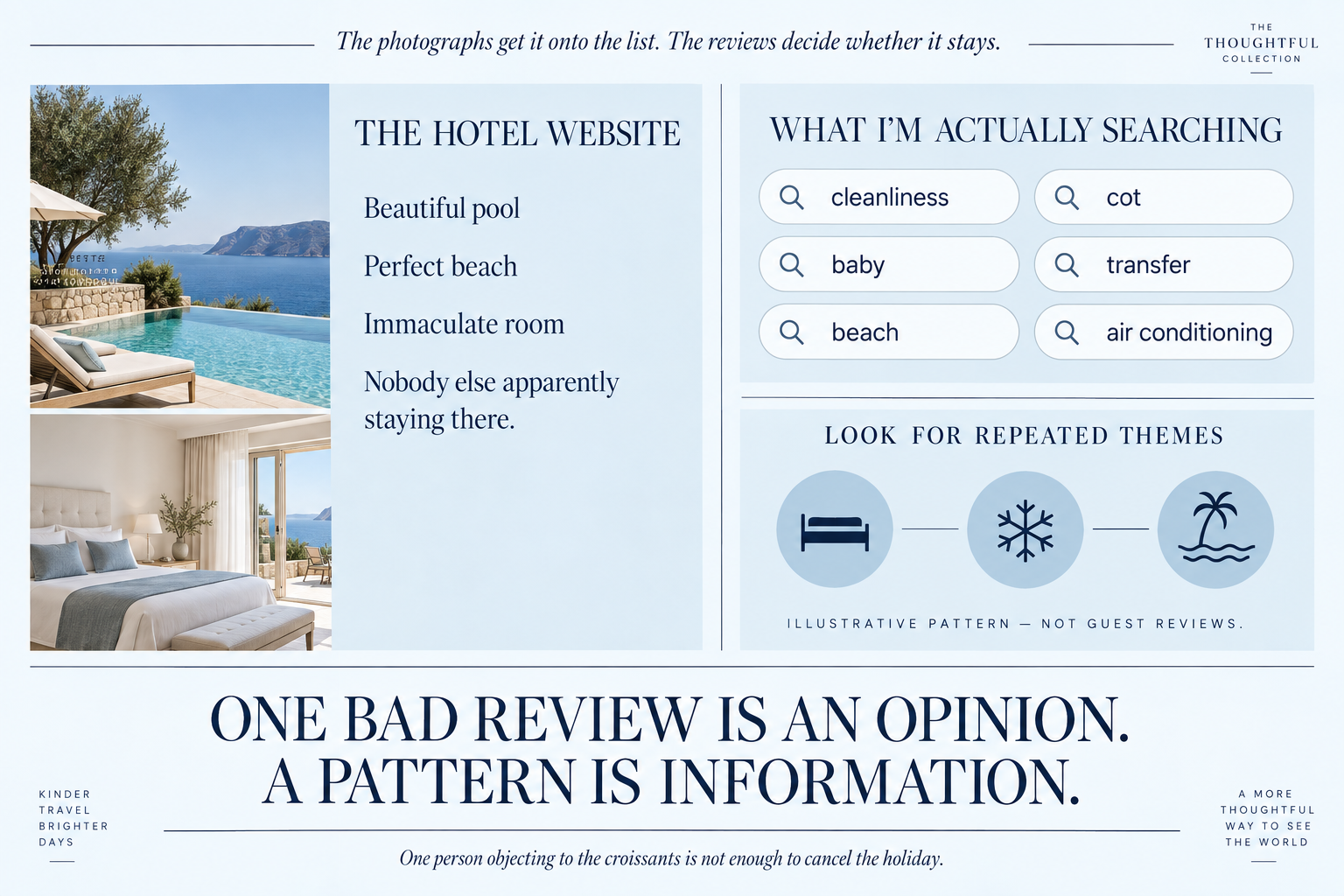
I start with the reviews before I fall in love with the photographs
When I'm initially looking for a holiday, I often search through British Airways Holidays and filter the results using TripAdvisor ratings. That immediately brings the stronger-reviewed options towards the top and gives me a much better starting point than simply looking at which hotel has photographed its swimming pool most persuasively.
Once something makes the shortlist, I go directly to TripAdvisor and properly investigate it. I'll normally read two or three pages of reviews rather than glancing at the overall score and deciding that 4.6 sounds reassuring enough.
I'm looking for patterns. One person complaining that the croissants at breakfast weren't sufficiently flaky is not going to derail a holiday. Several recent guests independently mentioning poor cleanliness, dreadful food or a recurring problem with the rooms is different.
That's the useful thing about reading enough reviews. Individual opinions can be wildly subjective. Patterns are information.
I also search within the reviews for the things I specifically care about. At the moment that might be cot, baby, children, transfer, beach or something else relevant to the particular trip. I want to know whether baby cots are genuinely available rather than discovering at 8pm on the first night that “family-friendly” apparently means they own three highchairs and once saw a child in reception.
The overall rating gets the hotel onto my list. The details decide whether it stays there.
Some things I simply expect
There are certain basics I don't particularly want to negotiate on. The hotel needs consistently good reviews. It needs to be clean. If we're going somewhere hot, I expect proper air conditioning. I want breakfast included or readily available, decent restaurant options and generally good quality.
That doesn't necessarily mean choosing the most expensive hotel. In fact, finding excellent hotels for disproportionately good prices is one of my favourite travel-planning activities. I am always much more interested in good value than in cheapness for its own sake.
A hotel can cost less because you've found the right dates, travelled in shoulder season or spotted an unusually good package. Excellent.
A hotel can also cost less because everybody who stayed there last month hated it.
Less excellent.
Those are not the same bargain, however attractive the saving initially appears.
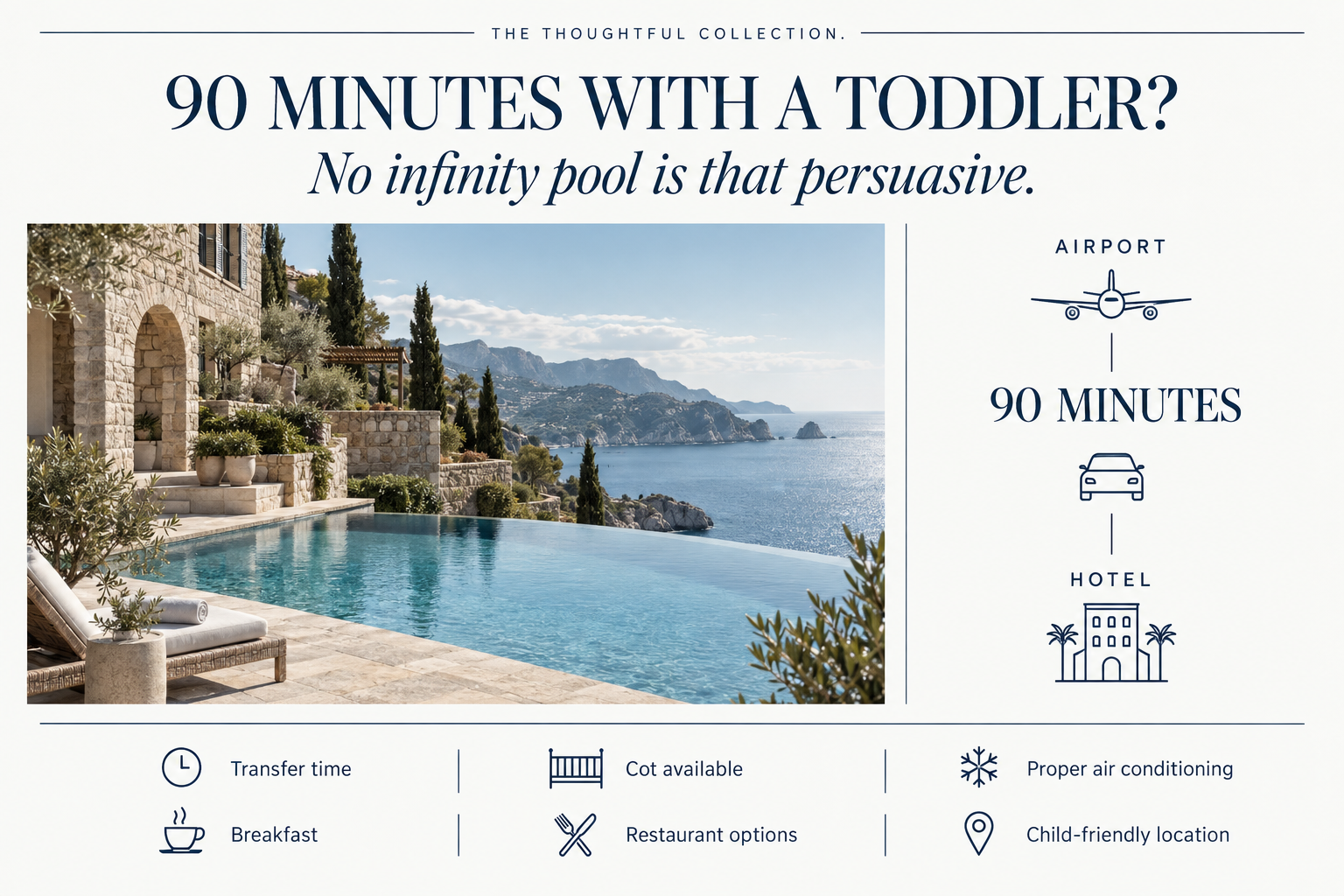
The 90-minute transfer test
Before having my son, I was considerably more tolerant of travel logistics. If somewhere wonderful required a longer transfer, we could probably cope.
I recently ruled out a hotel because it was around 90 minutes from the airport. There wasn't necessarily anything wrong with it. It simply stopped making sense once I pictured the actual day: getting a toddler to the airport, flying, collecting the luggage, locating the transfer and then spending another hour and a half in a car before we'd even reached the place we were supposed to be relaxing.
No infinity pool is that persuasive.
This is also why I now check the transfer before spending an hour investigating the room categories. There is little point discovering that the Junior Suite has precisely the separate living area I want if I have already mentally rejected the journey required to reach it.
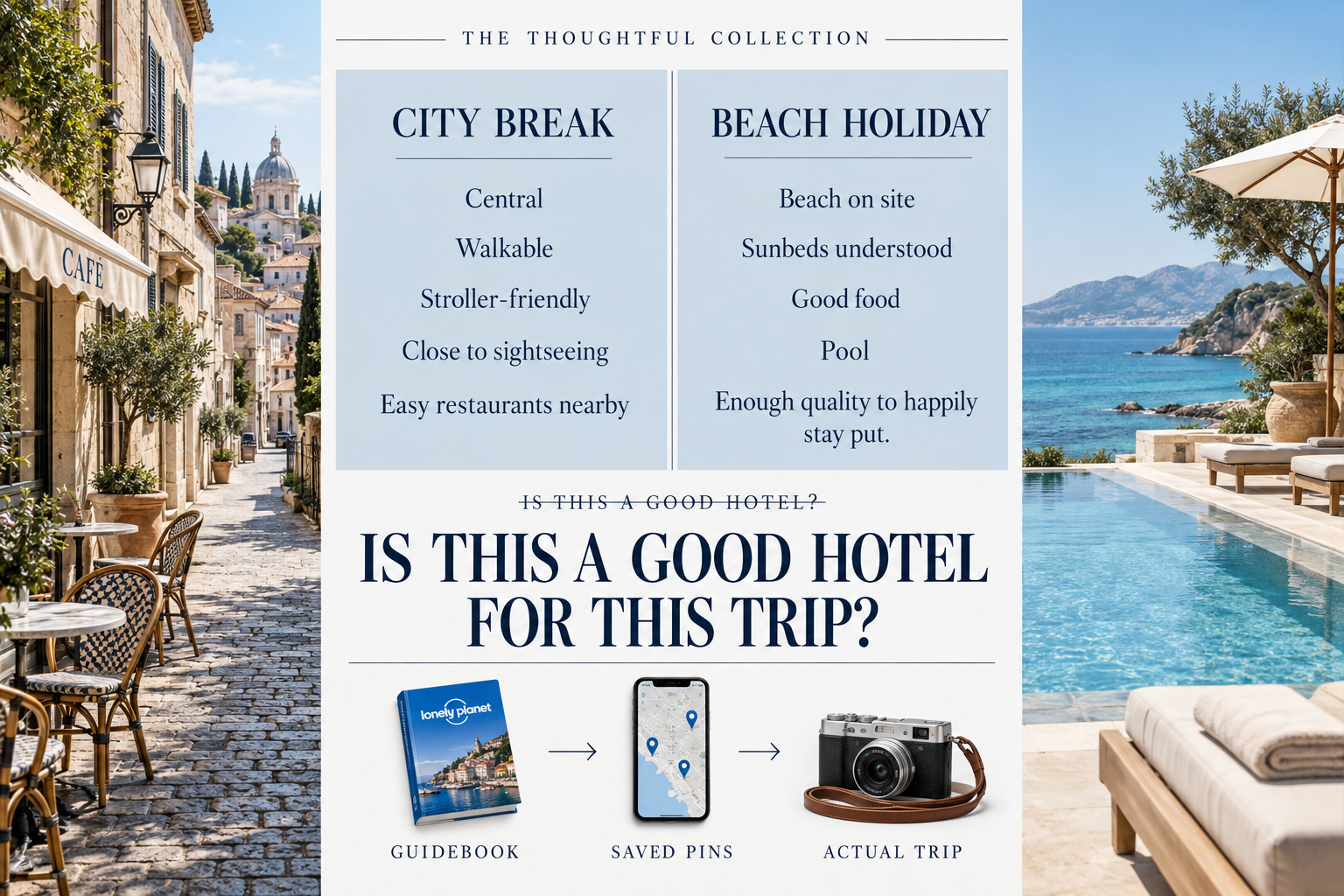
If we're booking a city break, location matters in a slightly different way. I want to be properly central and ideally within walking distance of the things we're likely to do. With my son and a stroller, being able to leave the hotel and actually walk somewhere useful is worth a great deal.
A hotel can describe itself as “conveniently located for the historic centre”. Google Maps and I may have a rather different interpretation of the word conveniently.
Hotel copywriters are an optimistic people.
If it's a beach holiday, I want an actual beach
If I'm booking a sunshine holiday, I increasingly want the beach at the hotel.
Not a lovely beach ten minutes away by car. Not a shuttle bus to a partner beach. Not “easy access to some of the region's finest beaches”, which could mean almost anything.
I want to be able to leave the hotel and get to the beach without turning it into an expedition involving snacks, spare clothes, suncream, hats, water, towels and approximately seventeen other items required by a person who is less than three feet tall.
Sardinia reinforced this for me. The beach at our hotel was stunning and immediately accessible, which made an enormous difference with my son. We didn't have to pack everything into a car every time we wanted an hour by the sea.
I also check whether the beach is private and whether things such as sunbeds are included or charged separately. These aren't necessarily deal-breakers, but I'd rather know beforehand.
There is something uniquely irritating about paying a significant amount for a beach hotel and then discovering that sitting on its beach is apparently an optional extra.
I now care quite a lot about doors
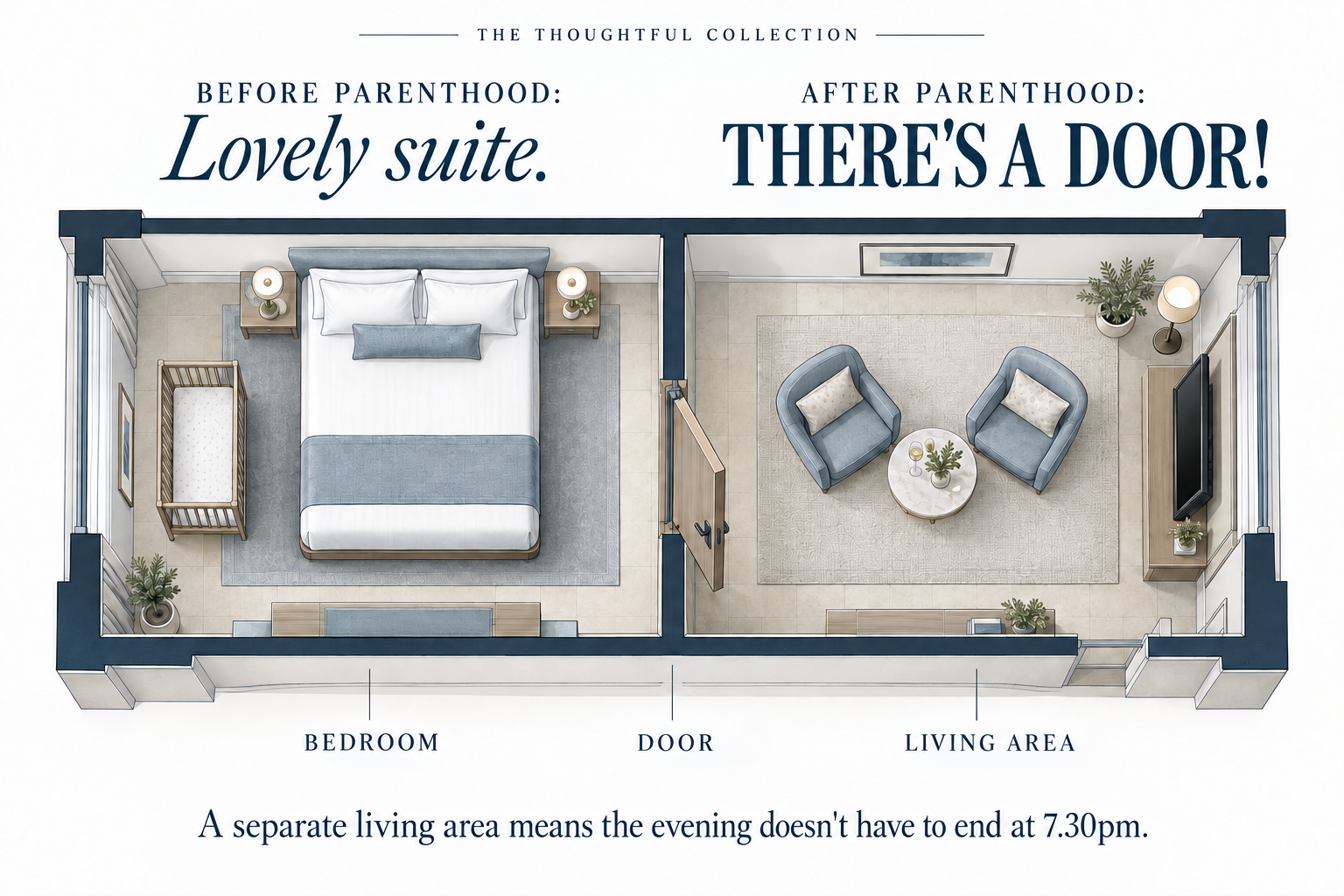
A separate living area is a major plus for us at this stage, which is not something I particularly appreciated before having a child.
If my son goes to bed earlier than we do, having another area where my husband and I can sit, talk, watch something or have a drink without spending the rest of the evening whispering in darkness is extremely valuable.
I used to look at hotel suites and think the separate living room was a nice luxury.
Now I look at one and think: there's a door!
Parenthood changes you.
It isn't always possible and it certainly isn't an absolute requirement for every trip, but if I'm comparing two otherwise similar options, a suite or room with a separate living area can make one considerably more attractive.
These are the kinds of details that generic hotel filters don't necessarily capture very well. A five-star rating tells me something about the standard of the hotel. It doesn't tell me whether our evenings will involve sitting silently in darkness at 7.30pm because the toddler is asleep six feet away.
I want to know where the hotel actually is
Once a hotel survives the reviews, I start looking properly at its surroundings.
Google Maps is invaluable for this. For a city break, I want to see how close we genuinely are to the centre, what is within walking distance and how the hotel relates geographically to the places we're likely to visit.
For a resort holiday, I want to understand the beach, surrounding area and practical access. I don't necessarily need a bustling town outside the front door if the hotel itself has everything we need, but I want to know what I'm booking.
This is also where my slightly old-fashioned travel habit comes in.
I buy a Lonely Planet guide for almost every trip.
I am gradually amassing quite a collection, much to my husband's horror.
I could make an excellent case for this being entirely practical, but the truth is that I also love having them. They sit on the shelf afterwards and remind me of where we've been. Buying the guide has become part of the ritual of having a trip booked.
I read it before we go, use it to understand the destination and identify things that interest me. Then, somewhat undermining the argument for carrying a physical guidebook, I transfer the useful bits into Google Maps.
I'm not realistically going to walk around on holiday repeatedly pulling Lonely Planet out of my bag, particularly now that the same bag also needs to contain half of my son's worldly possessions.
I save the places instead and add notes explaining why I've saved them. That way the research becomes useful when we're actually there.
The book stays on the shelf afterwards as a souvenir.
Everybody wins, apart from my husband, who can presumably see the point at which we're going to need another bookcase.
The hotel has to suit the holiday
I don't really assess a hotel in isolation.
For a resort holiday, the hotel itself may be a substantial part of the destination. That's why Sardinia worked so well: beautiful beach, excellent food, lovely surroundings and enough quality that spending a lot of time there felt like the point rather than a compromise.
For a city break, I almost want the opposite relationship. The hotel needs to be lovely, but it also needs to make the city easy. If we're spending the day sightseeing, I don't want to waste an hour getting back to somewhere supposedly luxurious on the outskirts when we could be staying somewhere excellent within walking distance.
The question is not simply “Is this a good hotel?”
It's “Is this a good hotel for this particular trip?”
Those are surprisingly different questions. The most beautiful resort in the world may be completely wrong for three days of sightseeing. The perfect city hotel might be deeply disappointing if I wanted to spend a week lying beside a pool.
Context, irritatingly, ruins a perfectly good universal ranking system.
I don't need perfection
For somebody who researches hotels this thoroughly, I am actually fairly pragmatic about reviews.
Every hotel will have complaints. Every restaurant will eventually serve somebody a disappointing breakfast. Every room will contain something that a sufficiently determined TripAdvisor reviewer can object to.
There is always one person who has given an otherwise spectacular hotel one star because it rained.
I am not looking for evidence that nobody has ever had a problem.
I'm trying to establish whether the things that matter to us are consistently good and whether any recurring problems would materially affect our trip.
A complaint about the evening entertainment might be irrelevant to me. Repeated complaints about cleanliness are not. Somebody disliking the decor is subjective. Multiple families reporting that the children's facilities aren't operating is useful information.
The point of research isn't to eliminate every possible imperfection. It's to eliminate the surprises I could reasonably have discovered beforehand.
I would much rather find out from TripAdvisor that everybody hates the breakfast than conduct that research personally for seven consecutive mornings.
Eventually, I do actually book something
There comes a point when I know I've found the best option for the approximate dates we want.
I've looked at the alternatives. I've checked the reviews. The location works. The transfer is sensible. The room works for us. The practical details don't reveal anything alarming and the price represents good value for the level we're getting.
At that point, I book it.
I do not, as my husband might occasionally suggest, continue researching hotels recreationally for the remainder of the evening.
Well. Usually.
The important thing is that by the time I press Book, I understand what I'm buying. I've looked beyond the infinity pool, found out how long it takes to get there, established that we'll have somewhere to eat and checked that the beautiful beach is not actually a 25-minute shuttle ride away.
A beautiful hotel photograph can make me want to go somewhere.
The research is what tells me whether I actually should.
When I get that decision right, as we did in Sardinia, I don't spend the holiday wondering whether we chose the wrong place.
I can just enjoy the one we're in.
Which, after approximately 47 open tabs, is really the whole point.