Travel · The Thoughtful Traveller
How I Plan a Trip Without Turning It Into a Second Job
I love planning holidays. This is useful, because I am also the sort of person who can turn choosing a hotel into a research project of surprising complexity.
I will compare dates, investigate the weather, read the reviews and check how far the hotel is from the airport. I will establish whether the beach really looks like that when photographed by somebody who isn't being paid by the hotel and whether booking exactly the same trip another way would save enough money to make the exercise worthwhile.
I have planned a month-long trip around India involving several cities, approximately eight flights, multiple hotels, private guides, transfers and an overnight stay in Agra strategically positioned so that we could visit the Taj Mahal in the morning. I am, in other words, probably not the natural spokesperson for “Just book something and see what happens.”
But here's the slightly contradictory thing: I don't research a trip because I want every hour of it planned. I research it so that, once I'm there, I don't have to.
That distinction is basically my entire travel philosophy.
I start with when to go, not where to stay
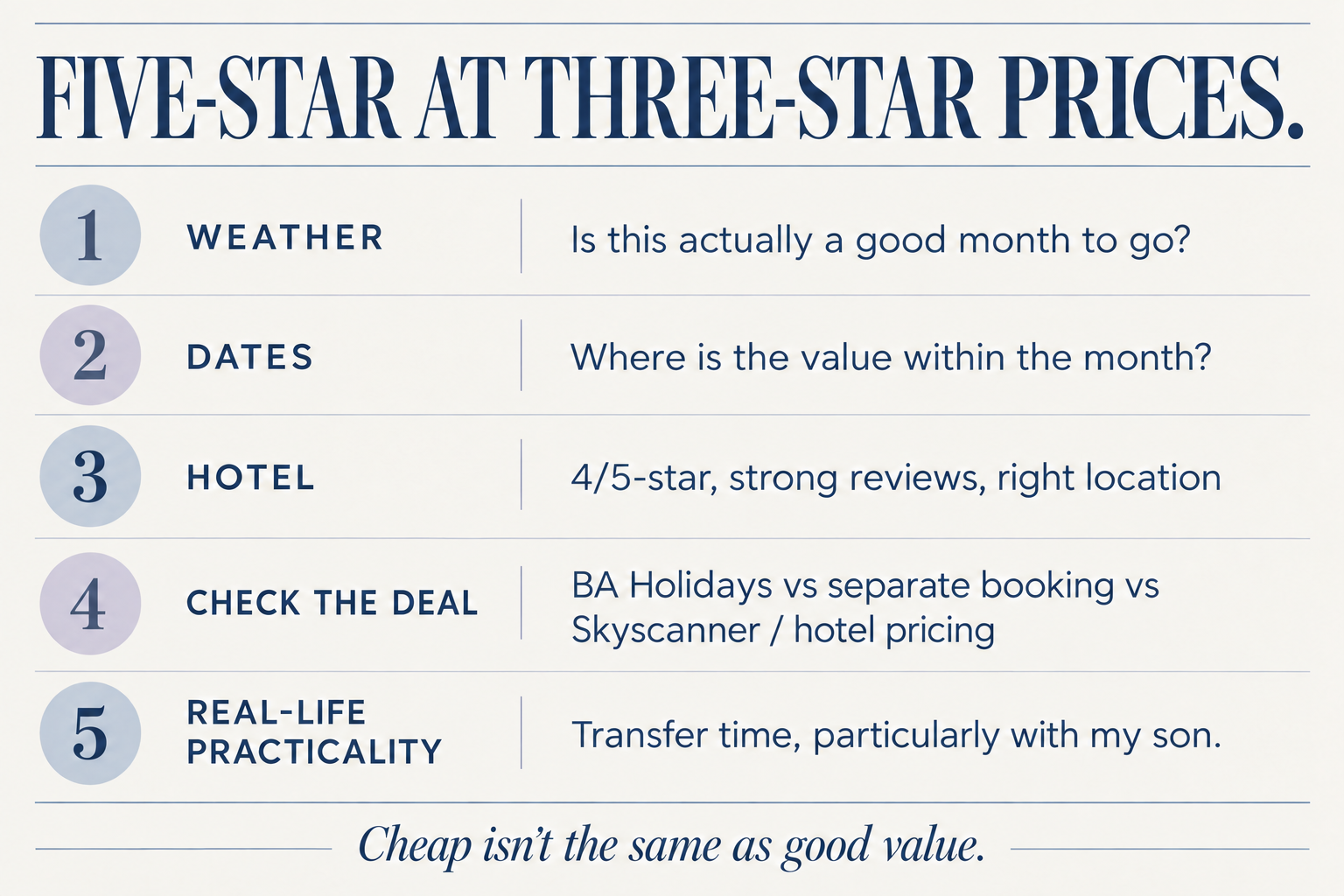
Before I become emotionally attached to a hotel, I want to know whether I actually want to be in that destination at that time of year. This sounds obvious, but there is little point congratulating yourself on finding an extraordinary Caribbean deal only to discover there may be a meteorological reason for it.
I look at typical temperatures, rainfall and any significant seasonal risks. Hurricane season matters. Monsoon season matters. Forty-degree heat matters. A photograph of an infinity pool on a booking website does not override any of these things, however persuasive it may be.
My favourite time to travel is often shoulder season, provided the weather is reliably good enough. You can get a much better level of hotel for the same money, destinations are often less crowded and the weather can actually be more pleasant than travelling at the absolute peak.
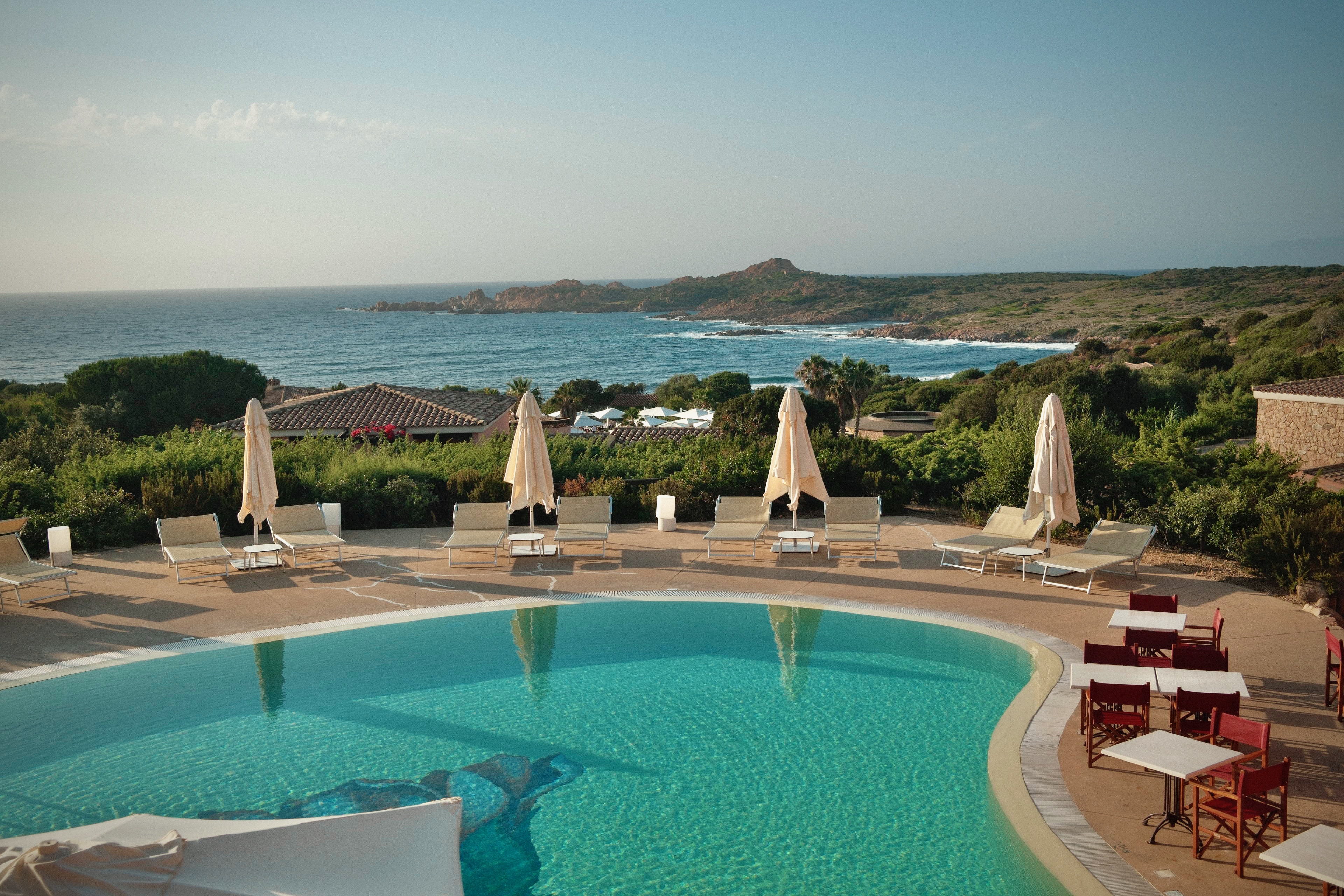
Sardinia is a perfect example. We went in June, when the weather was glorious: properly hot, but not oppressively so. It was also better value than travelling later in the summer. That combination is exactly what I'm looking for.
I let the good-value dates reveal themselves
Once I know roughly when I want to travel, I often start on the British Airways Holidays website. One of my favourite ways to search is by month rather than beginning with completely fixed dates. The Holiday Finder makes it relatively easy to see when the better-value combinations appear within that period.
I'll set the destinations I'm willing to consider, hotel standard, maximum budget and review criteria, then see what emerges. This is where I think there's an important distinction between cheap and good value.
I'm not generally looking for the cheapest holiday I can possibly find. I'd much rather find something excellent for considerably less than it would ordinarily cost. My preferred category of holiday deal could probably be described as five-star at three-star prices.
This is not always achievable, obviously. I remain optimistic!
If BA shows me something interesting, I don't immediately book it. I'll check whether buying the flights and hotel separately is cheaper, look at Skyscanner and check the hotel through TripAdvisor because it can sometimes surface very competitive rates. Quite often, BA still comes out the same or cheaper and, if it does, I'd generally rather have everything booked together through BA.
The point isn't to check seventeen websites because I enjoy opening browser tabs. It is to establish whether the apparent bargain is actually a bargain.
Reviews tell me what the hotel website won't
I don't book hotels without reading reviews. Hotel websites are, understandably, not in the habit of highlighting that the beautiful pool loses the sun at 2pm or that half the rooms overlook the service road.
TripAdvisor is still one of the places I use most because I'm interested not only in the overall score but in patterns. One person complaining about breakfast doesn't particularly concern me. Thirty-seven people independently mentioning the same problem is information.
Travelling with my son has changed some of the criteria too. Transfer time matters much more than it did before, as does how easy the hotel is once we're there. A beautiful beach somewhere in the vicinity of the hotel is not necessarily the same thing as a beautiful beach that I can actually reach easily with a nearly two-year-old and everything that apparently has to travel with him.
Sardinia passed that test spectacularly.
Sardinia was the reward for doing the homework
The hotel we found in Sardinia was exceptional value for the level of holiday we got. The location was fantastic, the beach was stunning and, importantly, immediately accessible. We didn't need to get my son into a car every time we wanted to go to the beach. The weather in June was brilliant too.
Then there was the food.
We were half-board and it was genuinely the best included hotel food I've experienced. The evening buffet wasn't the slightly dispiriting procession of trays that the words hotel buffet can occasionally bring to mind. There were food stations, canapés, loads of seafood and three different types of pasta freshly cooked to order every night. It was fantastic.
We mostly ate at the hotel because, unusually, there was very little incentive not to. That holiday didn't require an elaborate itinerary once we arrived because the work had gone into choosing the right holiday in the first place.
We could relax because the hotel, beach, food, location, weather and value had already been properly considered. That is exactly what I mean when I say planning can create freedom rather than remove it.
Sardinia · June · Photographs by Emma-Kate
When the research pays off
The work had gone into choosing the right holiday in the first place.
VALUE
The standard we wanted without peak-summer pricing.
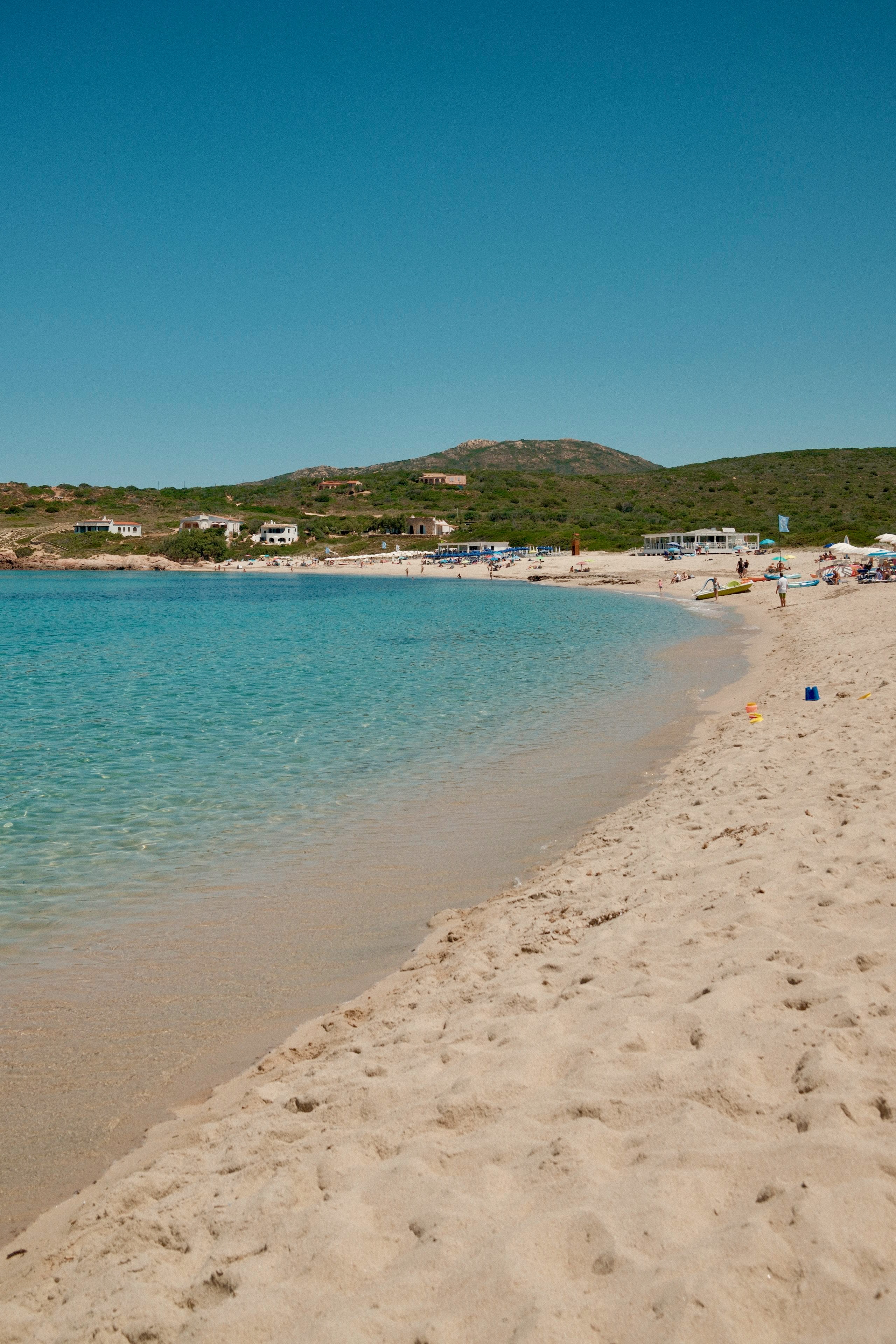
BEACH
Beautiful and immediately accessible.
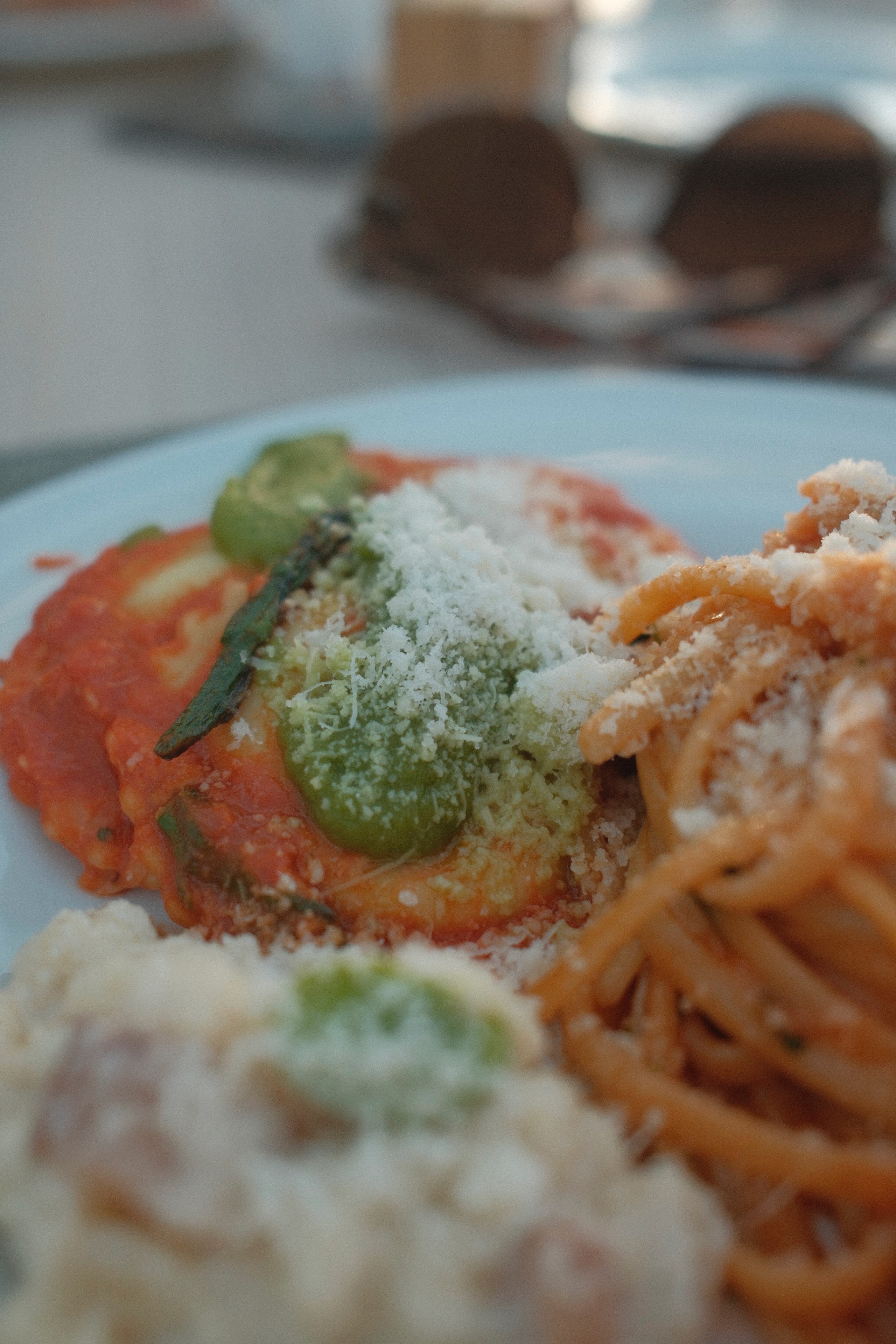
FOOD
Three fresh pasta stations. Every night!
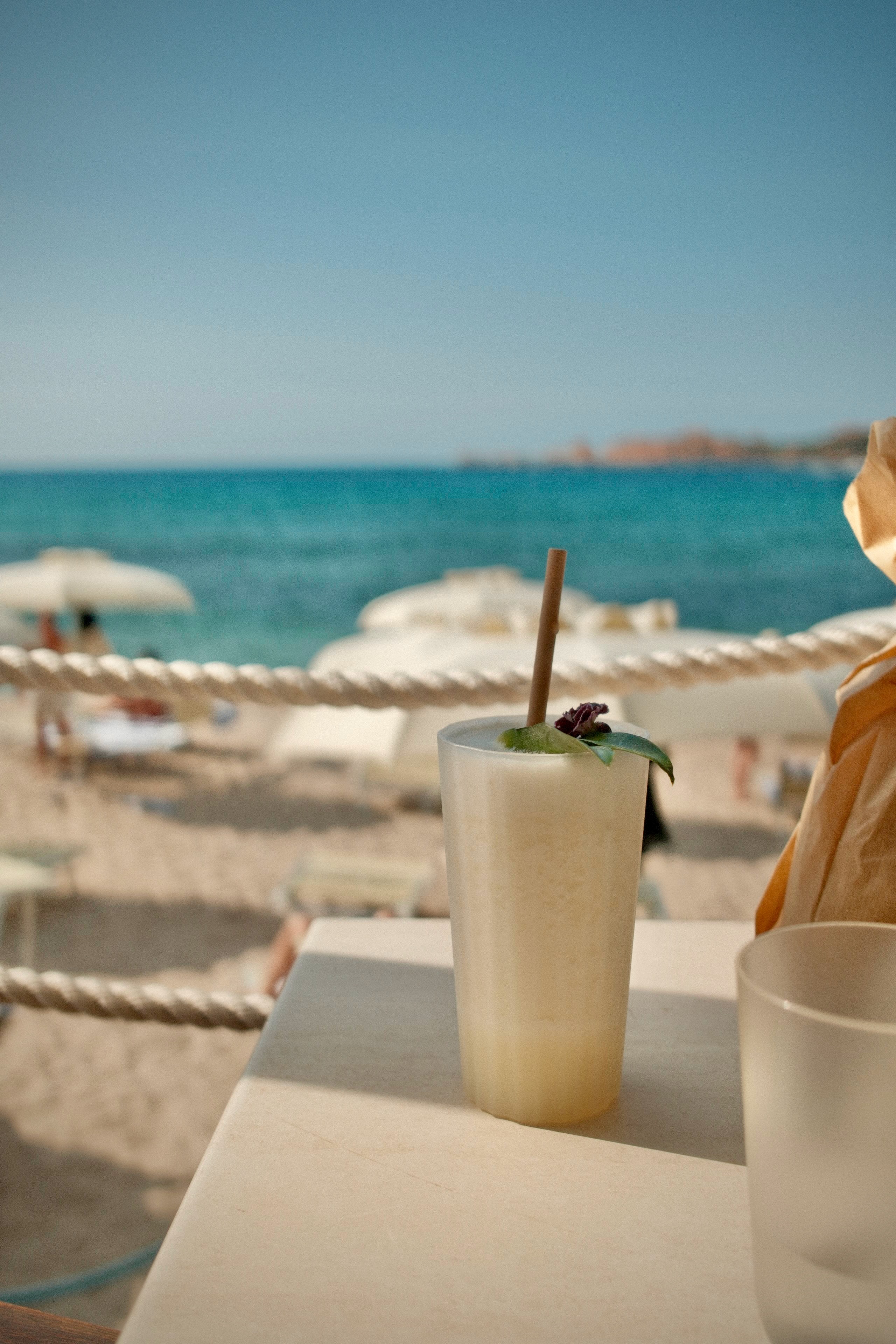
JUNE
Hot, but not unbearably hot.
Once I've booked, I want to understand where I'm going
Finding the holiday is only the first stage. Once it's booked, I research the places we might want to visit, neighbourhoods, restaurants, good coffee, practicalities and, because photography is one of my great passions, the places I particularly want to photograph.
I don't necessarily decide in advance that we will visit every one of them. I want to know what the options are.
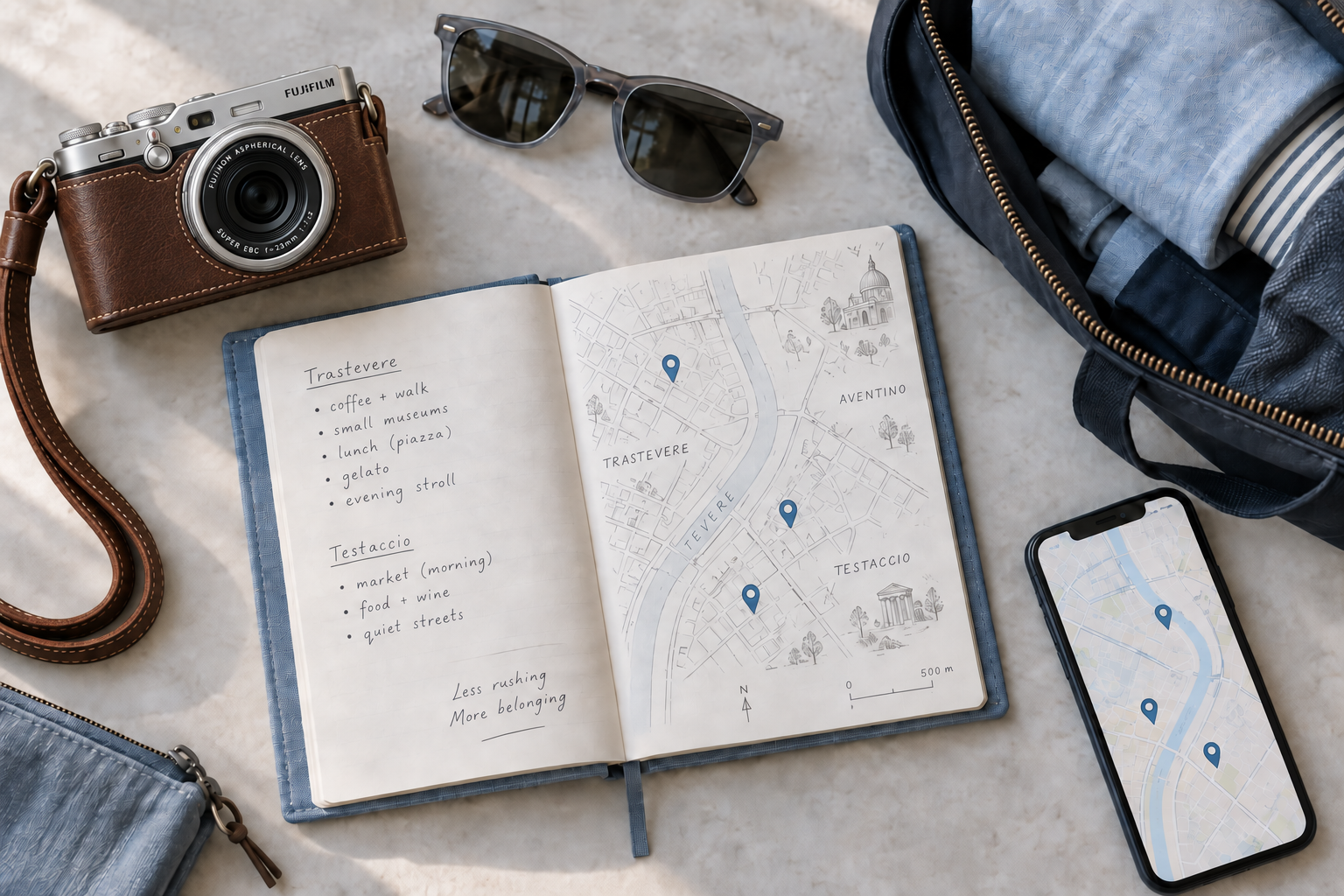
I save everything useful into a Google Maps list and, crucially, add a little description explaining why I've saved it. This is because the version of me researching a holiday three months in advance apparently believes the future version of me will look at a random pin called Bar Centrale and immediately remember the detailed TikTok recommendation that led me there.
She will not. Future Emma-Kate requires notes.
By the time we arrive, I have a map containing places I already know are potentially worth our time rather than beginning every day with a blank Google search.
I plan geographically, not hour by hour
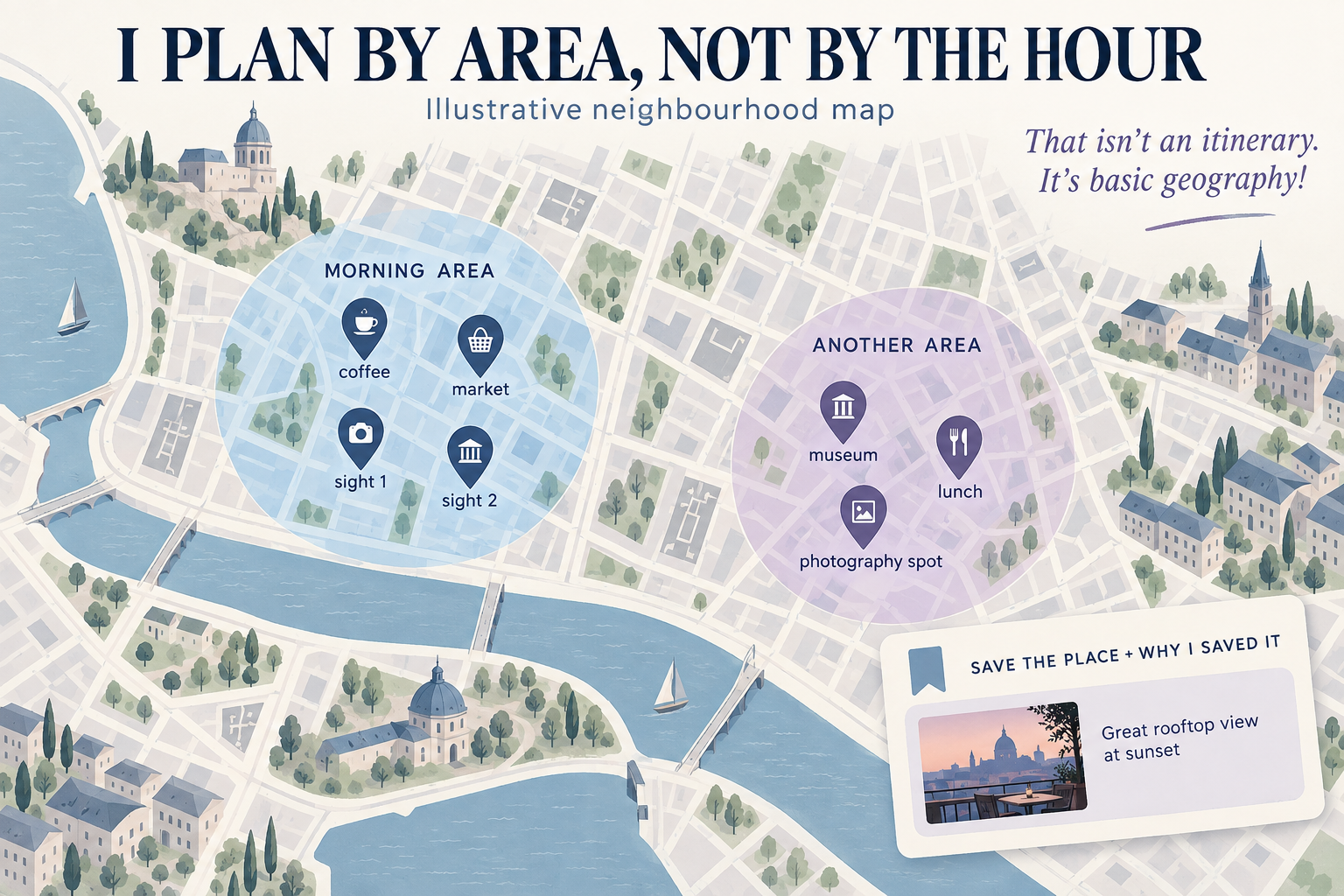
This is one of the simplest things I do and probably one of the most useful. If we're sightseeing, I look at where everything actually is.
If three things we want to see are in the same part of a city, they belong naturally together. I don't want to visit one attraction, cross the city for lunch and then discover that the next thing on my list is two streets away from where we started.
That isn't an itinerary. It's basic geography!
I'll think in terms of areas or anchor activities rather than planning every hour. Perhaps there are two or three things we'd like to see around one neighbourhood. Great. That's potentially one day. The rest can remain flexible.
If we're tired, we stop. If my son needs a nap, plans change. If we find somewhere lovely and want to stay longer, we stay. If we'd rather spend the afternoon by the pool, the museum will cope without us.
The purpose of the research isn't to create a timetable we have to obey. It is to make the options obvious when we need them.
Some things are worth booking
For city breaks, I usually research restaurants before we travel. TikTok can be particularly useful for finding places that are interesting or currently popular and I'll also use TripAdvisor once we're actually there.
I don't book every meal in advance because travel days don't always unfold the way you expect. You may end up in a completely different neighbourhood at 6pm from the one you imagined when planning the trip at home, so I generally prefer a researched shortlist plus flexibility.
There are exceptions. Before having my son, we went to Rome for my birthday and there were particular places I wanted to experience. We made a couple of reservations, including drinks at a fabulous rooftop bar. Without booking ahead, we simply wouldn't have got in.
That's where advance planning earns its keep. I don't particularly want to stand underneath a beautiful rooftop bar in Rome discovering that the next available table is on Tuesday.
Some things are worth anchoring. Everything else can move around them.
AI now does some of the homework with me
Having spent years refining this process, I eventually did something fairly predictable: I built an AI travel agent around it.
I explained how I research holidays, what matters to us and the sort of recommendations I actually find useful. It knows that good value does not mean cheapest. It understands the standard of hotel I generally want and the compromises I am and am not willing to make. It also knows we're travelling with my son and that practical things such as transfer times now matter more.
It can suggest destinations and hotels, compare options and help narrow down a huge amount of information remarkably quickly. It isn't perfect, though. One significant limitation is that it can't properly do the BA Holidays searching that remains one of the most useful parts of my own process, so I still handle that stage myself.
I also still check things independently. AI is very useful at doing the homework with me. It does not get to book my family into a hotel I've never investigated because it said the reviews looked nice.
I retain certain trust issues.
Then there was India
If Sardinia demonstrates how research can produce an incredibly relaxing holiday, India demonstrates what happens when I am given a month and access to flight-booking websites.
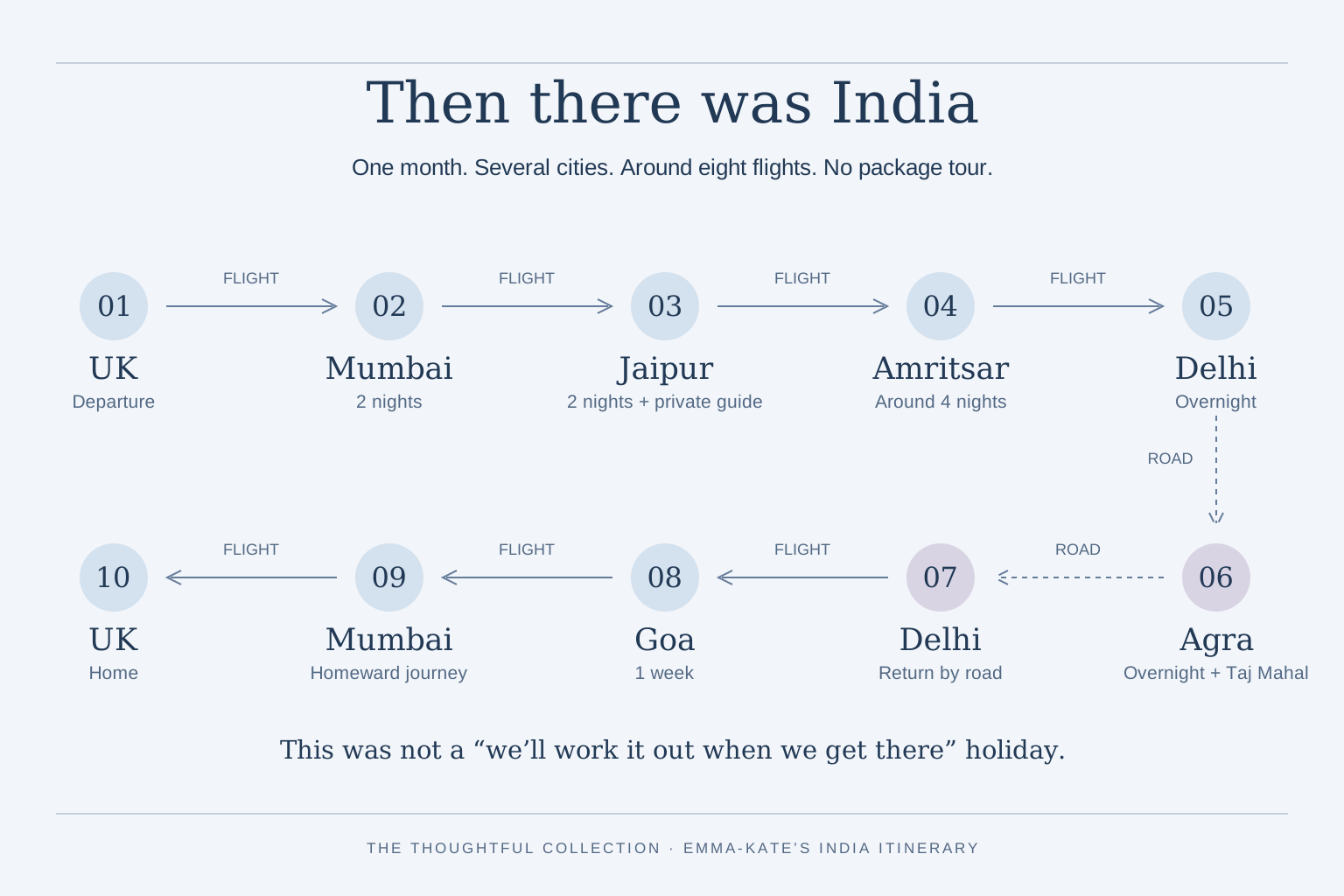
We flew into Mumbai and stayed for a couple of nights, then flew to Jaipur, where we stayed for two nights and had a private guide, followed by Amritsar for around four nights. From there we flew to Delhi, stayed overnight, travelled down to Agra, stayed there for the night, visited the Taj Mahal the following morning and drove back to Delhi.
After another night in Delhi, we flew to Goa for a week. Then we flew back to Mumbai and from Mumbai home. By the time international and domestic sectors were included, we probably took around eight flights.
I organised the flights, internal flights, hotels and transfers. I also researched the excursions and arranged guides for Jaipur, Delhi and the Taj Mahal. This was not a holiday I approached with “I'm sure we'll work it out when we get there.”
It required a frankly unreasonable number of moving parts!
But it worked. We were able to experience completely different parts of India within one trip because the logistics had been worked out beforehand. I wasn't spending each evening in India researching how to get to the next city. I had already done that job at home.
Research makes me notice more
There is another reason I research destinations that has nothing to do with logistics. I think you experience a place differently when you know something about it.
If I arrive somewhere knowing nothing beyond the name of the hotel, I am much more likely to experience only what happens to be directly in front of me. If I've researched it beforehand, I understand a little more about the neighbourhoods, history, food, places worth seeing and what makes the destination distinctive.
That doesn't mean turning every holiday into an educational field trip. Sometimes the most culturally significant thing I want to do at 3pm is order another drink by the pool.
But I like coming home feeling that I've actually experienced somewhere, not merely slept there.
Photography is part of that for me too. I want to know where the beautiful views are, which streets or buildings I particularly want to photograph and whether there are perspectives I might otherwise walk straight past. The research makes me notice more.
The trick is knowing when to stop
There is always more you could research. There is another restaurant list, another review, another hotel comparison and another person on TikTok with very strong views about where you should eat pasta.
At some point, more information stops improving the decision.
That's where I want my planning systems, including The Thoughtful Traveller, to help: capture the useful research, keep the decisions somewhere sensible, know what you've already established and then stop repeatedly solving the same problem.
Because the point isn't to become exceptionally good at planning holidays. The point is to have better holidays.
For me, good planning means arriving with enough knowledge that I don't spend valuable holiday time doing homework I could have done at home. I know the things we might want to see and where they are. I've saved restaurants worth considering. I've booked the things that genuinely needed booking. I know where the good photography opportunities are.
Then we can decide what we actually feel like doing.
That is why I research a trip so thoroughly: not because I want every hour planned, but because once I'm there, I really don't.