The Thoughtful Career · Family
Returning to Work After Maternity Leave: What Actually Matters

I dreaded going back to work after maternity leave. Except that isn't quite true. I wasn't really dreading the work at all. Part of me was actually looking forward to it: using that part of my brain again, seeing colleagues, wearing proper clothes and perhaps even drinking an entire cup of coffee while it was still hot.
I was dreading leaving my son.
I had loved my maternity leave. I know that isn't everybody's experience. Some of the new mums I knew were desperate to get back to work and reclaim a part of their old lives. I understood that completely. I just didn't feel it myself. I took the full year of maternity leave and then added my annual leave onto the end because I wanted every bit of time with him that I could reasonably have.
The day my son was born was the day all my dreams came true. I was enormously happy being his mum. The prospect of handing him over to somebody else for four days a week, particularly people I didn't yet really know, felt far harder than the prospect of returning to a demanding career.
At the same time, I never seriously considered giving my career up. That apparent contradiction has probably defined my experience of being a working mother ever since.
Why I wanted to go back
I'm very fortunate that I didn't have to return to work for purely financial reasons. If I'd decided not to, we could have made that choice. But I'd spent years studying, training, qualifying and building a career as a lawyer. I'd worked my way up, accumulated expertise and reached a senior level in a profession that still challenges me intellectually. Walking away from all of that simply because I'd become a mother would have felt like throwing away a substantial part of myself.
I'm also fiercely independent. I've never wanted to be in a position where I have to ask a man whether I can buy something because he is the one earning the money. My husband would never make me feel like that, but that isn't really the point. I need to know that I can stand on my own two feet.
I also need something that challenges my brain. If I didn't practise law, I would find something else that did. This project is probably fairly compelling evidence that I am not naturally inclined towards sitting quietly with nothing to think about.
So I wanted to go back. I just also wanted to stay at home with my son.
Very convenient.
We started with nursery before we started with work
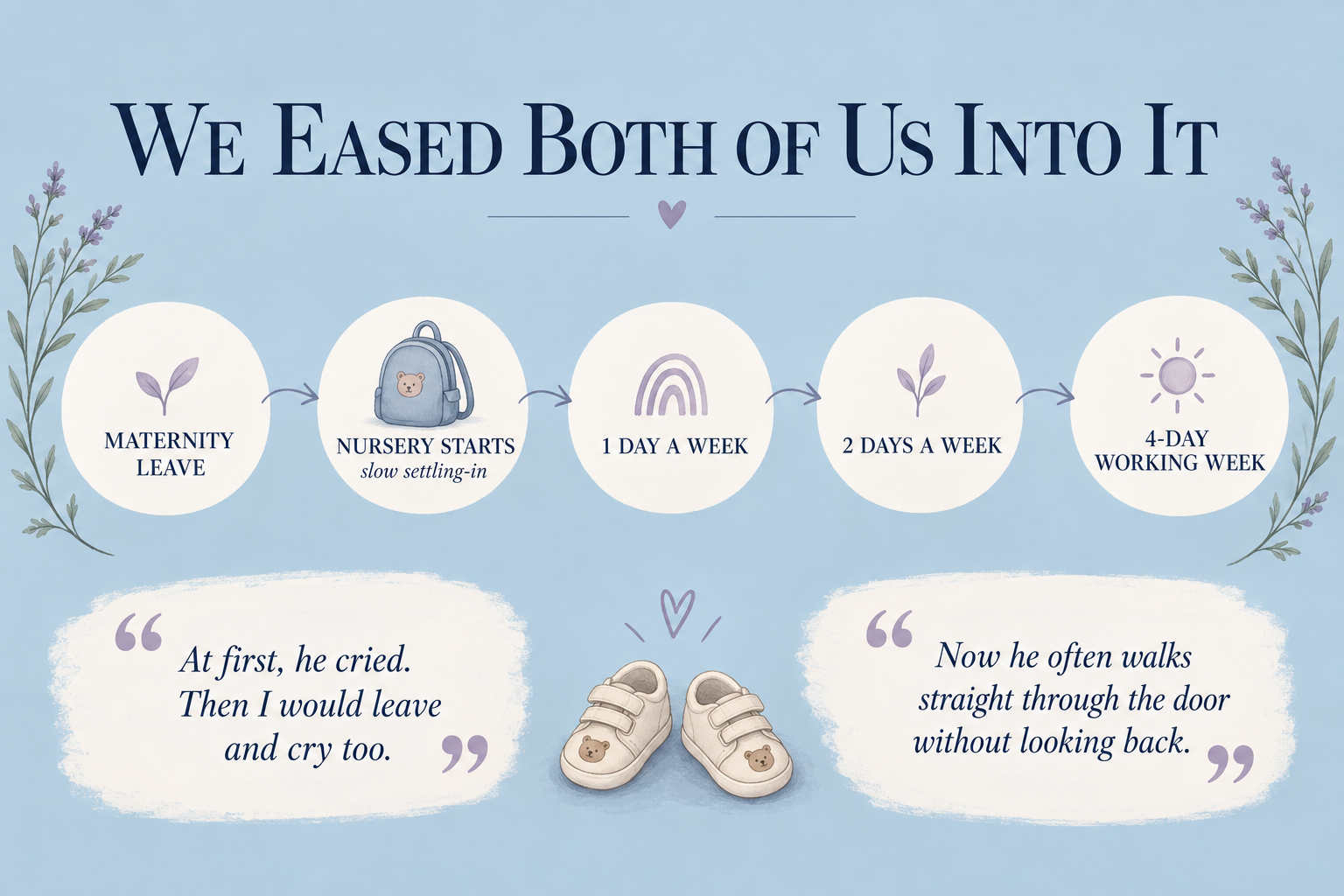
One of the best decisions we made was not making nursery and my return to work happen at the same time. We started settling my son into nursery months before I was due to be fully back because I wanted to be available if he needed me. Looking back, I think I needed the gradual transition every bit as much as he did.
We eased him in rather than suddenly going from being with me almost all the time to spending four full days a week somewhere completely new. At first, he cried. Then I would leave and cry too.
Everybody told me this was normal. They told me he would stop crying shortly after I left, that he would learn Mummy and Daddy always came back and that eventually nursery would simply become part of his world. They were right.
His key worker was wonderful. He adored her and she did everything she could to make the transition feel safe for him and reassuring for us. Gradually, nursery stopped feeling like somewhere I was leaving my baby and became his place too.
Over the following year I watched his confidence grow. He developed relationships with the staff and other children. He learnt things, played, laughed and became increasingly independent. Now he often walks straight through the door without looking back. At collection, the problem can be persuading him to stop running around with his friends for long enough to acknowledge that I've arrived.
This is not particularly flattering after the emotional turmoil I put myself through during those early drop-offs, but it is extremely reassuring!
Seeing him genuinely happy there removed a huge amount of the conflict I had felt about going back to work. Nursery stopped representing time I wasn't spending with him and became something positive in his life in its own right.
I had to remember that I still knew what I was doing
I didn't go from maternity leave straight into four full working days. I used the annual leave I'd accumulated to phase myself back over about three months, starting with one day a week, then two and eventually moving up to my normal four-day week.
For me, that was ideal. It gave my son time to adjust and it gave me time to rediscover my professional brain without simultaneously trying to operate it at full capacity.
Although I had been practising law for years, there was still a little voice in my head asking whether I actually remembered how to do it. I did, as it happens, but for the first little while I noticed myself sense-checking things I wouldn't previously have thought twice about. I had been away from practice for an extended period and wanted to make sure I hadn't missed a legal development or forgotten something important.
Objectively, my years of experience hadn't disappeared because I'd spent a year discussing naps and starting solids. Emotionally, I needed a little time to remember that. Fortunately, the wobble didn't last long. I was soon back in the full swing of things and the confidence returned remarkably quickly.
The knowledge was still there. It had merely been temporarily buried underneath an extraordinary amount of information about baby sleep.
My first day back was actually rather fabulous
My return had one unusual advantage: while I had been away, the office had moved. So I wasn't simply returning to work. I was returning to a completely new City office in a beautiful building with fabulous views over London.
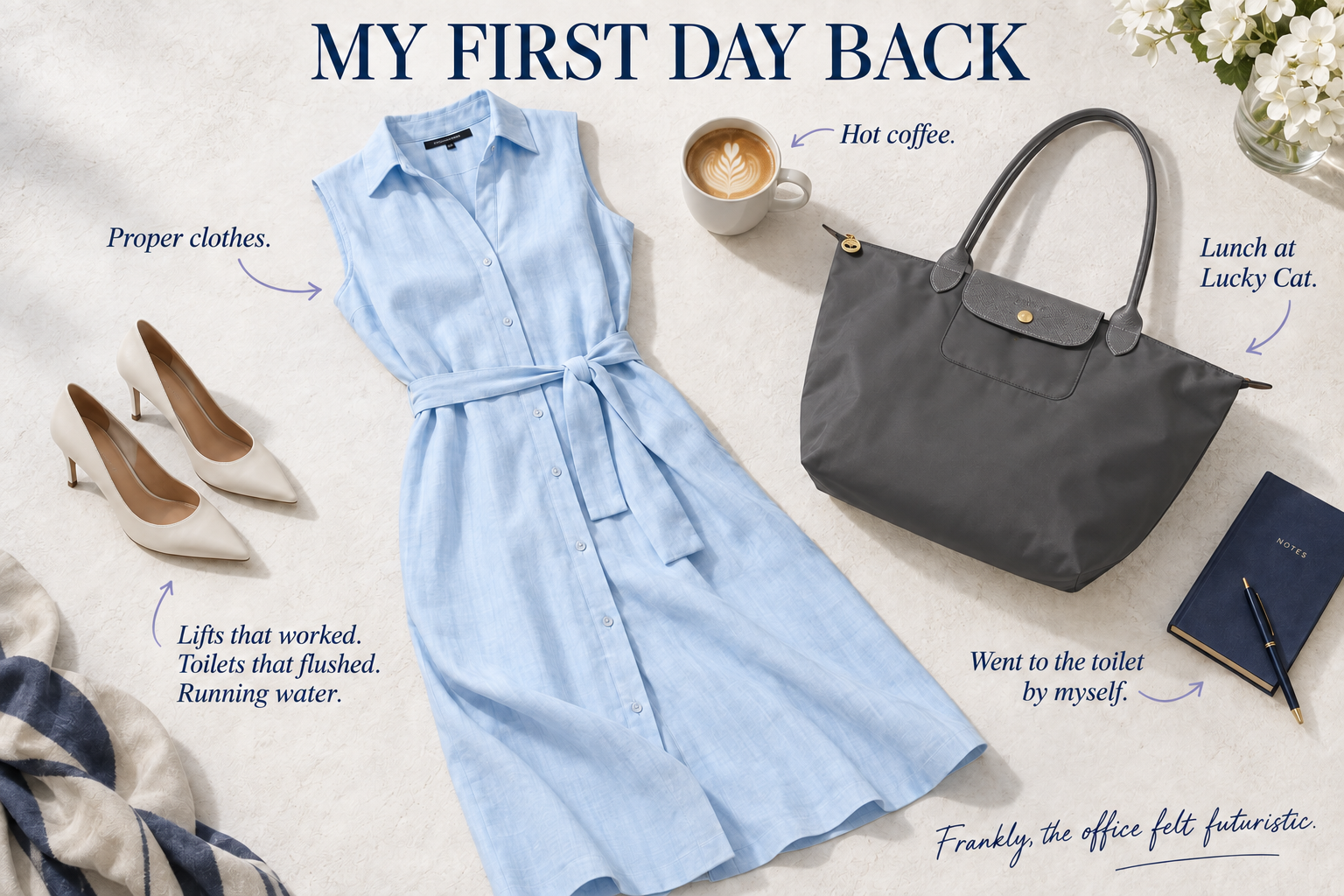
It also had lifts that worked, toilets that flushed and reliable running water. I wish I were exaggerating how exciting these developments were. After some of the quirks of the previous building, it felt positively futuristic.
I wore a powder-blue sleeveless linen dress with ivory LK Bennett heels. I had recently had my colours analysed, partly because I wanted to feel good about myself when I returned to the office. Buying some new workwear had helped me feel polished again after maternity leave.
It worked. I received lovely comments, including one from a younger lawyer who said something along the lines of motherhood or maternity leave clearly suiting me. The tone was essentially one of mild surprise that I had returned looking quite so glamorous, which I chose to take entirely as a compliment.
We all went out for a lovely lunch at Lucky Cat in one of the City's skyscrapers. I saw colleagues I hadn't seen properly for a year. I wore heels, drank coffee while it was hot and went to the toilet completely by myself.
It was quite a day!
Those tiny freedoms are oddly luxurious after having a baby. Nobody followed me into the bathroom. Nobody tried to drink my coffee. I could begin a conversation with another adult and, in many cases, actually reach the end of it. There were parts of being back that felt really good.
Four days felt like the right compromise
I chose to return four days a week because I wanted one weekday that still belonged to my son and me. Friday is that day.
I love our Fridays. Sometimes we go somewhere. Sometimes we do very little. Sometimes we sit on the sofa surrounded by cuddly toys watching Ms Rachel while he strokes my arm and I genuinely can't think of anywhere I'd rather be. Knowing I have that day with him makes working the other four easier.
The problem with a four-day week, unfortunately, is that work has not necessarily received the memo. There are weeks when five days' worth of demands seem determined to fit themselves into four. There have been evenings when I've logged back on after my son has gone to bed because I simply haven't managed to finish everything during the day.
I don't think working four days has damaged my progression, but motherhood has changed the way I think about progression itself. I'm still ambitious. I still care about doing excellent work and developing professionally. I just no longer think career progression automatically deserves first refusal on every other part of my life.
Those are not the same thing.
Sometimes the difficult part is simply getting to work
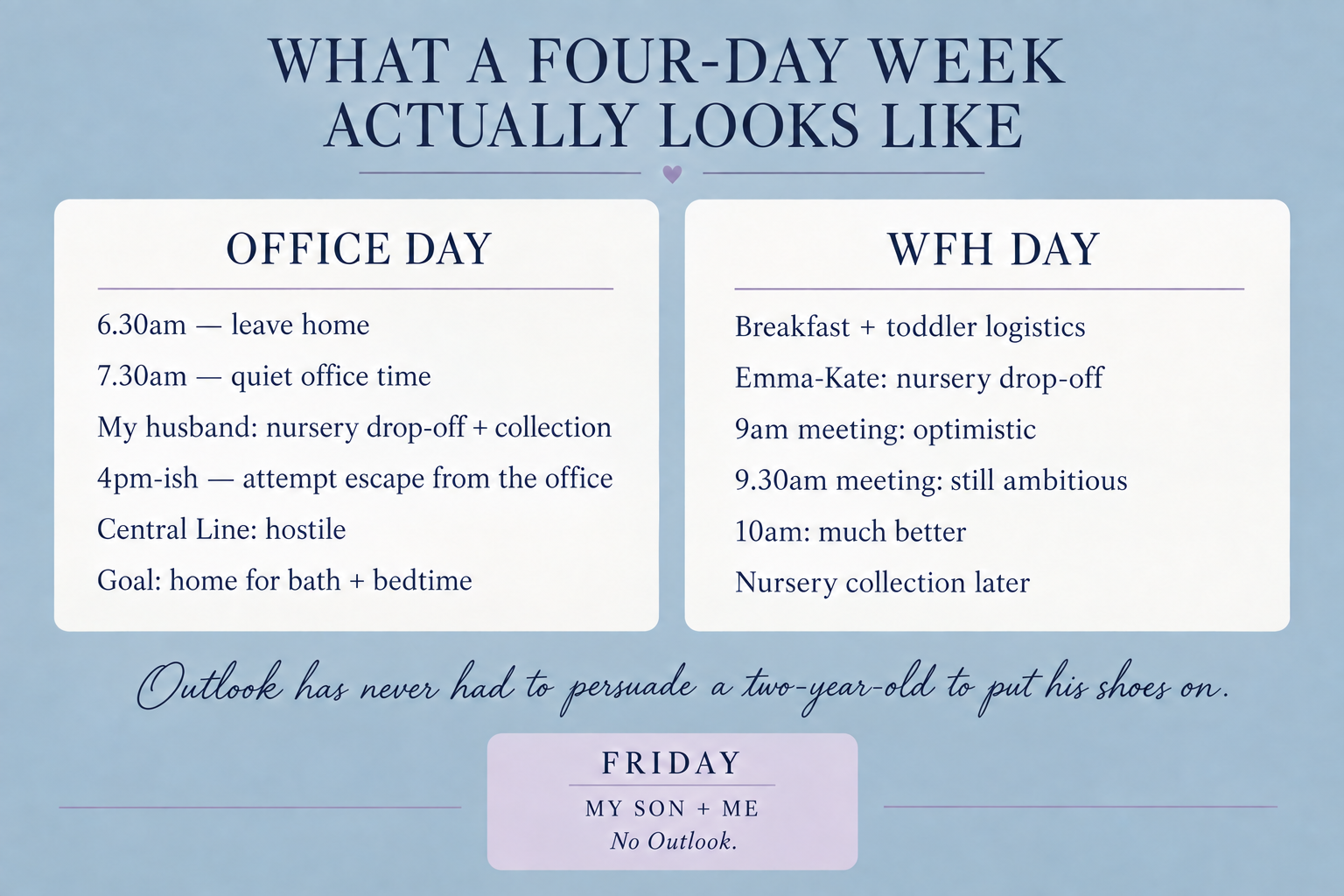
On office days, my husband does nursery drop-off and collection. I leave home at around 6.30am so I can get into the office for about 7.30. There is a real advantage to being there that early because the office is quiet and I can get through a surprising amount of work before the interruptions begin.
I then try to leave at around 4pm. This has the twin benefits of avoiding at least some of the Central Line's daily attempt to break the human spirit and getting me home for bath and bedtime. I don't always manage it, but that's the aim.
On my working-from-home days, I do nursery drop-off and collection instead, so my husband and I split that part of the week fairly evenly. This is where Outlook occasionally collides with reality.
A 9am meeting may look perfectly reasonable to somebody examining a calendar. It looks rather different when I am at 8.37am attempting to persuade a two-year-old that trousers are not an unreasonable infringement of his civil liberties.
Traffic can be dreadful. Shoes may become controversial. Leaving the house can inexplicably take seventeen minutes longer than it did yesterday despite containing exactly the same people.
I have arrived late to internal meetings. So have other parents I work with. Nobody's career has collapsed as a result. I simply don't schedule client meetings that early.
I recently agreed to a 9.30am client meeting after pushing back a suggested 9am start. Even 9.30 turned out to be a little ambitious. Ten or eleven is much more civilised.
This is perhaps one of the less glamorous lessons of returning to work after maternity leave: sometimes good professional boundaries look like knowing that nursery drop-off and a 9am client meeting are not compatible events.
Then somebody gets ill
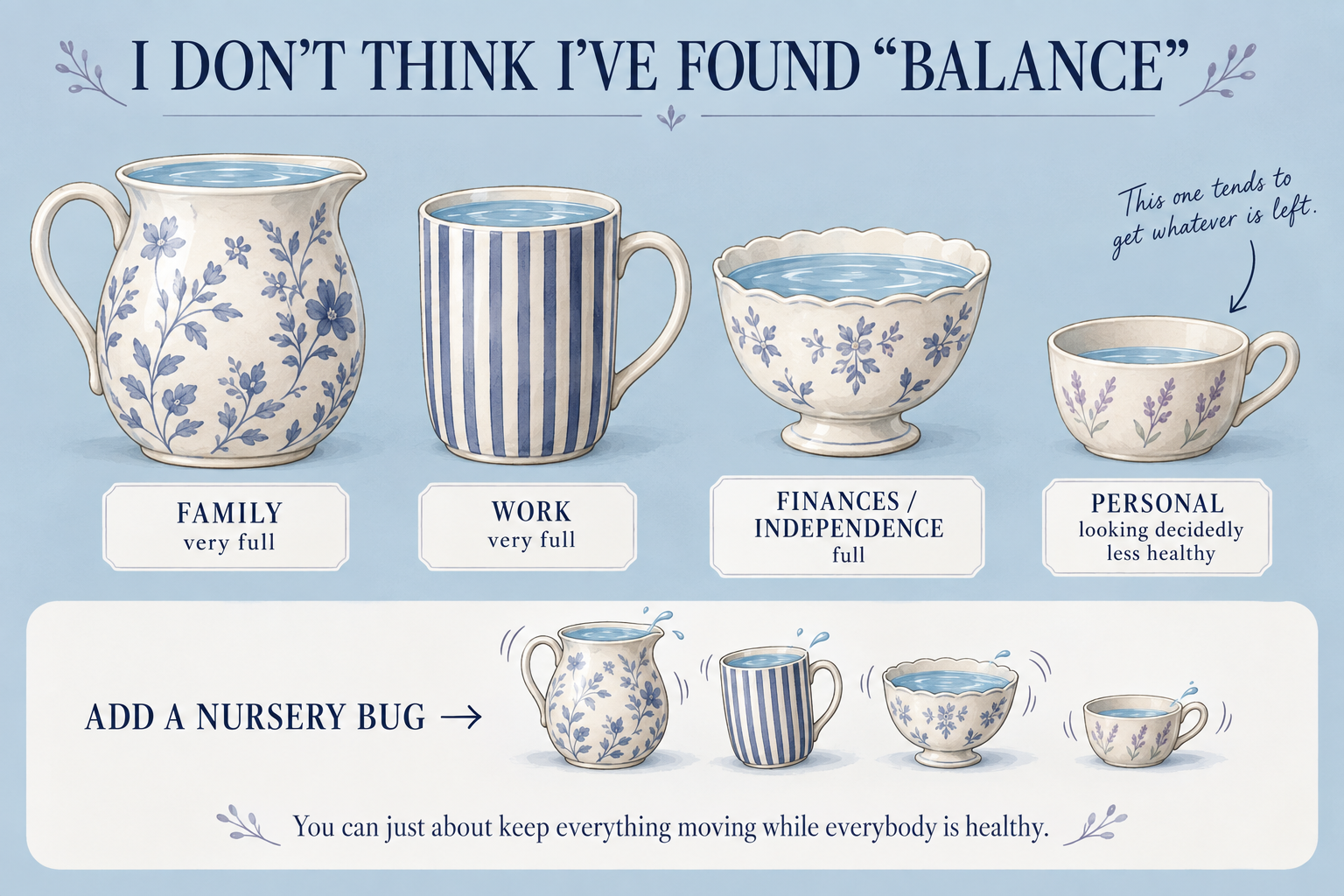
When everybody is healthy, I can just about keep all the plates spinning: work, nursery, food, house, family, life admin and perhaps even the occasional radical act of doing something for myself.
Then somebody brings home a nursery bug and suddenly the entire system falls over.
This is the part of the working-parent juggle that I think is particularly difficult to appreciate before you're living it. You can create a perfectly sensible routine based on the assumption that everybody will be where they are supposed to be. Toddlers have no respect for this assumption.
Illness doesn't just add caring for a poorly child. It removes childcare, disrupts work, creates washing, wrecks sleep and somehow makes the house look as though nobody has tidied it since 2019. The things that aren't essential disappear first.
Which brings me to the buckets.
I don't think I've found “balance”
People talk about work-life balance as though it is a destination you eventually reach if you organise your calendar properly enough.
I have not reached it.
I tend to think of life as having several buckets: family, work, finances and personal. Perhaps you can keep three of them reasonably full at once. Something usually has to give.
For me, the personal bucket is often the one sitting at the bottom looking rather neglected. Family is a priority. Work is a priority. Financial independence matters to me. So the time that gets squeezed is often my own: time alone, exercise, hobbies, the house being exactly as organised as I'd like or simply doing absolutely nothing.
When everybody is well, the arrangement more or less works. Add illness or an unusually demanding period at work and whatever fragile claim the personal bucket had on my attention disappears completely.
I don't say that because I think it's a good thing. It's simply the truth. I haven't found the perfect balance yet.
If working three days a week were practical, I suspect that might feel closer to the balance I'd ideally like. Whether my workload would politely reduce itself by another 25 per cent is a separate question.
I have my doubts.
Motherhood changed my ambition, but it didn't remove it
I don't think becoming a mother made me less ambitious. It made me more selective about what ambition is allowed to cost.
Before having my son, it was easier for work to expand into whatever space was available. Stay later. Attend the event. Take on another thing. There was always another professional milestone to pursue.
Now there is somewhere else I actively want to be and that changes the calculation.
Career still matters to me enormously. Being a lawyer is part of my identity. I like being good at what I do. I like being intellectually challenged. I value the independence my career gives me and I would be deeply uncomfortable giving that independence away.
I also don't want motherhood to become my only identity. One day my son will grow up. He will build his own life, as he should. I don't want to reach that stage and realise I dismantled every other part of myself while raising him.
So I don't think the answer for me is choosing between Emma-Kate the mother and Emma-Kate the lawyer. I want both.
I'd simply quite like an additional day in the week.
I was much kinder to myself than I expected
There was one area where I consciously decided not to add more pressure: my body.
Pregnancy, birth and recovery had put it through an extraordinary amount. I watched some other new mums become very focused on losing weight quickly, but I didn't feel that urgency. My body had done something amazing and I was gentle with it.
I bought clothes that fitted the body I had rather than punishing myself because older clothes didn't. I gradually lost weight without heavily restricting myself and, perhaps because I was so happy and content with my son, I simply wasn't obsessing about it.
Colour analysis helped here too. Instead of focusing entirely on whether I had returned to my old shape, I could buy a few new pieces in colours that made me feel fantastic. That felt much more positive than standing in front of a wardrobe demanding that my body reverse the previous year as quickly as possible.
I hadn't failed to get my old body back. I had had a baby.
There is quite a significant difference.
The guilt didn't disappear, but it changed
I have experienced mum guilt. I felt it acutely during those early nursery drop-offs and I still sometimes wish I could spend more time with my son. In an ideal world, I probably would.
But watching him thrive at nursery has changed the nature of that guilt. I can see that he has a life there. He has relationships, experiences and confidence that are his own. He isn't sitting miserably by the door for eight hours waiting for me to return.
Quite the opposite. Sometimes I arrive and he appears to regard my suggestion that we go home as an unnecessary interruption to his social calendar.
That helps.
So does knowing that the time we have together matters enormously to me. I protect Friday. I try to get home for bedtime on office days. I arrange my working week so that I still do half the nursery drop-offs and collections.
It isn't perfect. It is ours.
What actually matters looks different now
There is something about my particular area of law that makes it difficult to avoid thinking about this. I work with people dealing with wills, estates, trusts and the realities that come with ageing and death. Over the years, I've spoken to many people in the later stages of life.
When people look back, they don't generally tell me about the extra evening they spent in the office. They talk about their families, their children, their grandchildren, their relationships and the people they love. They talk about the life they built around them.
That perspective stays with you.
However valued any of us may be professionally, organisations continue without us. Someone else can eventually take over a role, inherit a caseload or sit at our desk. Our place within our family isn't interchangeable.
That doesn't make work meaningless. Far from it. My career gives me independence, intellectual stimulation, achievement and a part of my identity that matters deeply to me. It simply puts it in context.
Years ago, shortly before he retired, a very hardworking former senior partner at a firm I worked for said something to me that surprised me precisely because of who was saying it:
“You should never get so busy making a living that you forget to make a life.”
At the time, I remember thinking about the fact that this was coming from somebody I'd always regarded as extraordinarily committed to his work.
I understand it much better now.
So, what actually matters?
I don't think the secret to returning to work after maternity leave is becoming exceptionally good at balancing everything. I'm not convinced anybody is.
For me, what mattered was making the transition gradually, giving my son time to settle at nursery before I needed childcare to work perfectly and giving myself permission to double-check things until my professional confidence returned. It mattered that I bought clothes for the body I actually had and kept one day that was ours.
It mattered that I went back to a career I genuinely wanted rather than because I thought I was supposed to. It also mattered that I stopped expecting the version of ambition I had before becoming a mother to remain completely unchanged afterwards.
I still want a successful career. I still want financial independence and intellectual challenge. I also want Friday mornings on the sofa with my son and all his cuddly toys. I want to be there for bath and bedtime. I want to know the little person he is becoming rather than discovering later that I was too busy to notice.
I haven't found the perfect balance between those things. Perhaps I never will.
But I am increasingly certain that balance isn't really about giving everything equal weight. It's about knowing which things you would regret having given too little.
Work matters to me. My career matters to me and my independence matters to me. But when I imagine myself many years from now looking back at this part of my life, I already know which memories I will wish I had more of.
They won't be the meetings that started at 9am.