The Thoughtful Home
I Don't Want a Perfectly Organised Home. I Want One That's Easier to Run
Social media has given me a slightly unrealistic idea of what an organised home is supposed to look like. Apparently, at some point on Sunday afternoon, I should begin a reset. The fridge should be restocked, the laundry washed, folded and returned to its rightful place, every horizontal surface cleared and the coming week's outfits thoughtfully prepared. Ideally, several perfectly serviceable products should also be removed from their original packaging and decanted into matching containers.
By Monday morning, the house should look as though nobody actually lives in it. This is not always what happens in my house.
I like things tidy. I am naturally organised and I feel calmer when our surroundings are reasonably ordered. But since having my son, returning to work and generally discovering just how much administration is involved in running a family, I've become much less interested in achieving a perfectly organised home and much more interested in creating one that's easier to run.
Those aren't quite the same thing. I don't want to spend hours every week maintaining elaborate systems designed to prove how organised I am. I want a handful of useful systems that mean I spend less time thinking about running the house in the first place. Some of those systems are working very well. Others are currently in development.
Laundry, I'm looking at you.
I try to make tomorrow easier while I still have the capacity today
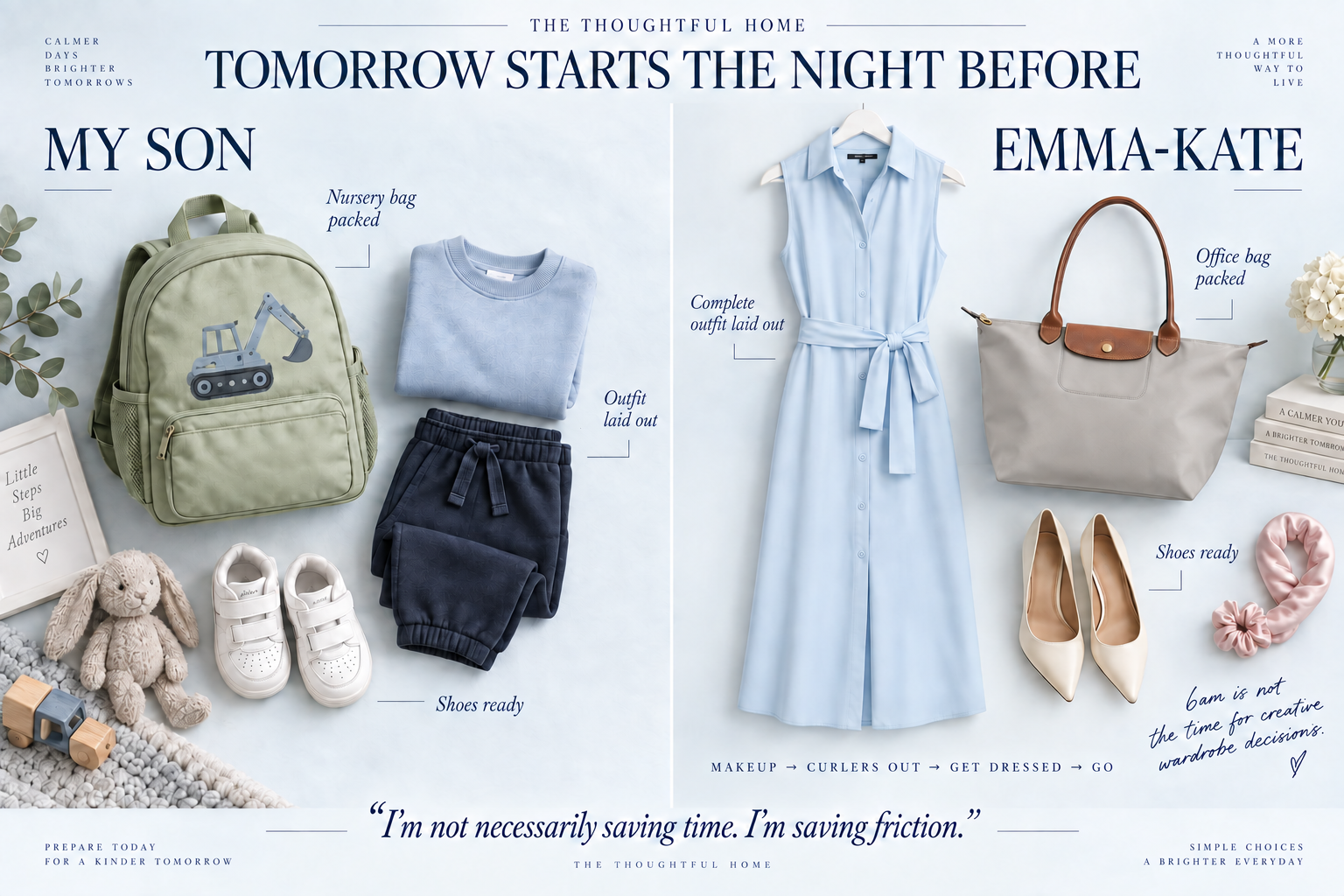
One of the simplest things we do is prepare for the next day the night before. On nursery nights, we pack my son's bag and lay out his clothes ready for the morning. None of this is revolutionary, but it means that when we're trying to leave the house the following day, we're not simultaneously looking for something he needs or trying to decide what he should wear.
There are enough unpredictable elements involved in getting a two-year-old out of the house without adding avoidable ones. We can prepare the bag. We can choose the outfit. We cannot guarantee that the person expected to wear the outfit will share our enthusiasm for it. There is a limit to every system.
I do exactly the same thing for myself before an office day. I leave home at around 6.30am, which is not an hour at which I am interested in exploring my wardrobe creatively. The night before, I decide exactly what I'm wearing, get the whole outfit out and pack my office bag. In the morning, I need to get up, do my makeup, take out my heatless curlers, get dressed and leave.
There is no 6am debate about whether the grey trousers would actually look better than the navy ones, no discovery that the top I'd mentally planned to wear is in the wash and no wandering around looking for the thing I absolutely need to take to work but apparently put somewhere very sensible three days earlier. Those decisions have already been made by a version of me who was sufficiently awake to make them.
I'm not necessarily saving an enormous amount of time. I'm saving friction, which I increasingly think is just as valuable.
I've stopped expecting myself to remember everything
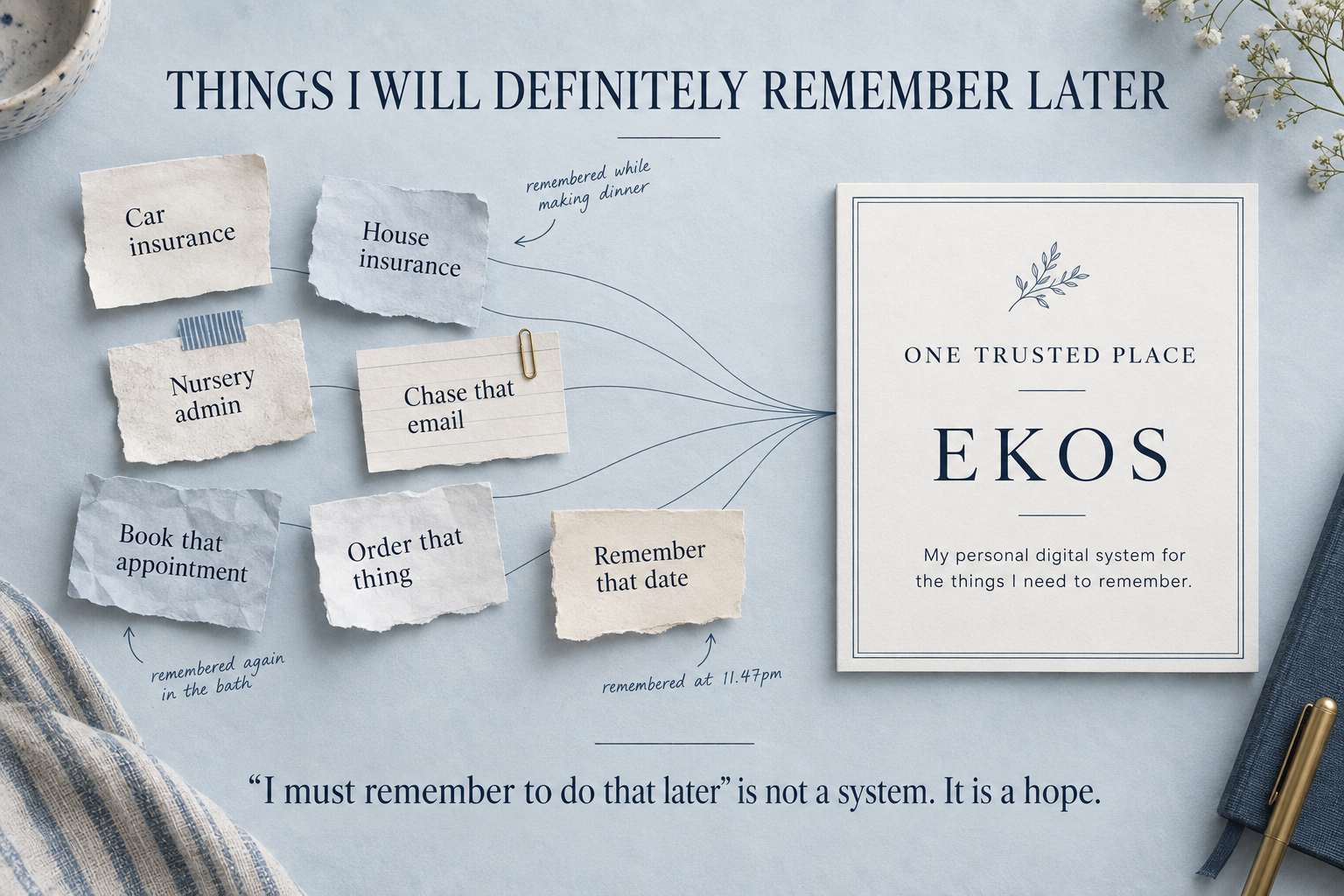
The other thing I've gradually changed is how I deal with all the small pieces of household administration that need remembering: car insurance, house insurance, renewals, things to chase, things to book, nursery admin and something that needs doing next week but absolutely does not need doing now.
None of these tasks is particularly complicated. The problem is the sheer number of them and the fact that they tend to occur to you at deeply unhelpful moments. I can be making dinner and suddenly remember something needs renewing. Later, while giving my son a bath, I'll remember something else I need to order. Then I'll get into bed and my brain will helpfully announce that there was an email I meant to chase three days ago. Excellent. Thank you.
I've gradually built a personal digital system where I capture those things instead. I call mine EKOS, but the name isn't really important. What matters is that I have one trusted place where I can put something I need to remember and then stop carrying it around in my head.
For years, I relied far too much on thinking, I must remember to do that later. This is not a system. It is a hope.
The mental load of running a home isn't necessarily made up of enormous jobs. Often it is the accumulation of tiny unfinished ones, each occupying almost no space individually but collectively creating a surprising amount of background noise. Getting them out of my head has made a real difference.
There is an obvious trap here, though. Once you start trying to organise your life, it is very easy to create a system so elaborate that maintaining the system becomes another administrative responsibility. If remembering to renew the car insurance requires a 40-minute weekly review, three dashboards and a colour-coding convention I need to consult a manual to understand, I have probably over-engineered the solution.
My test is increasingly simple: does this remove mental load or merely relocate it?
The systems that survive in our house tend to be the ones that disappear into ordinary life. Packing the nursery bag takes a few minutes. Laying out tomorrow's clothes takes a few minutes. Capturing something I need to remember takes seconds. Then I don't have to solve the same problem again when I'm tired, late or trying to do four other things.
Some systems are still very much works in progress
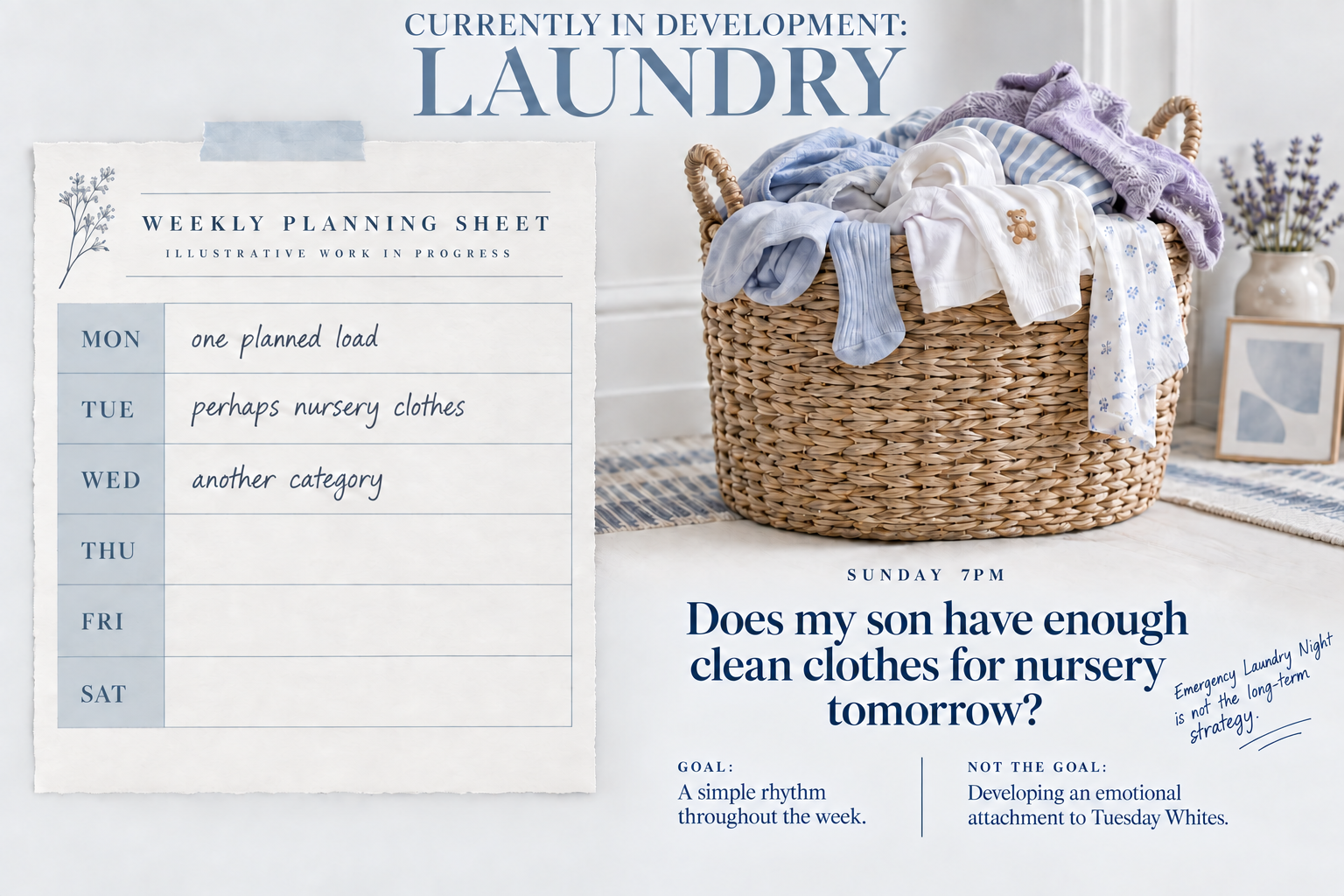
Laundry is currently my best example. I always intend to keep on top of it during the week, and this seems entirely achievable on Monday. Then work happens, nursery happens, dinner happens and somebody needs something. Suddenly it's the weekend and apparently everybody in the house has spent the previous five days wearing clothes.
The audacity.
At that point, I find myself working backwards from the more pressing question of whether my son has enough clean nursery clothes for Monday and trying to get everything washed before the week begins again. So I'm currently trying to establish a simple laundry rhythm, with certain washing happening on certain days rather than allowing everything to accumulate until the weekend.
This is not because I've reached a stage of personal development where Tuesday Whites brings me joy. I would simply quite like Sunday evening not to become Emergency Laundry Night.
This is really how most of the useful systems in our home develop. I notice the same point of friction happening repeatedly and eventually think, There must be an easier way of doing this. Sometimes there is. Sometimes I am still looking for it. I think that's a much more realistic version of an organised home than pretending everything has already been solved.
There is also, inevitably, clutter. Our kitchen counter seems particularly capable of acquiring a collection of miscellaneous objects that don't obviously belong together and yet have somehow decided to form a small community. Nobody appears entirely sure how they got there. One object becomes two, two become several and eventually somebody clears them so the counter looks lovely again. Then a new settlement appears.
I have decided not to investigate responsibility too closely in the interests of domestic harmony.
This is the part I think social media sometimes edits out. Real homes have surfaces. People put things on them. A house containing two adults and a toddler is occasionally going to look as though two adults and a toddler live there.
I want our home to be reasonably tidy because that makes me feel calmer, but I don't want maintaining it to consume the life taking place inside it. There is a difference between a home that is organised enough to support you and a home you spend all your time supporting. I'm interested in the first one.
Having a child changed what “organised” means to me
Before having my son, being organised was largely a preference. I liked having things in order because I like having things in order. Now it is much more functional.
There are simply more moving parts: nursery, work, food, shopping, laundry, appointments, insurance, childcare administration, commuting, the house itself, two adults' schedules and one small person's schedule, with the small person showing surprisingly little interest in calendar management. At the same time, I have less spare capacity to deal with things going wrong.
That's the irony of family life. It creates more things to organise at precisely the point when you have less time available to organise them.
So I'm much more interested now in preventing avoidable friction. I don't particularly care whether the nursery bag has a beautiful designated storage basket with a tasteful label; I care that it is packed when we need it. I don't need the laundry system to be aesthetically pleasing; I need clean nursery clothes on Monday. I don't need a household admin system that would impress somebody on TikTok; I need the house insurance not to expire because I remembered the renewal while washing my hair and then forgot about it again.
The outcome matters much more to me than whether the system itself is attractive.
Meal planning is probably the clearest example of something that became sufficiently repetitive and time-consuming that it needed a proper solution. Since returning to work, trying to decide what we were eating on the hoof simply wasn't working particularly well. So I've gradually built a Recipe Bank and an AI-assisted meal-planning process that gets us from “What are we eating this week?” to a proper Monday-to-Friday plan and shopping list.
That system has become substantial enough to deserve an article of its own, but the principle is exactly the same: move the decision away from the stressful moment.
I don't want to decide dinner at 5.30pm when everybody is hungry. I don't want to choose an office outfit at 6am. I don't want to remember an insurance renewal on the day it expires. If something can be decided, prepared or captured while I have the capacity to deal with it, there is very little benefit in handing it to Future Emma-Kate at the worst possible moment.
I am increasingly considerate towards Future Emma-Kate. She has been through enough.
The systems matter most when life isn't running smoothly
When everybody is healthy and work is relatively calm, most of this can feel almost unnecessary. Of course I can choose an outfit in the morning, remember a few things or catch up on the washing at the weekend. Then somebody brings home a nursery bug or work becomes particularly busy and suddenly all that spare capacity disappears.
Those are the weeks when preparation pays for itself. If I've slept badly, I'm particularly grateful that my office clothes are sitting there waiting for me. If the morning is chaotic, I'm grateful that the nursery bag isn't another problem to solve. If my working day has been relentless, I'm grateful that dinner was decided before I became tired enough to regard toast as a complete family meal plan.
A good household system should still help when you're not operating at your best. In fact, that's probably when it earns its place.
It also means accepting that when life becomes unusually demanding, some things will slide. The laundry might accumulate. The house may not be as tidy as I'd like. The kitchen counter may develop another thriving population. That isn't evidence that the system has failed. It's evidence that people live here.
I don't want to optimise the joy out of our home
There is a particular corner of the internet where every domestic inconvenience appears to require a solution. Everything must be decanted, every drawer divided, every cupboard filled with matching storage and Sunday must involve a reset sufficiently comprehensive that Monday morning appears to take place in an entirely new house.
If that genuinely makes somebody's life easier, wonderful. But I don't want to spend Sunday preparing to live efficiently from Monday to Saturday and then start the whole process again.
I also don't want to look back at the years when my son was small and remember that I spent an unreasonable proportion of them trying to keep the house looking as though there wasn't a small child in it. I want him to play here. I want us to cook and eat here. I want toys to come out and friends and family to feel comfortable. I want our home to be beautiful because I enjoy beautiful things, but I also want it to be lived in.
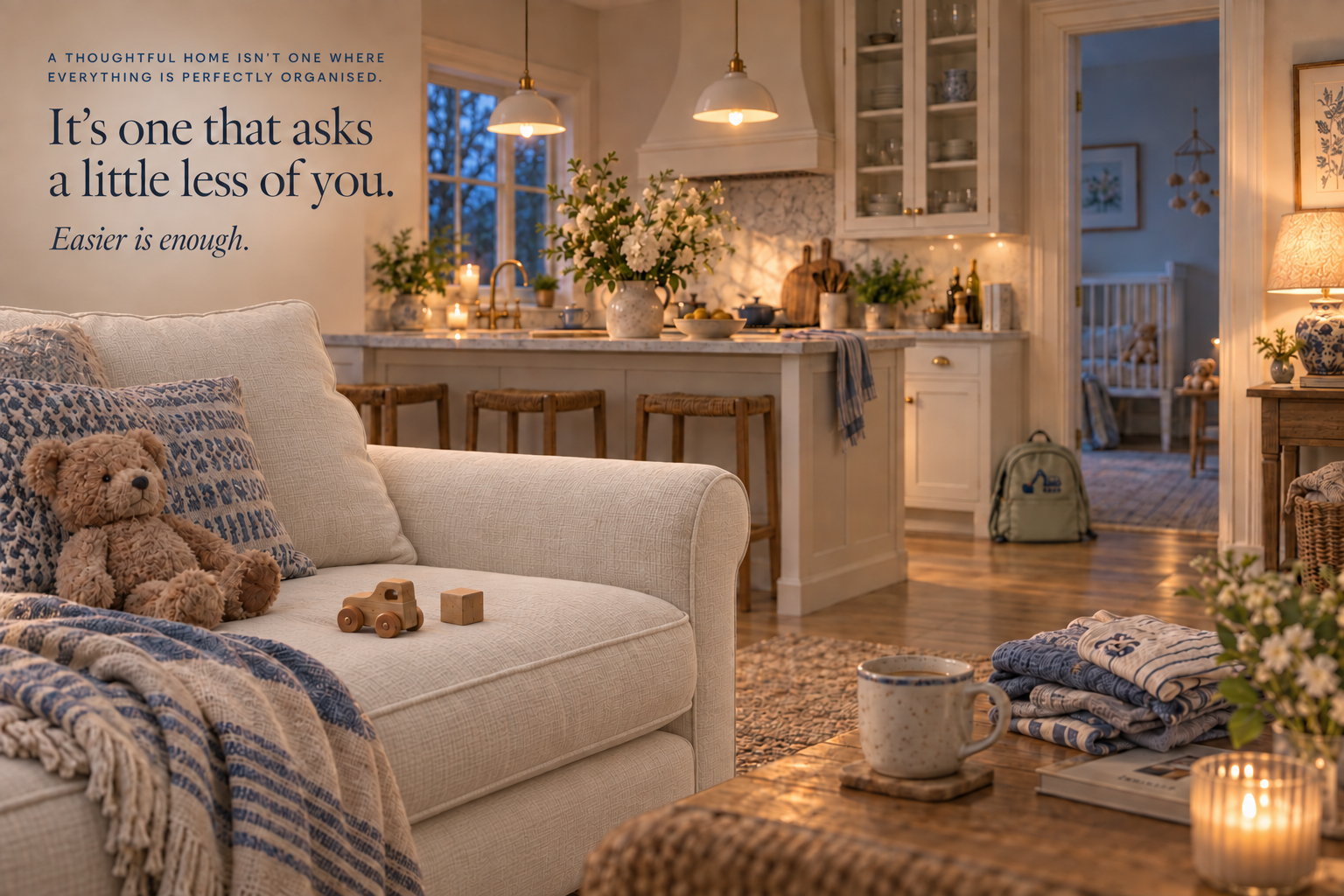
A thoughtful home, to me, isn't one where everything is perfectly organised. It's one that asks a little less of you.
That is ultimately what I'm trying to create: not a perfect home and not a perfectly organised one, just a home that is gradually becoming easier to run.
Some of the solutions are almost laughably small. Pack tomorrow's bag tonight. Put the outfit on a hanger. Capture the thing you need to remember somewhere trustworthy. Decide dinner before everybody is hungry. Some are still being worked out, and I am hoping my emerging laundry schedule will eventually prevent the weekly Sunday-night realisation that several essential items are currently at the bottom of a washing basket.
There will always be more we could organise. There will always be another drawer, another pile and another household task that could theoretically be performed more efficiently. I don't think that's the goal.
The goal is to remove enough unnecessary friction that the house supports the life happening inside it rather than becoming another job that constantly needs doing.
Tomorrow will still contain work, nursery, traffic, laundry and a toddler who may or may not consider shoes acceptable. The kitchen counter may already be plotting its next collection.
But the bags are packed and, for now, easier is enough.