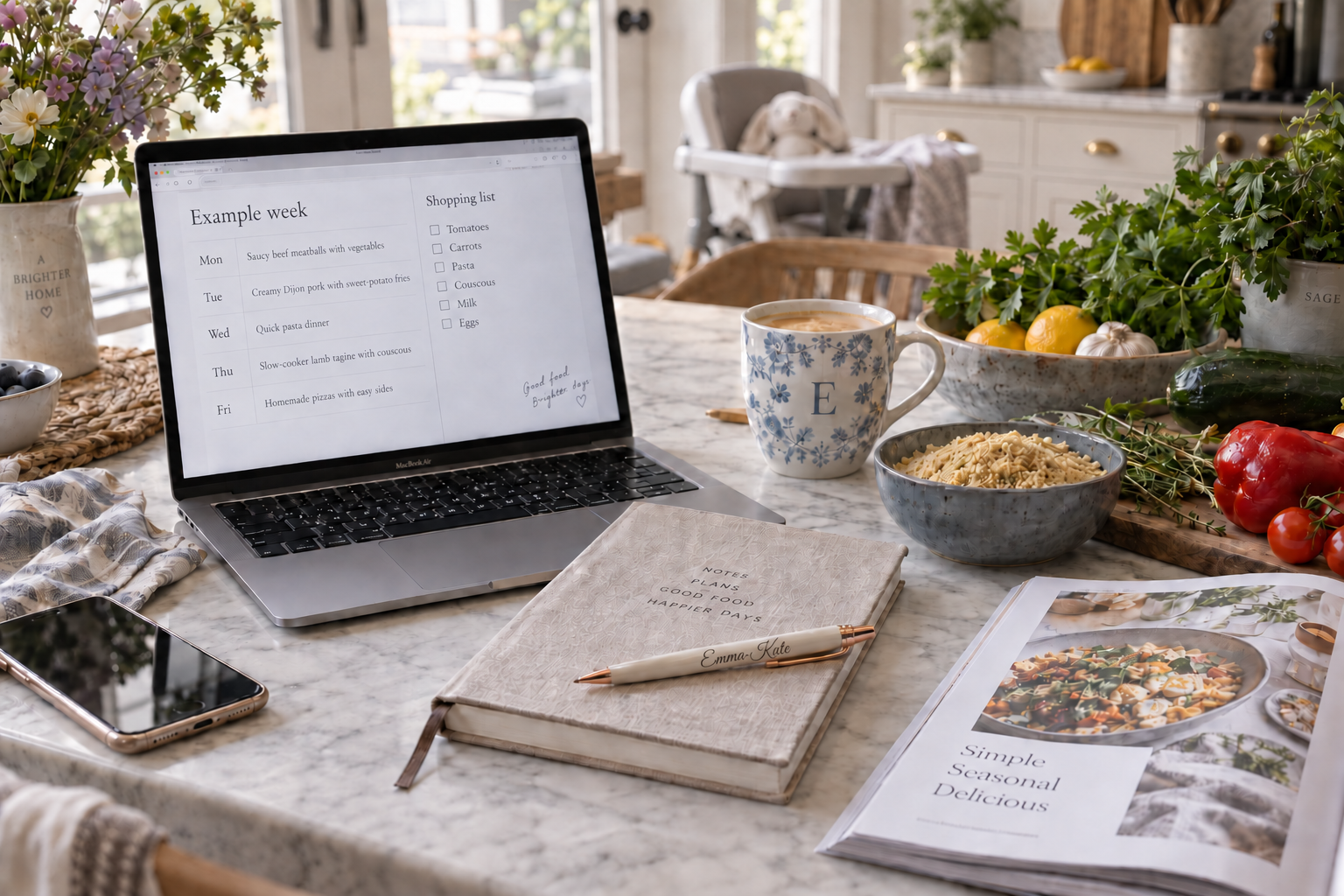
One of the more irritating things about feeding a family is that everybody expects to eat again the following day.
You can produce a perfectly respectable dinner on Monday and, rather than regarding the matter as settled, they will apparently require another one on Tuesday. Then Wednesday. Then, quite astonishingly, the rest of the week.
I used to be good at meal planning. Before I went back to work, I would sit down with my Notes app, recipe books and the various recipes I'd saved and work out what we were going to eat. It wasn't particularly sophisticated, but it worked.
Then I returned to the office after maternity leave and the whole thing rather fell apart.
It wasn't that I'd suddenly forgotten how to plan meals. I simply didn't have the time to sit down every week, flick through recipe books, hunt through screenshots and notes and decide what everybody was going to eat for the next seven days. Dinner became increasingly reactive, shopping became more ad hoc and I found myself having to make the same decision over and over again.
What are we having for dinner?
It is not, objectively, one of life's great questions. It is remarkable how tedious it becomes when you have to answer it every day.
So I started building a better system.
The problem wasn't that I needed more recipes
I already had recipes. Hundreds of them, as it turned out.
They were simply everywhere.
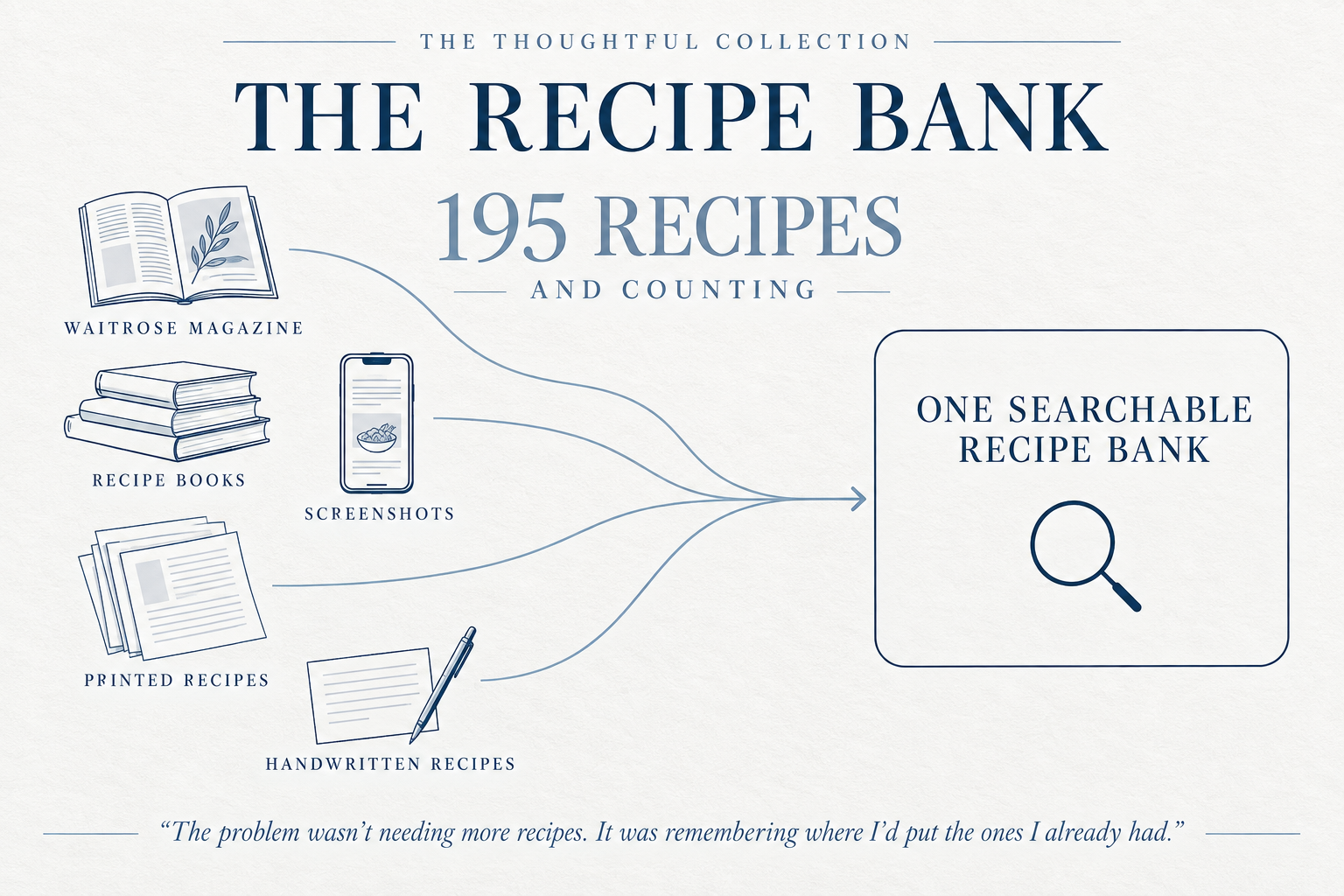
I had screenshots on my phone, recipes saved in Notes, cookbooks, things I'd found online, recipes I'd printed over the years and handwritten ones sitting in a plastic wallet folder. I also regularly pick up the Waitrose magazine because I'm a Waitrose card holder and it's free, which is obviously all the encouragement I require to bring another collection of recipes into the house.
I love looking through it and pulling out things I think we'd enjoy. The difficulty was remembering, several weeks later, where I'd seen them.
So I built a Recipe Bank.
It now contains around 195 recipes in one place, and it will continue growing. My plan is to photograph the old printed and handwritten recipes I've collected over the years and add those too, along with new things I find in magazines or elsewhere.
The aim isn't to create an enormous recipe archive for the satisfaction of knowing I own 600 ways to cook a chicken.
It is to make the recipes I actually want to use findable.
That was the first part of the problem solved.
The second was deciding which of them we should actually eat.
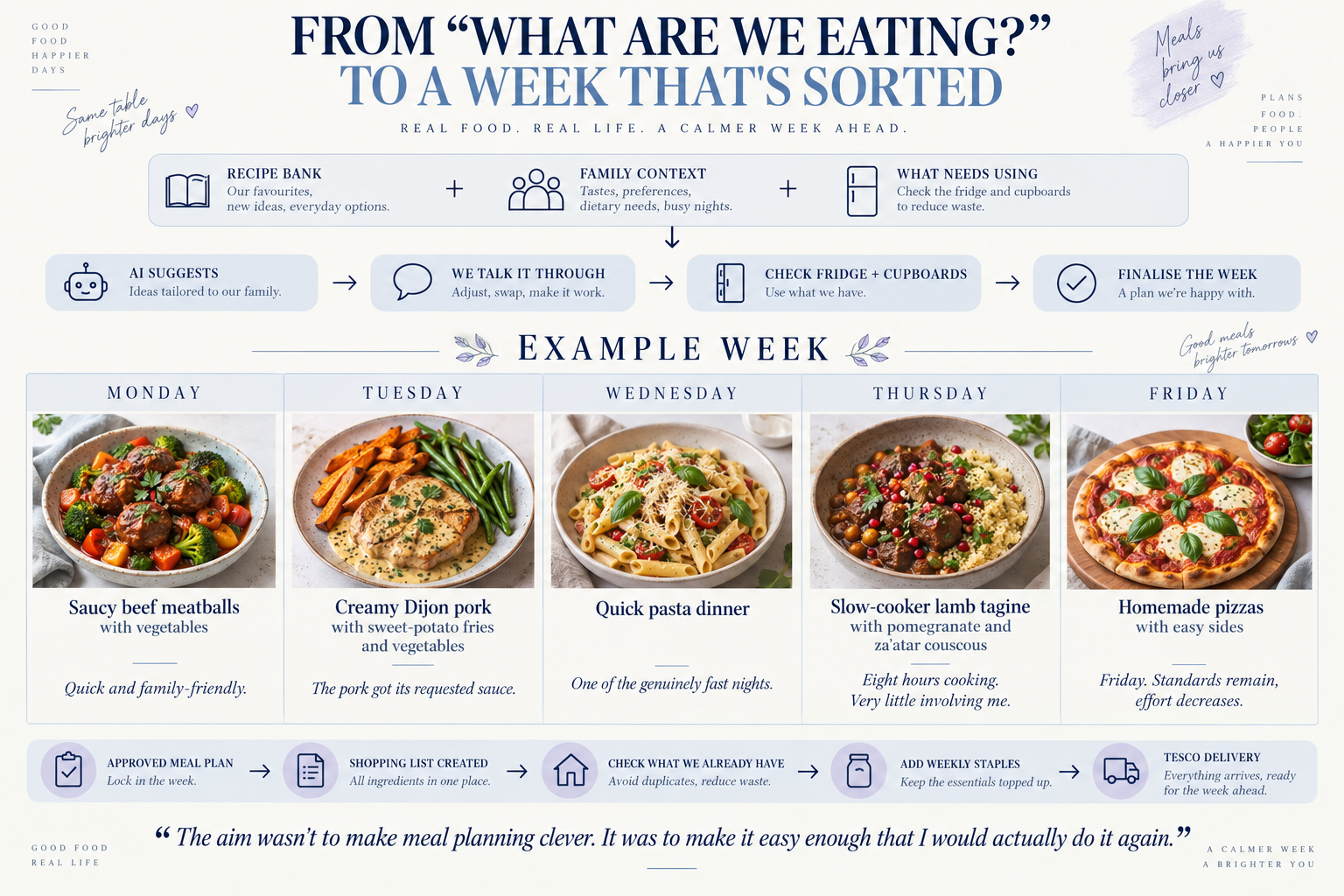
So I gave the Recipe Bank to an AI meal planner
I now use an AI meal-planning agent that knows about our family and can work with the Recipe Bank.
This is the important bit: I don't open ChatGPT every week and ask:
“Can you suggest some easy family dinners?”
That would give me exactly what you'd expect. A perfectly respectable collection of generic meals assembled for a fictional family whose children apparently eat all vegetables enthusiastically and whose parents have limitless enthusiasm for sheet-pan chicken.
Instead, my meal planner has context.
It knows the sort of food my husband and I like. It knows my son is two and currently exercising his constitutional right to change his opinion about food without notice. It knows our dietary preferences and the things I simply don't like. It knows I don't want unnecessarily spicy food. It knows that fish in our house is, for practical purposes, largely represented by fish fingers.
It also knows, importantly, that I regard chicken in pasta or on pizza as a culinary offence and would prefer not to discuss the matter further.
That context means its starting suggestions are already much closer to something we'd genuinely eat.
The Recipe Bank is a starting point, not a prison
The planner looks through the Recipe Bank first to see what might suit that particular week, but it isn't confined to it.
That matters because a lot of the recipes I've collected over the years belong to a previous era of my life when apparently I thought spending 75 minutes preparing dinner on a Tuesday was a perfectly reasonable recreational activity.
These days, it isn't.
Most weekday meals need to be quick, straightforward and involve as little washing up as reasonably possible. So if there isn't something suitable in the Recipe Bank, the planner can suggest something else.
Then we talk about it.
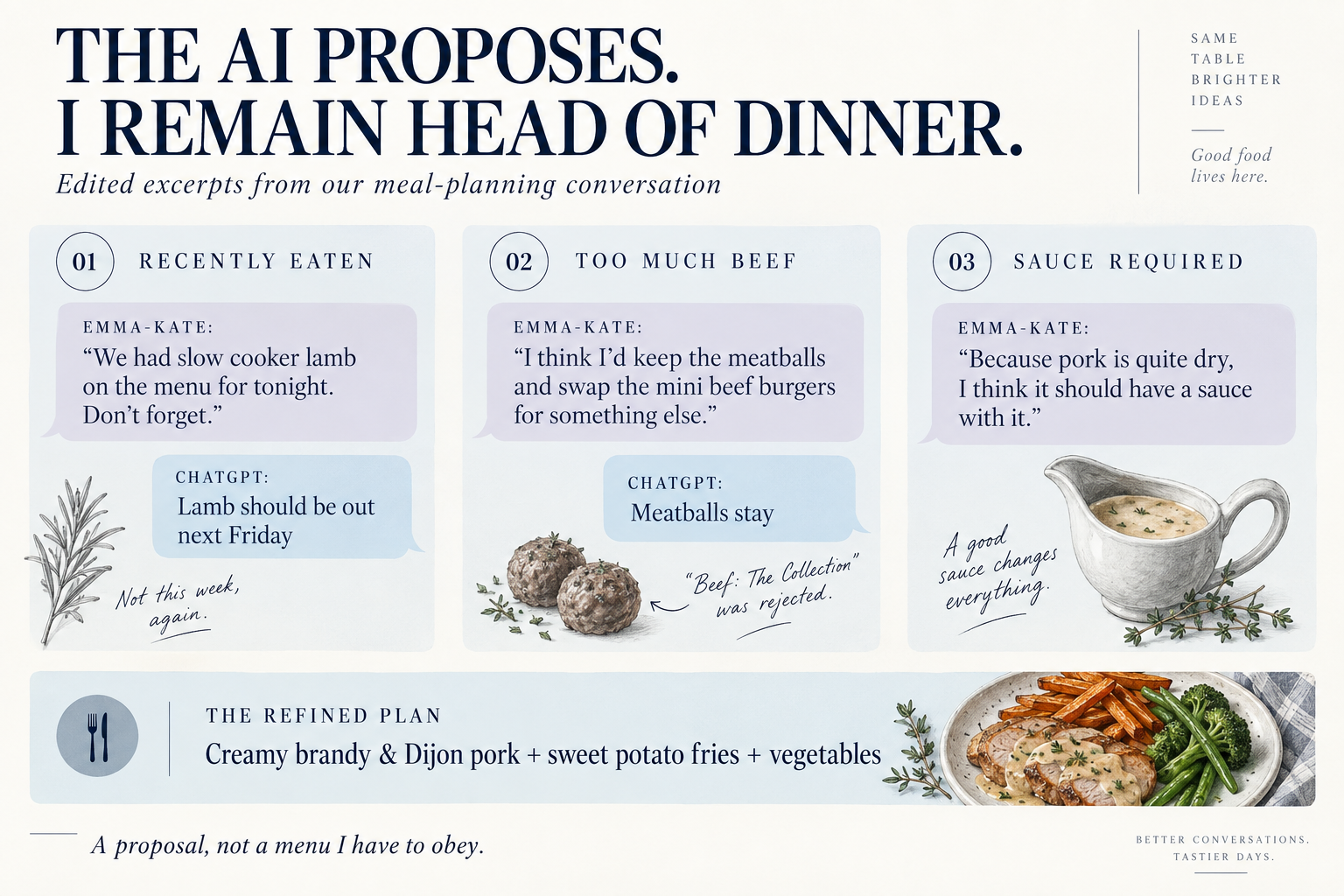
I might say I don't fancy something. I might point out that we had lamb last week. I might decide that two meals are too similar or that something needs a sauce. We move days around, swap meals and refine the week until it actually looks like something I want to cook.
The AI proposes.
I remain, quite firmly, Head of Dinner.
It does occasionally need correcting
A recent plan is a good example.
ChatGPT suggested lamb when we'd only just had slow-cooker lamb. I pointed this out, because apparently its enthusiasm for lamb was exceeding ours.
Another version of the week contained both mini beef burgers and meatballs. There was nothing inherently wrong with either meal, but together they gave the week a slightly excessive Beef: The Collection quality.
I kept the saucy meatballs and changed the burgers.
Then there was pork. Pork can be lovely, but I find it quite dry if it doesn't have something with it, so we talked through alternatives and eventually landed on a creamy brandy and Dijon sauce with sweet-potato fries and vegetables.
That's what makes the system useful to me.
It doesn't need to produce the perfect menu on its first attempt. It needs to get me from blank page to good set of options quickly enough that making the final decisions is easy.
That is a much smaller mental job than beginning every Friday with, Right. What food exists?
“Quick” doesn't necessarily mean 15 minutes
There is one important exception to my general rule that weekday dinners need to be quick: the slow cooker.
I'd considered buying one for years and never quite got around to it. Then my son reached about six months and started weaning and suddenly I understood the point.
Honestly, what a time saver!
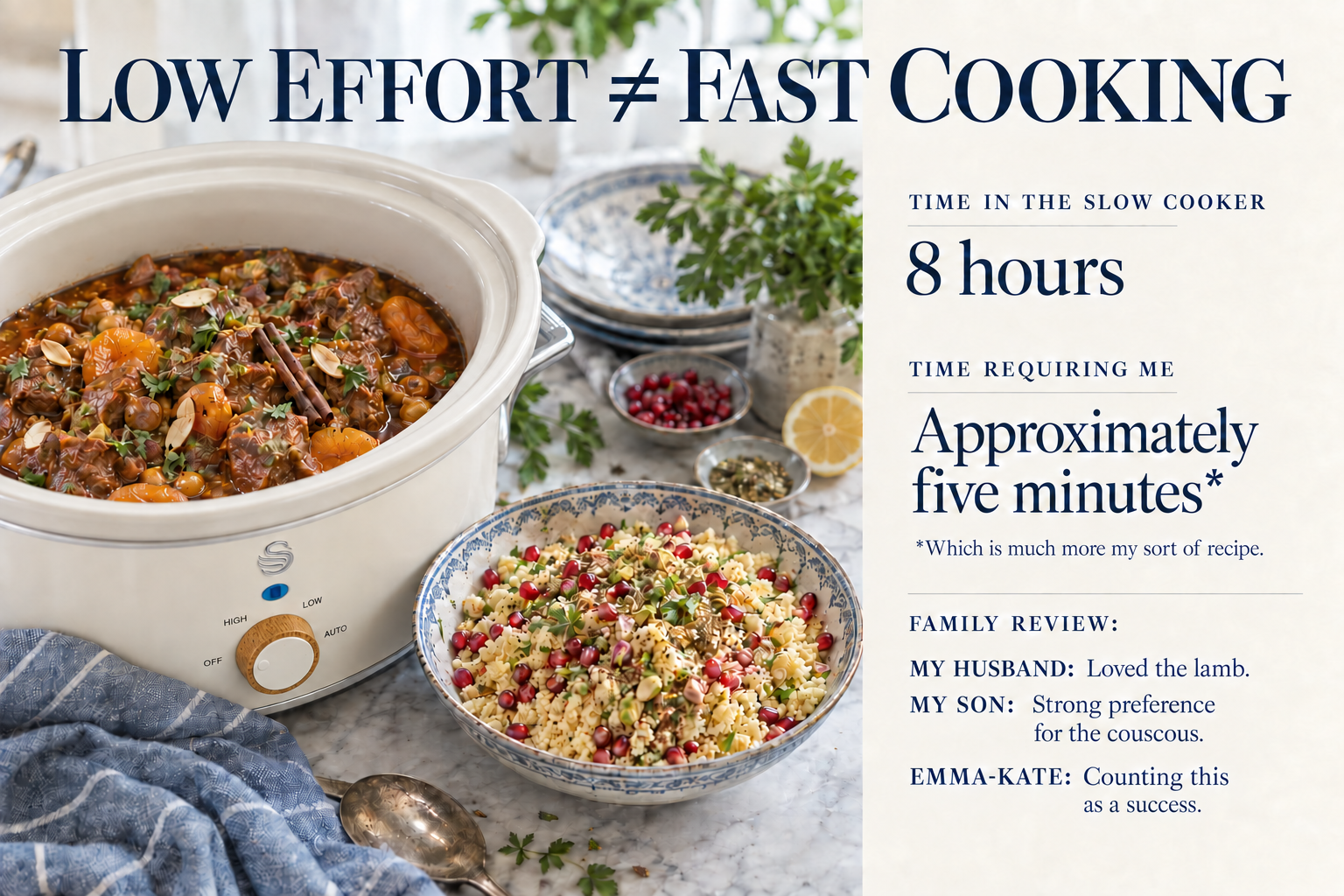
I now quite often build one slow-cooker meal into the weekly plan. It might technically take six or eight hours to cook, but that is completely different from a recipe requiring me to spend an hour actively cooking it.
I can put everything in earlier, switch it on and leave it alone. Several hours later, it has somehow turned itself into dinner while I've been doing something else entirely. This is the sort of domestic arrangement I can support.
So when I tell my meal planner that I need quick weekday meals, what I really mean is low-effort meals. Most need to be genuinely quick. One can happily take eight hours if seven hours and fifty-five minutes of those require absolutely nothing from me.
The lamb tagine we had recently is a good example. Lamb, apricots and spices could cook slowly without requiring me to spend the end of the working day standing over a saucepan. I made couscous with pomegranate and za'atar to go with it.
My husband loved the lamb.
My son was considerably more enthusiastic about the couscous.
He is two. I am choosing to count this as positive feedback.
I usually talk through the plan rather than type it
Another small thing has made this whole process considerably easier: I tend to speak to ChatGPT rather than type every instruction.
I use Wispr Flow, although ChatGPT's own dictation can do the same basic job. Speaking is simply much faster for me, particularly when I'm explaining all the little qualifications that actually make a meal plan useful.
I can say that we don't need milk because I've checked the fridge, that the sausages need using first, that I don't fancy the meal suggested for Wednesday, that we've already had lamb recently and that I think the pork needs a sauce.
Typing all of that feels like admin.
Saying it takes seconds.
I also find that I naturally provide more context when I speak. Instead of typing “change Tuesday”, I'll explain why I want to change Tuesday, which gives the planner useful information for future suggestions too.
It becomes less like filling in a meal-planning form and more like talking the week through with somebody who happens to have access to 195 recipes and no objection to discussing sausages at length.
The plan works around the food as well as the calendar
Once we've got a rough menu, I check what we already have.
This sounds extremely basic because it is. It is also one of the easiest things to skip when you're shopping reactively.
I'll look in the fridge and cupboards to see what needs using, what we already have and what staples we're running low on. Milk, eggs and the ordinary things that don't necessarily appear in a dinner recipe still need to make it onto the shopping list.
Expiry dates can also affect the order of the week. If sausages need using before chicken and the lamb can wait, there is no particular reason to cook them in the opposite order just because an AI initially put Tuesday above Wednesday.
The plan adapts.
This has helped with food waste too. Instead of buying ingredients with good intentions and rediscovering them several days later looking considerably less optimistic, I have a much clearer idea of what we're actually going to use.
Once the meals are agreed, the shopping list largely writes itself
This is probably the point where the system saves me the most admin.
Once I'm happy with the week's meals, we save the plan and produce the shopping list from it. Then I adjust that list based on what is already in the house and add the regular things we need.
The final shop can then become the basis of our weekly Tesco delivery.
That has completely changed the rhythm of food shopping for me.
I'd gone from being someone who used to meal-plan to somebody trying to work everything out on the hoof after returning to work. Shopping was more last-minute and I was constantly having to think about what we could make.
Now, I have a proper week of meals planned and the food arrives for that plan.
It sounds almost embarrassingly simple when written down.
Apparently the breakthrough was knowing what we were going to eat before buying the food for it. Revolutionary stuff!
But the difference in mental load is enormous.
The system learns with us
The meal planner isn't static.
If I tell it something about our preferences, that becomes useful context for future planning. It can learn the things I like, what my husband enjoys, what my son will currently entertain and the practical rules that make a meal suitable for us.
I say currently because attempting to create a permanent database of a two-year-old's food preferences would be an act of extraordinary optimism.
Today's favourite food may be tomorrow's personal insult.
The important thing is that the system gets better as our circumstances change.
The Recipe Bank can change too. Some of the meals in it are too elaborate for our life at the moment, but that doesn't mean they need deleting. They may become useful again later.
New quick meals can be added. Slow-cooker recipes can be added. Pages from the Waitrose magazine can join the collection. The handwritten recipes in my plastic folder can finally stop relying on my remembering that they exist.
It is a living family resource rather than a finished cookbook.
I'm not trying to optimise family dinner
There is a point with any system where you can become more interested in perfecting the system than in the thing it was supposed to help with.
I don't want that.
I'm not trying to produce seven nutritionally immaculate, photogenic family dinners every week. I'm not interested in spending Sunday batch-cooking 42 colour-coded containers unless I suddenly develop a completely different personality.
I want dinner to be quick, tasty and reasonably balanced. I want something that can broadly work for all three of us, accepting that my son may occasionally regard the main component with deep suspicion while eating all the couscous.
Most importantly, it needs to be manageable after work and nursery.
That's the standard.
If everybody eats something, nobody has spent an hour stressed in the kitchen and there is food in the fridge for tomorrow, I consider the operation successful.
The AI didn't really teach me how to meal-plan
That's perhaps the most interesting part of all this.
I already knew how to meal-plan.
I'd done it for years.
What changed when I returned to work wasn't my ability to organise dinners. I simply stopped having enough time and headspace to maintain the process manually.
The Recipe Bank and AI meal planner gave me that habit back in a form that fits my life now.
I don't have to remember where I saved a recipe. I don't have to leaf through five books looking for inspiration. I don't have to stare at a blank Notes page trying to summon four dinners from nowhere.
The system can do the searching, remembering and first round of thinking.
I still decide what we're actually going to eat.
That distinction is important because I don't want an AI running family life. I want it taking some of the repetitive thinking out of family life.
There is quite enough of that already.
Dinner still comes around every day
Sadly, no amount of artificial intelligence has solved the fundamental flaw in family meal planning, which is that once you've completed a successful week, another one begins.
They all want dinner again!
But now I'm not starting from scratch.
I have a Recipe Bank full of meals we've collected over the years. I have a planner that understands how we actually eat. I can talk through what the coming week looks like, change the bits I don't like, use what we already have and turn the final plan into a shopping list.
Then Tesco brings the food.
For something that used to feel like a constant low-level piece of unfinished admin, that is an enormous improvement.
The aim was never to make meal planning clever.
It was to make it easy enough that I would actually do it again.