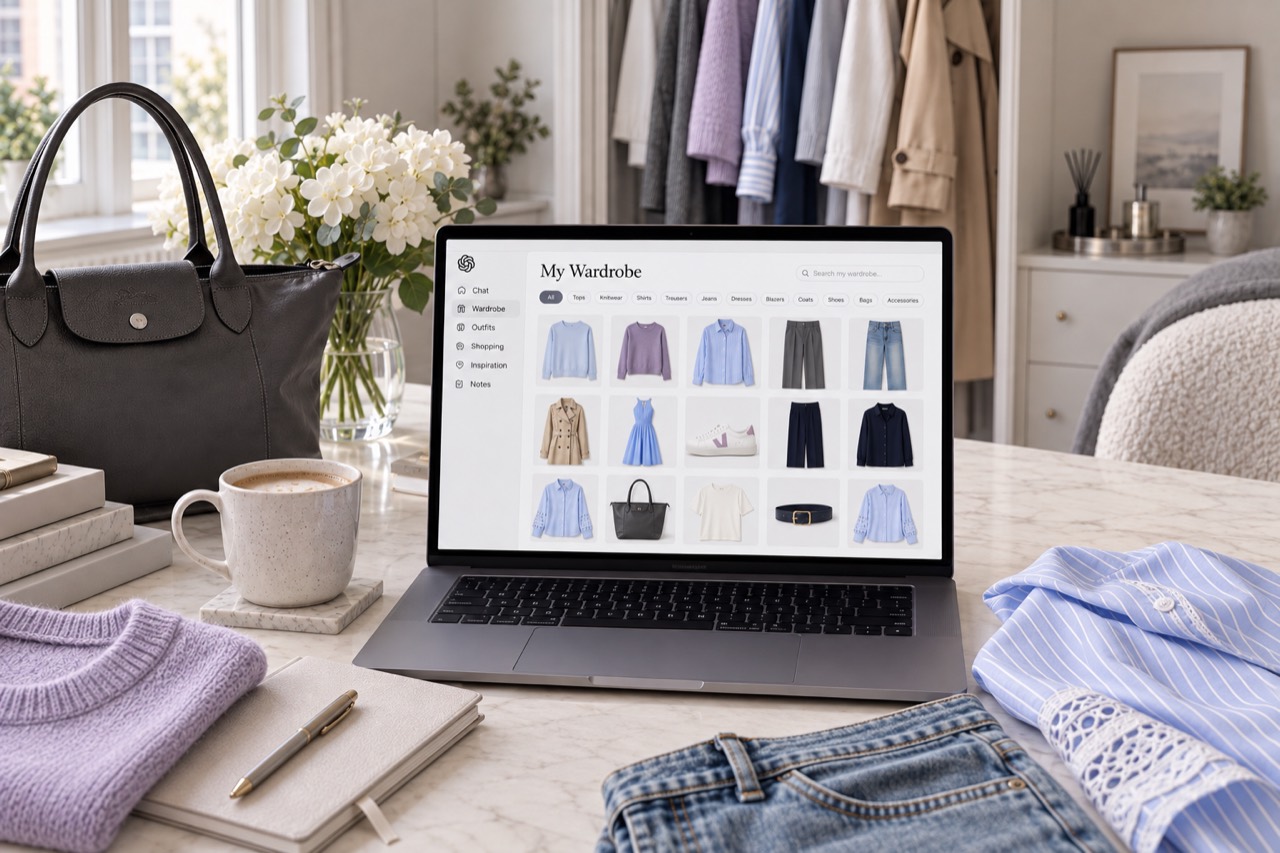
I have always been quite good at knowing what I like. I know the silhouettes I wear, the colours I reach for and the things that will sit in my wardrobe looking lovely while I inexplicably choose something else every single time.
What I was less good at was holding all of that information in my head at once.
My wardrobe is not enormous, but it is large enough that I would occasionally forget what I owned, buy something suspiciously similar to something already hanging upstairs or stand in front of a rail full of clothes and conclude, with impressive confidence, that I had absolutely nothing to wear.
So I decided to give ChatGPT my wardrobe.
Not metaphorically. The actual thing.
I photographed it.
I started taking photographs of the clothes I genuinely own: tops, knitwear, shirts, trousers, jeans, dresses, coats, shoes, bags and accessories. Not just the interesting pieces, either. If the point was to create something genuinely useful, it needed to know about the ordinary white T-shirt as well as the beautiful dress.
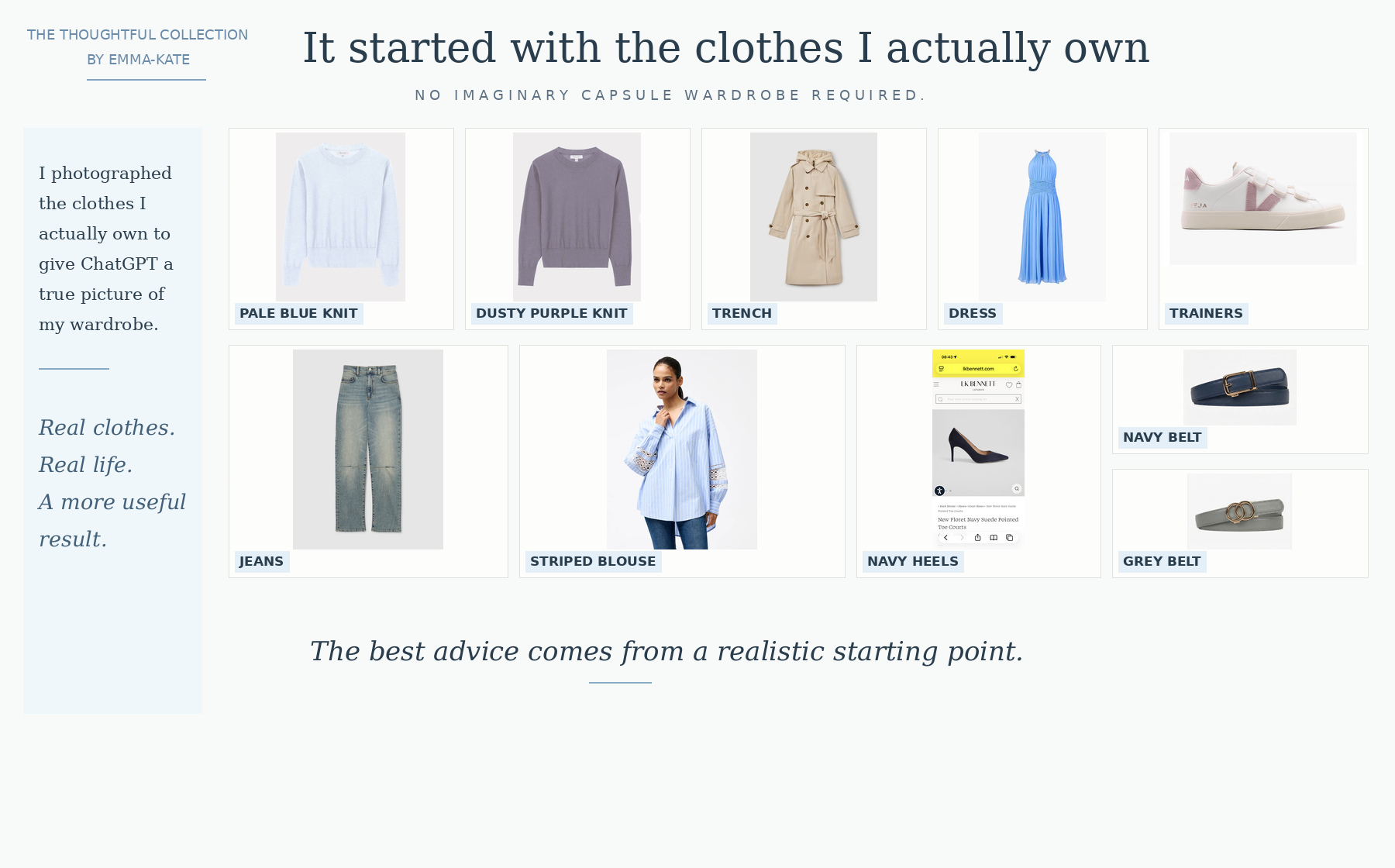
The idea was simple: if I wanted useful advice from AI, it needed a realistic starting point.
This is where my teenage obsession with Clueless finally became unexpectedly relevant.
I loved that film so much that at one point I knew virtually all the lines. More importantly, what girl watching Cher Horowitz flick through that computerised wardrobe did not want one of her own? The wardrobe itself would have been quite nice too!
Thirty-odd years later, mine is rather less yellow plaid and considerably more practical, but apparently I did eventually get the catalogue.
I used ChatGPT Work to help turn those photographs into a structured wardrobe library. Each item could be recorded with useful information about what it was, its colour and category, alongside the things that matter in real life: whether it is a favourite, whether it feels particularly “me” and whether I actually wear it regularly.
That became my wardrobe library.
The important bit, though, is not really the catalogue itself.
It is what happens when ChatGPT can use it as context.
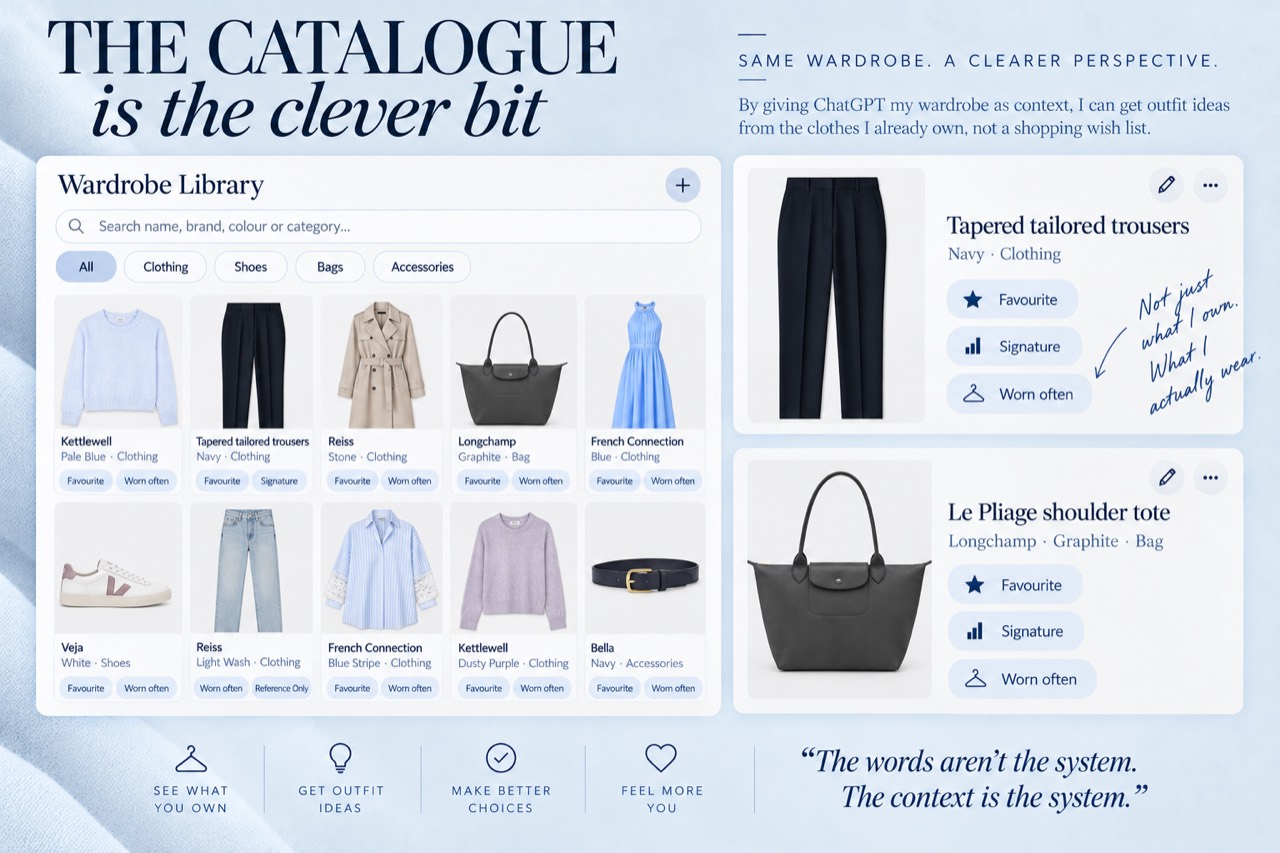
The words aren't the system. The context is the system.
There is a lot of conversation about finding the perfect AI prompt, as though somewhere out there is a magical sentence that will make ChatGPT understand your life.
Prompts matter, obviously. Context matters more.
My everyday ChatGPT setup does not have to start every wardrobe conversation from scratch. It can work with the catalogue and the wider context I have built around it: my True Summer colour palette, the silhouettes I actually like, the way I dress for work, the shoes I genuinely wear and the fact that a theoretically perfect outfit is not terribly useful if one of its components is sitting in the washing machine.
That changes the conversation completely.
Instead of asking:
“What should I wear in London today?”
and receiving a perfectly respectable outfit involving three things I do not own, I can have a normal conversation about the clothes that are actually upstairs.
That sounds like a small distinction. In practice, it is the whole point.
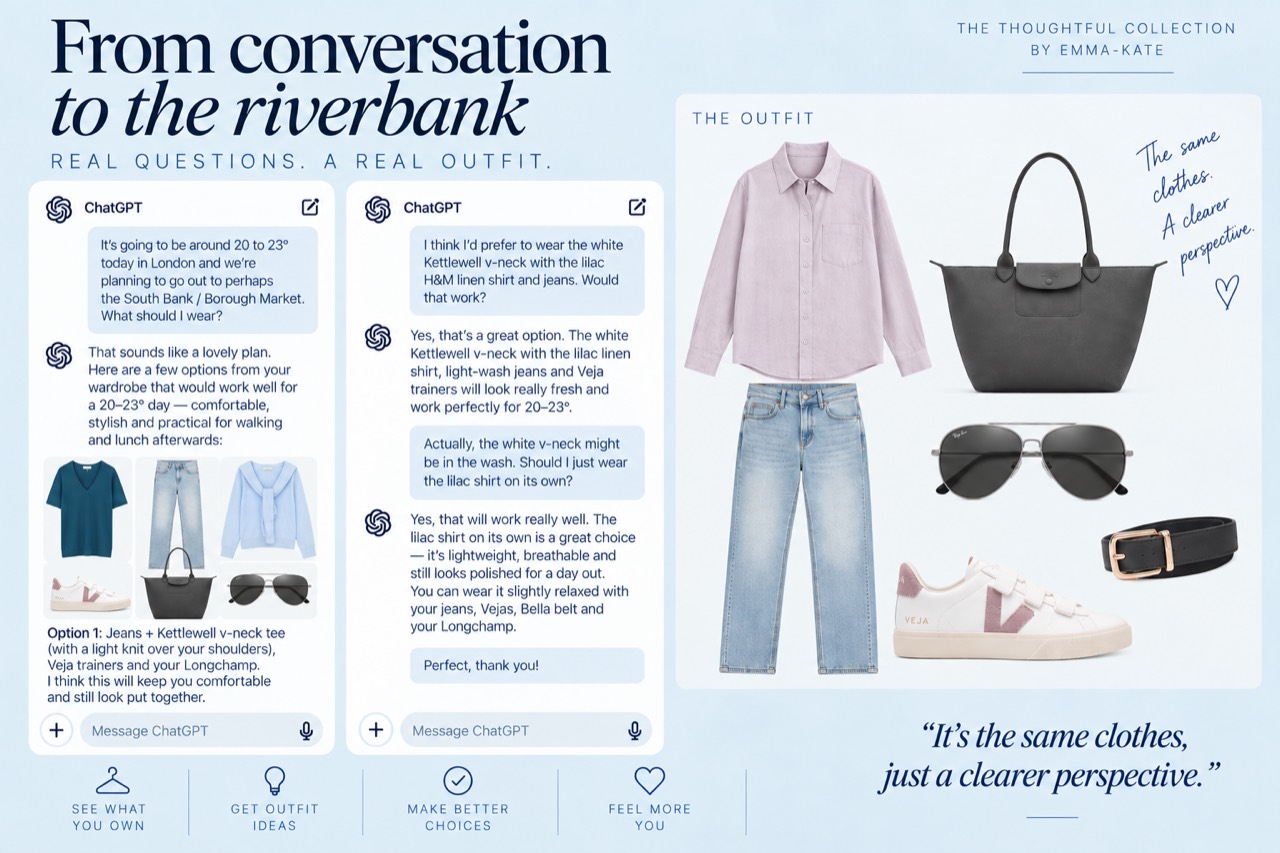
One day we were heading into London, probably to the South Bank or Borough Market. It was going to be around 20–23°C and I asked what I should wear.
ChatGPT started with what it knew about my wardrobe and suggested light-wash jeans, a Kettlewell V-neck, my Veja trainers, a lightweight knit and my graphite Longchamp.
Perfectly reasonable.
I preferred another combination: a white Kettlewell V-neck with my lilac linen shirt and jeans.
Then real life intervened.
The white V-neck might have been in the wash.
So I said I thought I should probably just wear the lilac shirt on its own.
That was the outfit.
There was no dramatic “AI styled me” moment. It was simply a useful conversation that started with clothes I actually owned and adapted when one of those clothes was unavailable.
That is much closer to how I want AI to work in my life.
Then I started using it for shopping.
This is possibly where the system became both more useful and slightly dangerous!
Once ChatGPT knows what I own, I can show it something I am considering buying and ask a much better question than “Do you like this?”
Does it suit my colouring? Does it work with the wardrobe I already have? What would I actually wear it with? Does it duplicate something? Is it filling a genuine gap or have I simply found another pale-blue top and decided that this one is somehow fundamentally different?
That last question is occasionally unwelcome.
The useful part is that the answer is grounded in my wardrobe rather than in some theoretical capsule wardrobe assembled for a woman who apparently owns twelve perfect neutral basics and never spills coffee on herself.
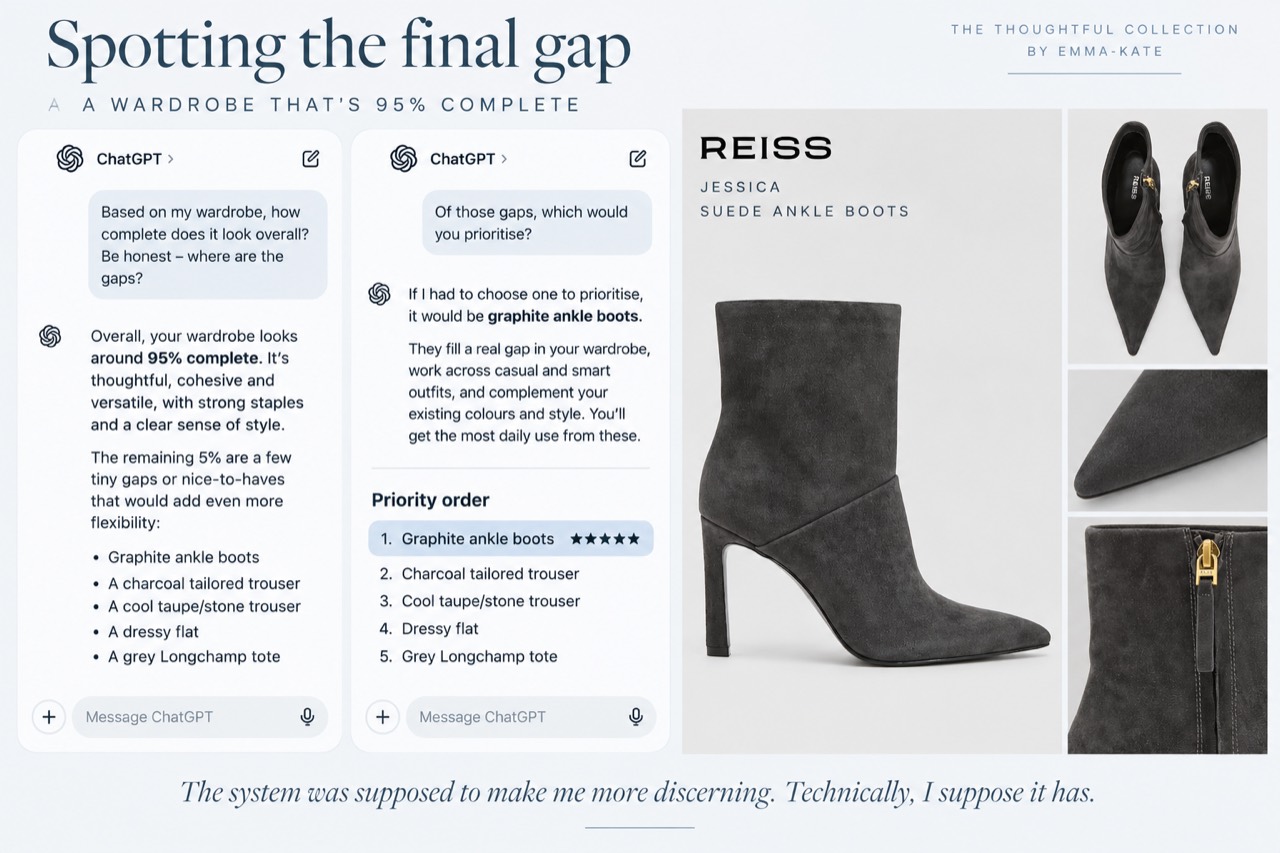
At one point I asked ChatGPT to assess how complete my wardrobe actually was.
The answer was approximately 95%.
Which was both reassuring and mildly inconvenient for someone who enjoys shopping.
It identified only a handful of genuine gaps and nice-to-haves. The strongest was a pair of graphite ankle boots.
Not black. Not brown. Graphite.
That made sense with the cool colours already running through my wardrobe and gave me something sufficiently different from the shoes I already owned.
Then I found the Reiss pair.
So yes, the system designed to help me buy less did technically result in me buying a pair of boots.
I am choosing to regard this as evidence that it works!
What this has changed most is not how often I ask ChatGPT what to wear.
It is how I think about my wardrobe.
I study purchases more carefully. I can see what I already own more clearly. I am less interested in adding something simply because it is nice and more interested in whether it genuinely earns its place.
The catalogue also makes the wardrobe much more useful as a whole. Clothes stop existing as isolated purchases and become part of a system: this shirt works with those trousers, those shoes solve this kind of outfit and this bag is the one I reach for constantly.
None of this requires AI to have better taste than I do.
I would not want it to.
The useful part is that it can remember more than I can, compare things quickly and bring the relevant information into a conversation when I need it.
I still make the decision.
That distinction matters to me, because the best version of AI is not one that makes every choice for us. It is one that removes enough of the friction around a decision that we can make the choice better ourselves.
My wardrobe catalogue happens to be a particularly pretty example of that.
Although I do think Cher would approve.