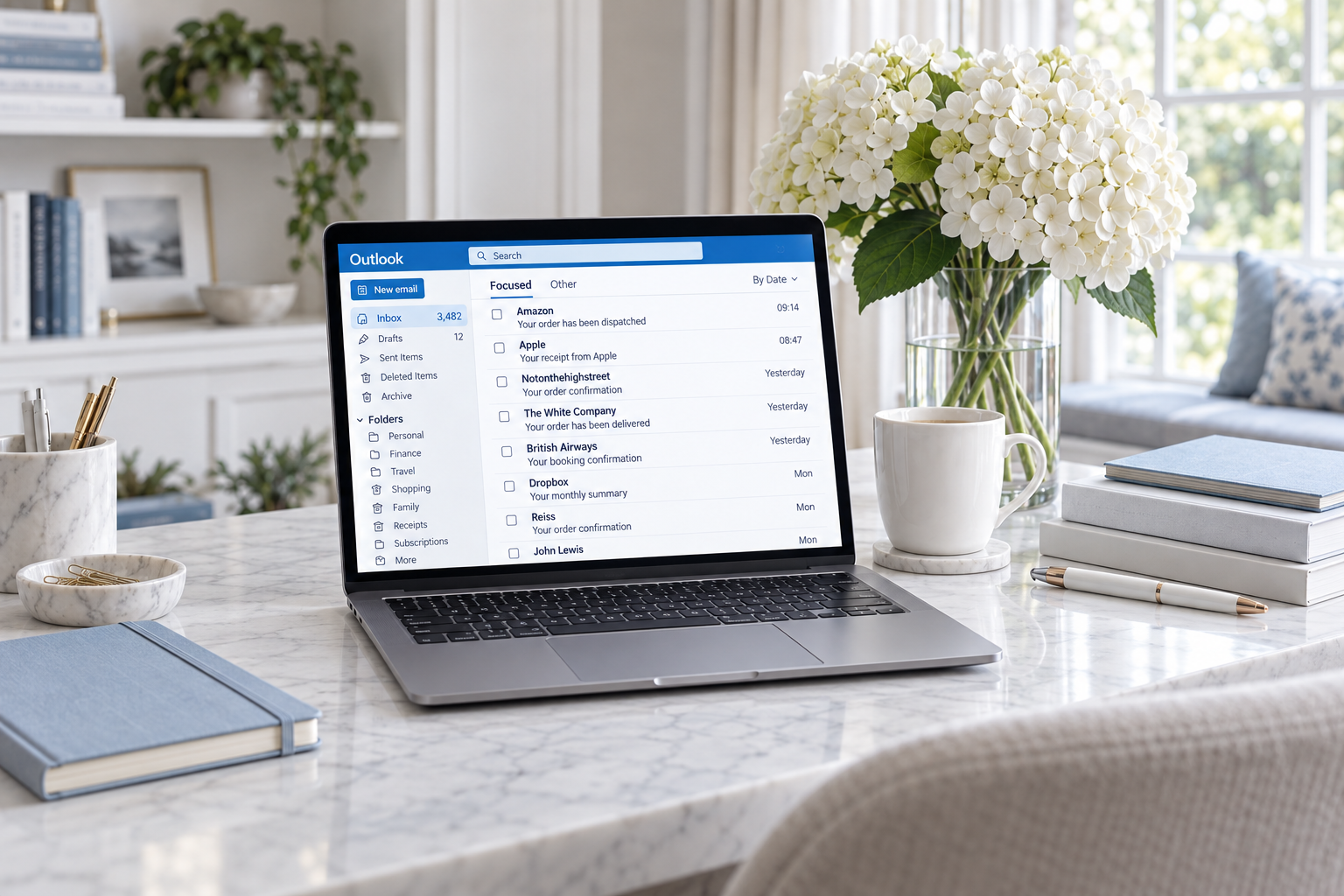
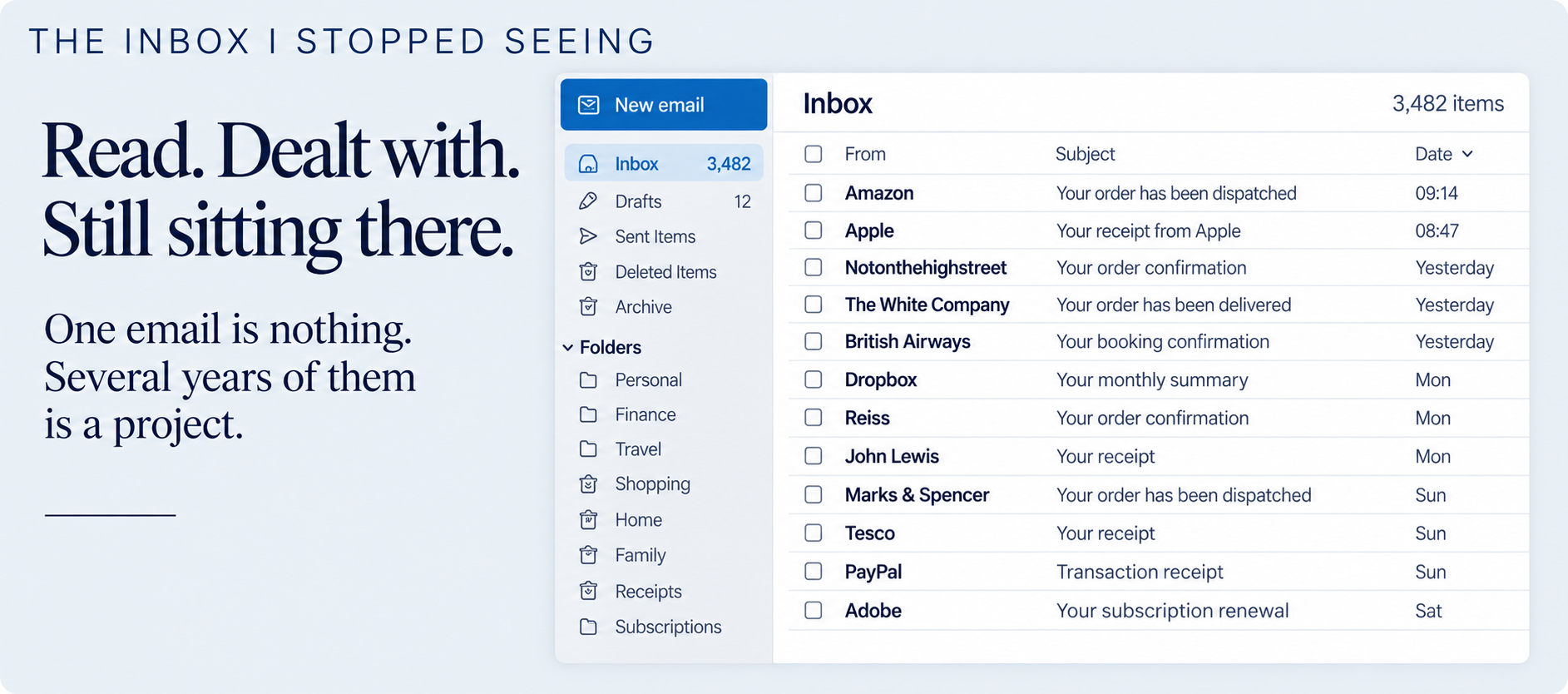
I had thousands of emails in my inbox.
Not thousands of emails I needed to answer. That would have been considerably more alarming.
These were emails I had already read, dealt with and then left sitting there because, apparently, clicking “file” was one administrative task too many.
The slightly ridiculous thing is that I am meticulous about my work inbox. Emails are filed. Folders are organised. I know where things are. My personal inbox, on the other hand, had quietly become the administrative equivalent of that drawer everyone has somewhere in the house: nothing in it is necessarily a problem, but opening it makes you feel vaguely guilty.
For three or four years, life had simply been too busy. Filing personal emails was never important enough to make it to the top of the list. There was always something more urgent to do, and because I had actually dealt with the emails, there was no immediate consequence to leaving them where they were.
One unfiled email is nothing.
Several years of them is a project.
Eventually, there were so many that the idea of sorting them manually was faintly absurd. I wanted my personal email to work the way my professional inbox did, but I certainly wasn't volunteering to spend a weekend clicking through thousands of old Amazon receipts to achieve it.
Then I had one of those thoughts that increasingly gets me into interesting situations:
I wonder if ChatGPT can do this?
I didn't ask it to reinvent my inbox
This is the part I think matters.
I already had folders in Outlook. I didn't need AI to design an elaborate new productivity system involving 47 colour-coded categories and a morning email ritual I would faithfully follow for approximately four days.
I wanted it to work with the system I already had.
So I connected my personal Outlook account to ChatGPT and asked it to look at the emails sitting in my inbox against the folders that already existed.
Then it started doing the bit I really didn't want to do myself.
It analysed what was there, grouped similar emails together and suggested where they could safely be filed. If there wasn't an appropriate existing folder, it could suggest one rather than quietly inventing an entirely new filing philosophy on my behalf.
The results were remarkably accurate.
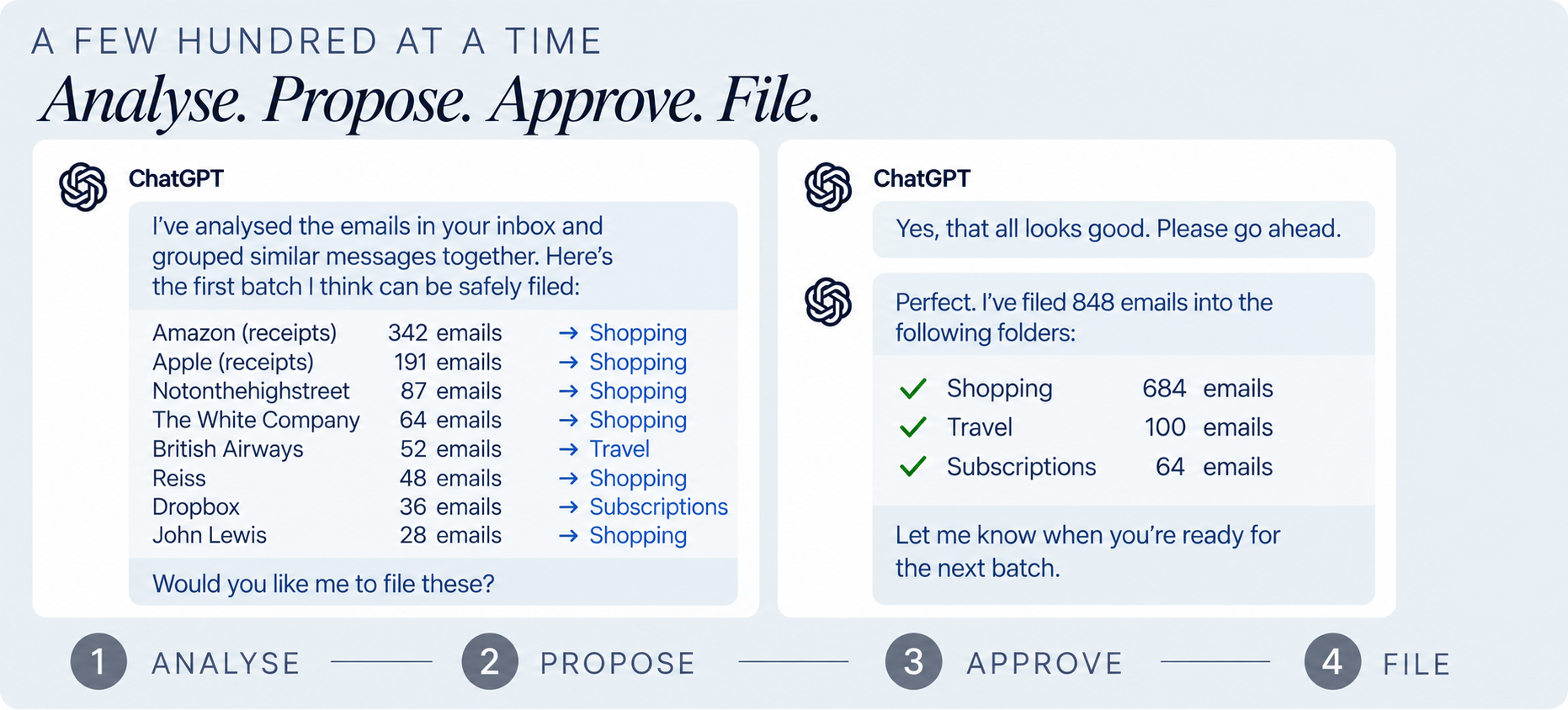
It would come back with something along the lines of: there are this many Amazon emails, this many Apple emails, these are shopping receipts, these messages belong together and I think this group can safely be filed here.
Suddenly, I wasn't making hundreds of tiny filing decisions.
I was reviewing one sensible proposal.
That is a very different job.
I still had to approve it
ChatGPT didn't simply sweep through several years of my personal email while I went off to make a coffee and hope for the best.
It proposed a batch first.
I could see what it had found, how it had categorised the messages and where it thought they should go. Only once I was happy with that did I approve the filing.
Then it got on with it.
Fast.
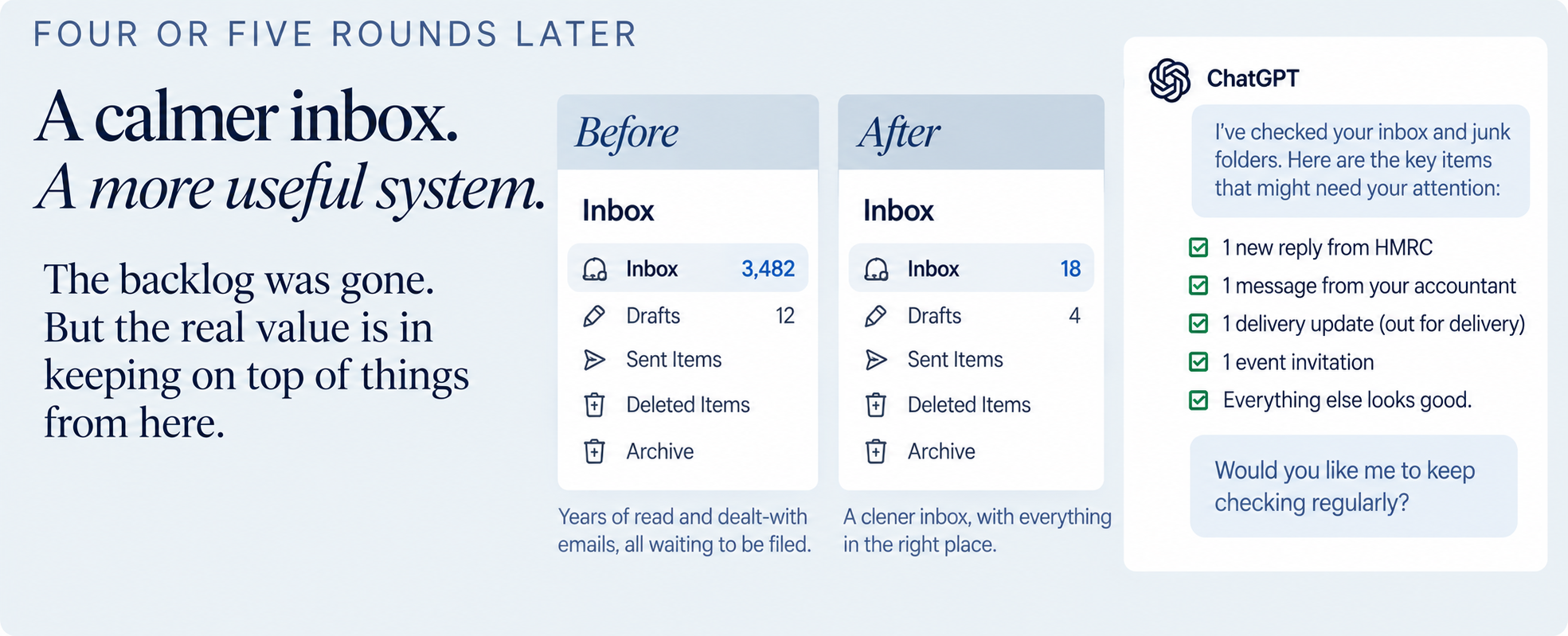
The first time you watch a few hundred emails that have been sitting in your inbox for years disappear into the correct folders after one approval, it is deeply satisfying!
We repeated the process. Another batch. Another breakdown. Another approval.
I think it took perhaps four or five rounds in total.
What had felt like a job sufficiently tedious that I had successfully avoided it for several years was suddenly done.
Nothing went wrong. I didn't discover that my Amazon receipts had been filed under family photographs or that an important email had vanished into some mysterious AI-created folder called “Miscellaneous 2”.
It just worked.
I almost resented how quickly it worked, given how long I had been ignoring the problem.
The approval step is the bit I wouldn't remove
There is a version of AI productivity that seems to assume the ultimate goal is to have the AI do absolutely everything without bothering you.
That isn't particularly appealing to me.
I didn't want ChatGPT deciding, without supervision, what should happen to years of personal correspondence. I wanted it to do the tedious analytical work that I didn't have the time or inclination to do, then bring me a decision that was easy to review.
That is the distinction.
Instead of:
read email → decide category → find folder → file email
repeated hundreds and hundreds of times, my job became:
Does this batch make sense? Yes. Approved.
I retained the judgment. ChatGPT removed most of the friction.
For me, that is a much more interesting use of AI than trying to remove the human from the process altogether.
The best bit came afterwards
Clearing the historic backlog was satisfying, but it turned out not to be the most useful part of the experiment.
Once my inbox was organised again, I could use ChatGPT to help keep it that way.
I now have it check my inbox and junk mail for things I may have missed or that need my attention. That has genuinely caught replies I had been waiting for before I had spotted them myself.
This is particularly useful because email has an irritating habit of mixing the thing you have been waiting three weeks to receive with seventeen things you did not ask anybody to send you.
ChatGPT can help separate the two.
Instead of my having to repeatedly scan the inbox thinking, I'm sure somebody was supposed to reply to me about something, I can ask it to look.
That alone is useful.
Then I discovered something I use even more.
Searching my email became conversational
Outlook already has a search function. I am aware of this.
Unfortunately, knowing that a search box exists and persuading it to find the obscure piece of information you vaguely remember receiving six months ago are not always the same thing.
I have spent far too long trying combinations of someone's name, half a subject line and a word I am almost certain appeared in an email, only to be presented with 93 messages that are definitely not the one I want.
With ChatGPT, I can ask for the information, rather than trying to remember the email containing it.
That difference has been unexpectedly useful.
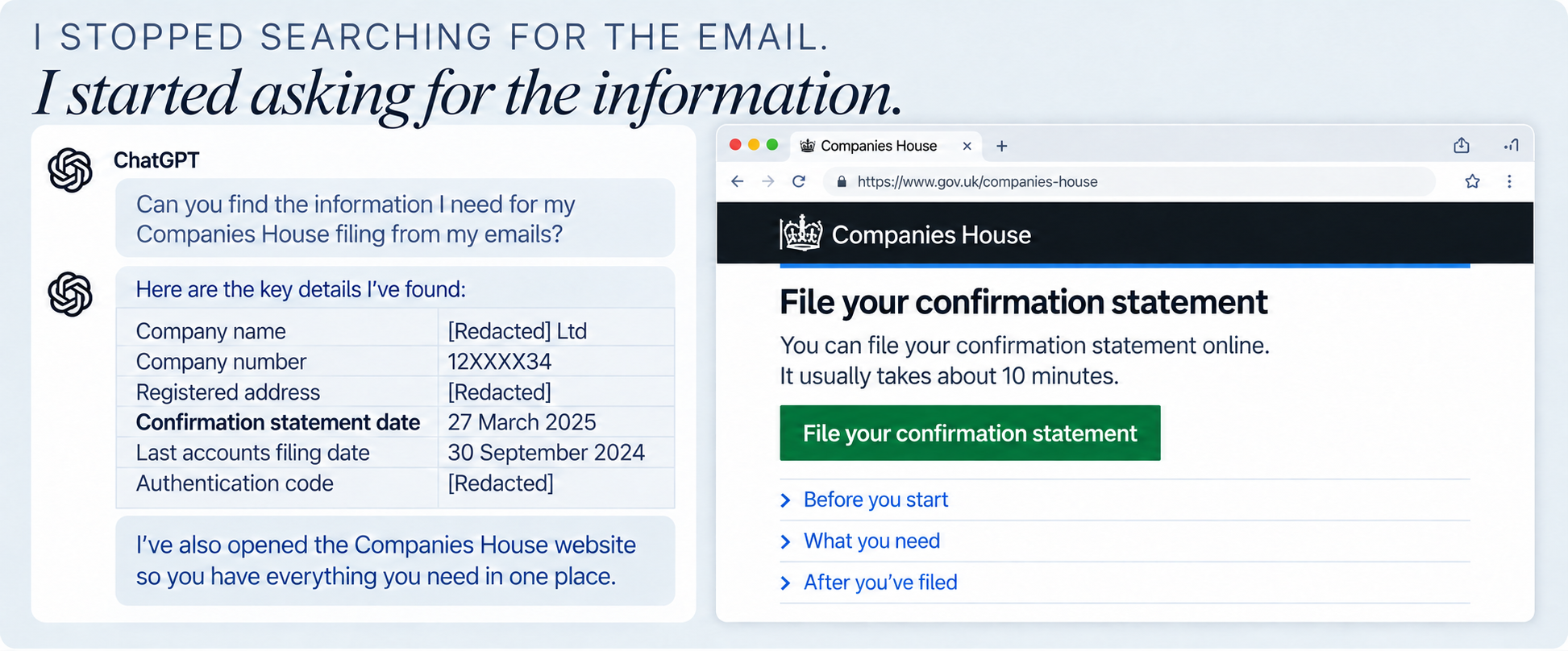
Recently, I had Companies House filings to complete. The information I needed was scattered across emails and records I had received previously.
Rather than stopping what I was doing, searching through Outlook, opening likely messages and extracting the relevant details one by one, I asked ChatGPT to find what I needed.
Within seconds, it had surfaced the relevant information.
I could have the Companies House website open and the information I needed available alongside it, then simply work through the filing.
A task that could easily have turned into “Where on earth is that email?” became a fairly straightforward piece of admin.
This is not revolutionary technology saving humanity.
It is arguably better.
It saved me from spending half an hour looking for an email.
I don't really want another productivity system
There is a theme emerging in the ways I find AI most useful.
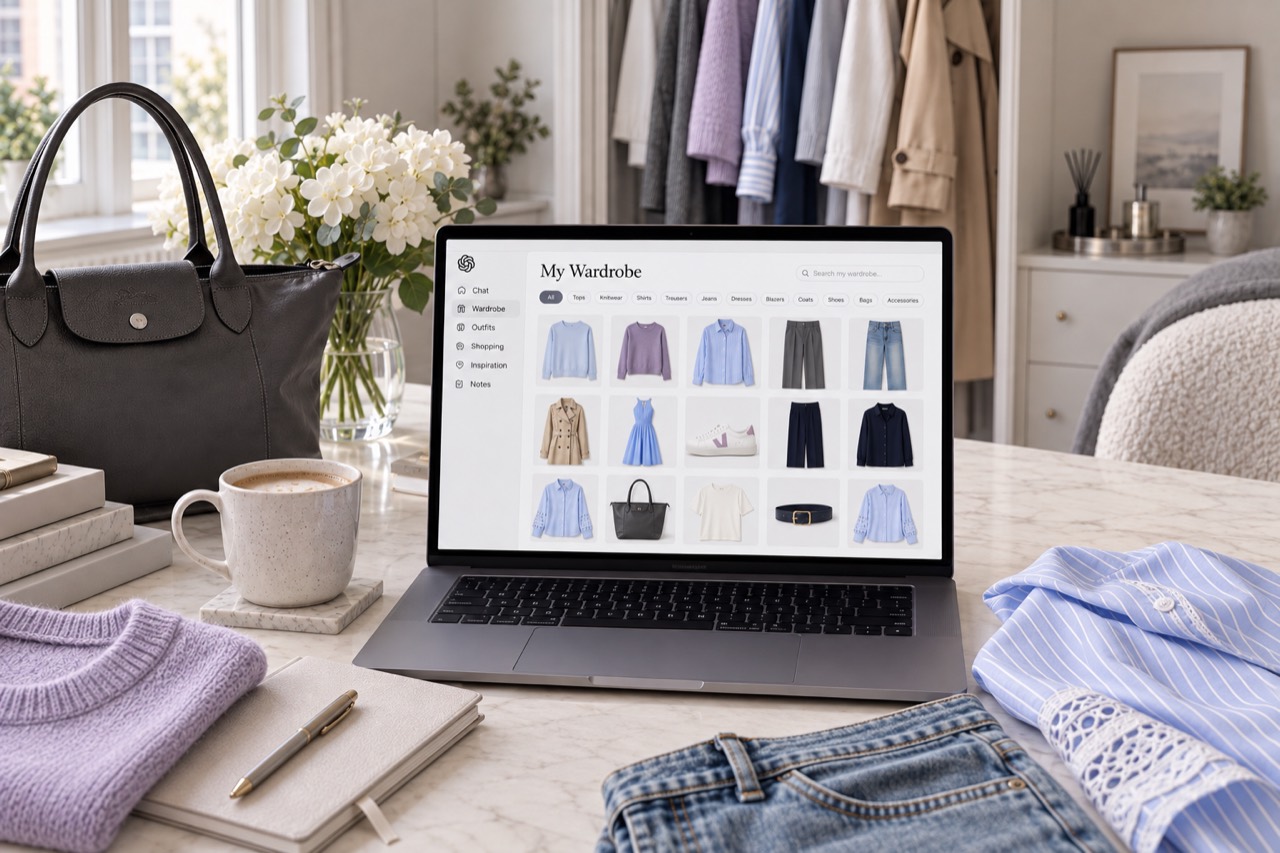
With my wardrobe, the breakthrough wasn't asking ChatGPT to invent outfits for an imaginary version of me. It was giving it the clothes I actually own.
With email, the breakthrough wasn't asking it to create the world's most sophisticated inbox-management system. It was giving it the folders and messages I already had.
The starting point was real life.
That matters because I don't particularly want technology creating more systems for me to maintain. I have enough systems. I have enough apps. I definitely have enough things that would apparently transform my life if only I remembered to update them every morning.
What I want is for technology to make the things I already need to do less laborious.
My email folders already worked.
I simply didn't have the time to spend hours putting several years of messages into them.
ChatGPT did.
The personal admin is often the stuff that slides
I think this is partly why the whole experiment felt so useful.
At work, I am organised because I have to be. Professional emails need dealing with. Deadlines matter. Filing matters. There is a structure around all of it.
At home, the consequences of leaving an Amazon receipt sitting in an inbox are considerably less dramatic.
So the personal admin slides.
Not because we don't know how to organise it, but because there is always something more important competing for the same half hour.
Eventually all those insignificant little jobs accumulate into something that feels disproportionately difficult to fix.
There is a tendency to answer that problem by telling people they need better habits.
Sometimes, perhaps.
Other times, I think we are allowed to admit that manually filing three years of old shopping receipts is simply not the highest and best use of anybody's Saturday night.
If AI can take the boring part and leave me with the decisions that actually require me, I am very happy to let it.
What I would do differently if I were starting now
I wouldn't wait three or four years!
More importantly, I would use exactly the same principle again: start with a bounded task and keep an approval step.
I wouldn't begin with, “Please organise my entire digital life.”
I'd begin with something specific:
Look at what is sitting in this inbox. Compare it with the folders I already use. Tell me what you think can safely be filed and where. Show me the proposed batch first.
Then review it.
If the suggestions make sense, approve them.
Once you know the system is behaving as expected, move to the next batch.
It isn't as exciting as handing an AI your inbox and telling it to sort out your life.
It is considerably more sensible.
The bigger lesson wasn't really about email
Clearing the inbox gave me the satisfying before-and-after moment, but it isn't why I still use the system.
I use it because email has become easier to interrogate.
Find the reply I was waiting for.
Check whether I've missed anything important.
Find the details I need to complete this form.
Show me the relevant information without making me remember which email contained it.
That is a much more useful relationship with an inbox than simply achieving the mythical state of Inbox Zero.
I don't particularly care whether there is a beautiful 0 sitting beside the word Inbox.
I care that I can find what I need, see what requires my attention and avoid wasting time on administrative work that a computer can do considerably faster than I can.
The inbox is organised now.
More importantly, it is useful again.
Although I will admit that watching several years of emails disappear into their proper folders was extremely satisfying.
I am only human.