There is a particular kind of satisfaction in building a system that promises to make your life easier. Everything has a place, repetitive jobs are handled, things move neatly from one stage to the next and future you appears to be heading towards a life of effortless efficiency with very little admin, an organised inbox and, presumably, excellent posture.
Future me is sometimes less impressed.
Not long ago, I built a content workflow that was supposed to take an idea through research, development and drafting with rather less intervention from me. In theory, one stage would finish, the next would begin automatically and I would step back in at the appropriate points to review what had been produced.
In practice, not long after I started testing it, I realised I was going to miss my own deadline because the system I had built to save time was sitting there doing absolutely nothing until I manually pushed it into the next stage.
“Has it moved on yet?”
No.
“What is happening now?”
Still nothing.
At this point, the system was displaying all the initiative of a teenager being asked to empty the dishwasher.
This was not quite the productivity breakthrough I had envisaged.
The technical part genuinely had failed because jobs that were supposed to move automatically simply were not moving. There was another problem too, and that one was mine. I had tried to automate too much of the process, including parts where my own judgement was not an irritating human delay to be removed, but actually the point.
I had built three stages where I really needed to be involved, then designed the system so that I was properly brought back in for only one of them. In other words, I had somehow managed to automate both the admin I wanted rid of and some of the thinking I actually needed to keep, which is quite an efficient way of making everything worse.
So I took it back to basics. Now I review what comes back, think about it, decide what is useful, what is missing, what I agree with and what I do not, then pass it to the next stage with my own thoughts attached.
It is less automatic.
It is also, rather inconveniently for the original grand plan, much quicker.
The point is not to automate everything
I think this is where a lot of systems go wrong. We start with the perfectly sensible goal of removing unnecessary work, then somewhere along the way that quietly becomes removing every possible human step, as though the presence of an actual person is itself evidence that the system has failed.
Those are not the same thing.
The point is not to automate every part of a process. The point is to automate the parts that do not need you. There is a huge difference between repetitive admin and personal judgement, and one of the things I am learning is that the latter is often exactly where the value sits.
Filing something into the right folder does not need much of me. Deciding whether an idea is actually good, whether it sounds like me, whether it is useful or whether it deserves making at all absolutely does.
That pause where I look at something and think, no, technically correct but absolutely not, is not inefficiency.
It is the work.
You can automate the process around your judgement. You cannot automate the part that makes the judgement yours. Unfortunately, there is currently no setting marked “make the same decisions I would make, but save me the bother of making them”.
I have checked.
Some systems are worth the effort
My wardrobe catalogue is probably the best example of a system that required quite a lot of effort at the beginning and has absolutely earned it back.
I photographed clothes I already owned or saved the product images online, added the relevant information and gradually built a catalogue of my actual wardrobe. It was not instant and there was a fair bit of work involved, but that work was largely finite, which makes all the difference.
Now, when I buy something new, I save the images, give Work the details and it gets added to the catalogue. Most of the heavy lifting has already been done, so the maintenance is tiny compared with the amount I use it.
The useful part is not that AI dresses me, because it does not. I still decide what I want to wear and I still reject suggestions because something is in the wash, I wore it recently, I do not fancy it that day or I have decided at 10pm that tomorrow’s weather forecast is clearly an act of fiction.
If it is late the night before an office day and I am tired, I can ask for a few suggestions. It can remind me what I have worn recently, suggest combinations I might not immediately think of and give me somewhere useful to start, which is considerably better than standing in front of the wardrobe hoping inspiration will eventually take pity on me.
Then we have a conversation.
“I do not fancy that.”
“That is in the wash.”
“I want to wear the navy trousers instead. What would work with those?”
The catalogue removes some of the thinking without trying to replace my taste. That, to me, is exactly what a useful system should do.

It does not make the decision for me. It means I do not have to start every decision from scratch, which is a much more useful ambition and also rather less unsettling.
The best systems often remove the boring bit
My inbox system is useful for an even less glamorous reason.
It files things.
Thrilling, I know!
I am actually very methodical about email filing at work. Personal email is different. When time is tight, filing my own emails is always going to lose against almost anything else, so hundreds and then thousands of dealt with emails accumulated.
I knew they were there. They had been read. They had been dealt with. They were just sitting in the inbox, quietly offending me.
I hate clutter, including digital clutter, so this was deeply irritating while also never quite important enough to spend an evening fixing. There are many things I am prepared to sacrifice an evening for. Manually filing 1,000 old emails ranks somewhere below descaling the kettle.
Now, most of that repetitive filing can happen without me manually dragging each message into the right place. The system is deliberately cautious, which I prefer. I would much rather a small group of emails remain unfiled than have something enthusiastically disappear into a folder nobody has ever heard of.
It also turns out that AI is often much better at finding things than the inbox search itself. I can ask it to locate an old receipt, insurance details or a particular message I vaguely remember receiving months ago and, invariably, it does a better job than me staring at a search box trying to remember whether the insurer used the word “renewal”, “policy” or some completely unhelpful subject line like “Important information”.
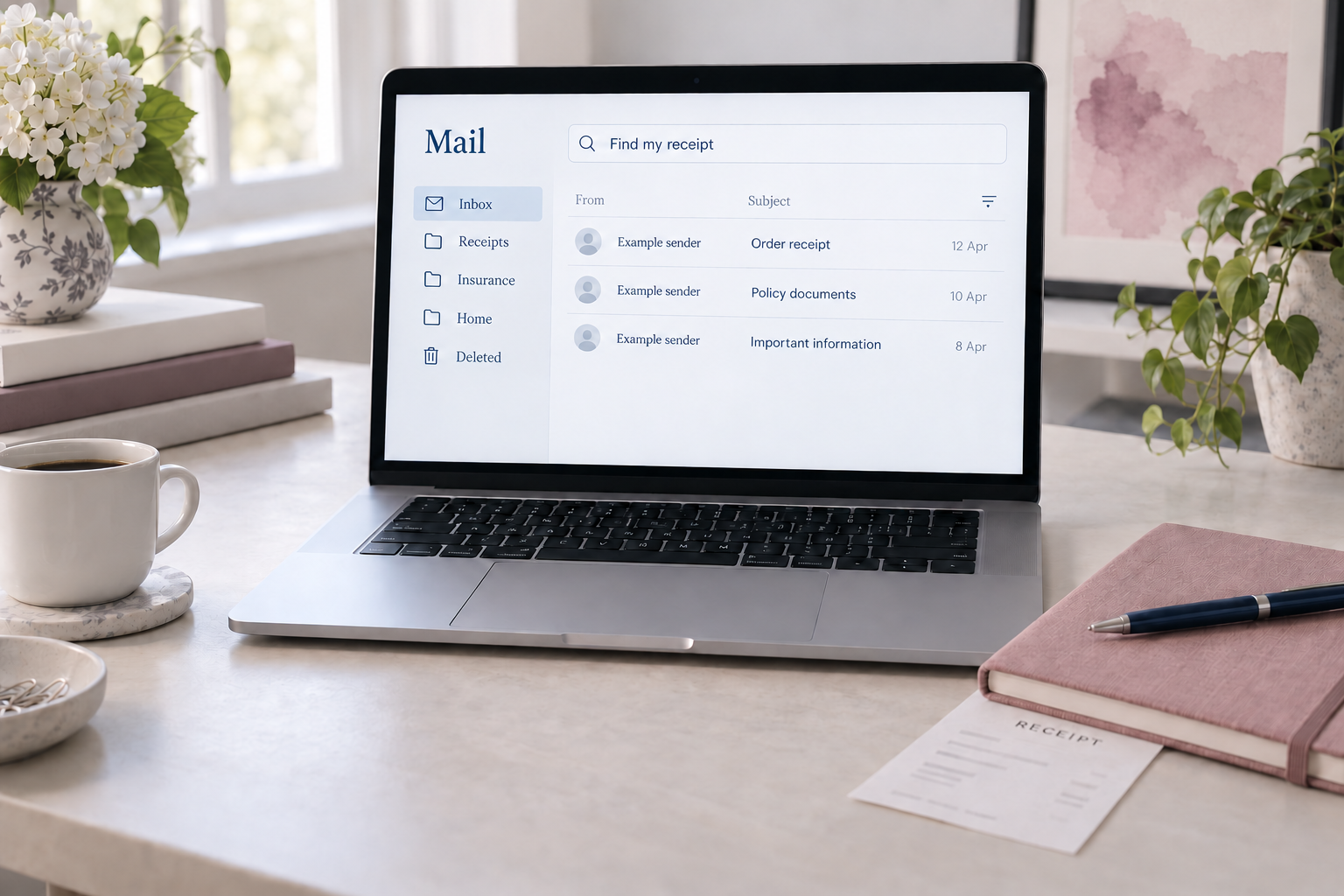
A good system does not have to remove you completely. Sometimes it just needs to remove the boring part and leave you with the judgement.
That is a recurring theme, which is slightly annoying because it suggests there may actually be a lesson in all of this.
Useful does not have to mean impressive
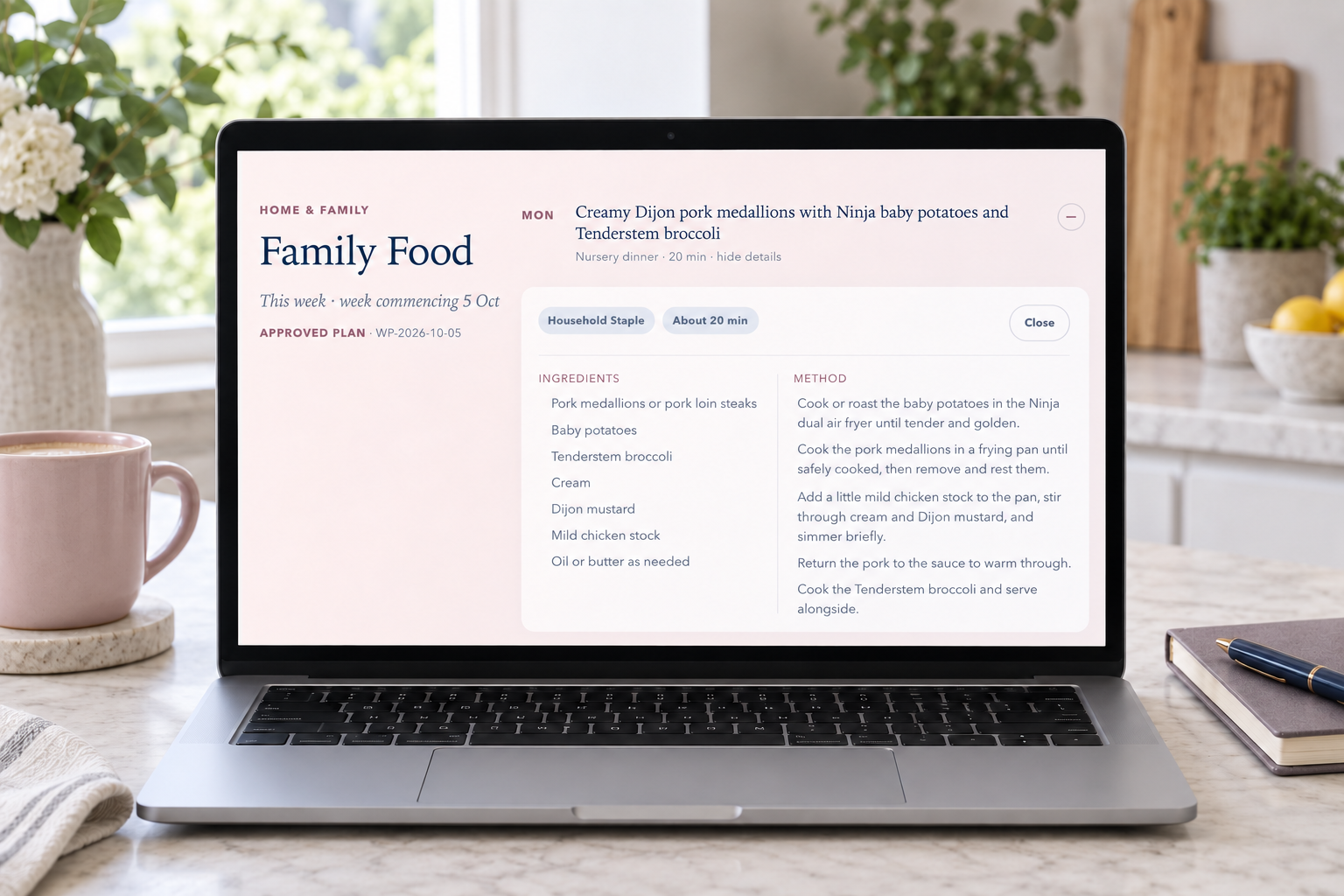
My family meal planner is another example. There is nothing especially dramatic about it. I open my personalised app and the first page tells me what we are eating that day, what ingredients I need and how to make it.
That is it, and that is also exactly why it is useful.
I am not hunting through photographs of recipes, old messages, screenshots or saved links at five o'clock trying to remember what I had apparently planned when I was feeling much more organised three days earlier.
What day is it? What are we eating? What ingredients do I need? What is the method?
Done.
It looks pretty too, and I am not going to pretend that does not help.
There is a tendency to treat aesthetics as somehow frivolous when we talk about organisation, as though anything genuinely useful should ideally resemble a tax return. I disagree. If I enjoy looking at something, I am more likely to use it. A useful system that also looks nice has not committed a moral failing.
Frankly, if I am going to be told it is chicken curry tonight, I would at least like the news delivered attractively.
Then there are the systems still on probation
EKOS is currently the system I most want to love. When it works, it is brilliant. The family meal planner sits there, tasks can be surfaced and information is gathered in one place. In theory, it acts rather like a personal chief of staff.
In theory!
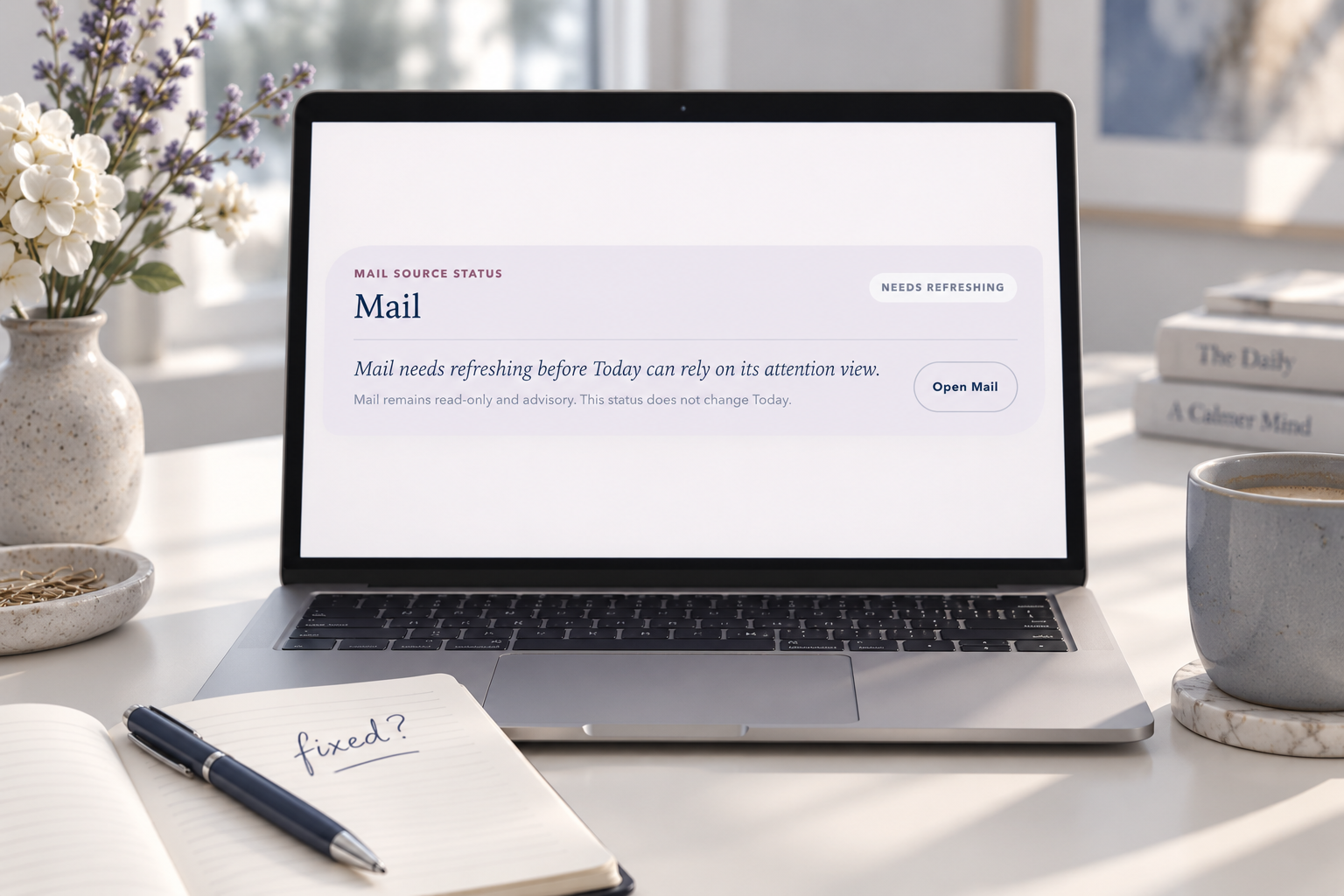
There are still parts that fail often enough to stop me fully trusting them. Something will be fixed, appear to work and then quietly break again later. I find myself going back to Work and saying, essentially, “We definitely fixed this last week. Why are we here again?”
At the moment, it works 70% of the time, every time.
I am determined it will eventually work properly because the potential is enormous. I am also not prepared to call a system successful simply because I can imagine how useful it would be if all the bits worked. By that logic, I am also fluent in Italian because I can imagine how useful that would be.
Potential is not the same as usefulness.
There is a difference between something being clever in theory and something actually making Tuesday easier.
That second one is the one I care about.
The busy week test
I think this is probably the test I care about most now. A system can look extremely impressive when you have plenty of time to maintain it, tweak it, review it and gently encourage it towards competence.
The interesting question is what happens when you do not.
Does it still help when work is busy, someone needs something from you, dinner needs making and you have approximately fourteen minutes of functioning brain left? Does it reduce decisions? Does it remove a repeated task? Does maintaining it become easier over time, or does it need constant feeding, checking and rescuing?
There comes a point where the productivity system itself needs its own productivity system.
That is usually a clue.
I do not mind doing a lot of work once if I know the benefit will recur. The wardrobe catalogue is a perfect example. The setup was substantial, but the ongoing maintenance is tiny compared with the value I get from it.
What I am much less interested in is a system that demands the same level of attention forever. If the thing designed to save ten minutes requires a weekly rescue mission, the maths is not especially persuasive.
This is also why I am becoming much more suspicious of complicated systems simply because they look sophisticated. Complexity can be useful, of course, but it can also be very well dressed admin wearing a lanyard.
Not all friction is bad
This may be the part we forget most often. We talk about friction as though every pause, decision and human intervention should be removed, when some friction is exactly where the value lives.
When I review a piece of content before it moves to drafting, I am not wasting time. I am deciding whether the idea is strong enough, whether the evidence supports it, whether the angle is right and whether it sounds like something I actually want to say.
That cannot sensibly be delegated away because my judgement is part of the output.
The same applies elsewhere. AI can suggest an outfit. I still decide whether I like it. It can organise information. I still decide what matters. It can surface options. I still choose.
That is not a failure of automation. That is the point.
We should not be automating away the parts of ourselves that make the work ours in the first place. Personal judgement is not an unfortunate obstacle between the system and perfect efficiency. It is the differentiator.
The systems I value most are not the ones that try to replace me. They are the ones that remove enough noise for me to spend my attention on the parts that genuinely need it.
So now, before I become too impressed by a clever new workflow, I ask a much less glamorous question.
Is this actually making life easier, or have I just built myself another job?