Actually Useful AI
How I Taught AI to Write Like Me, Without Trying to Describe How I Write
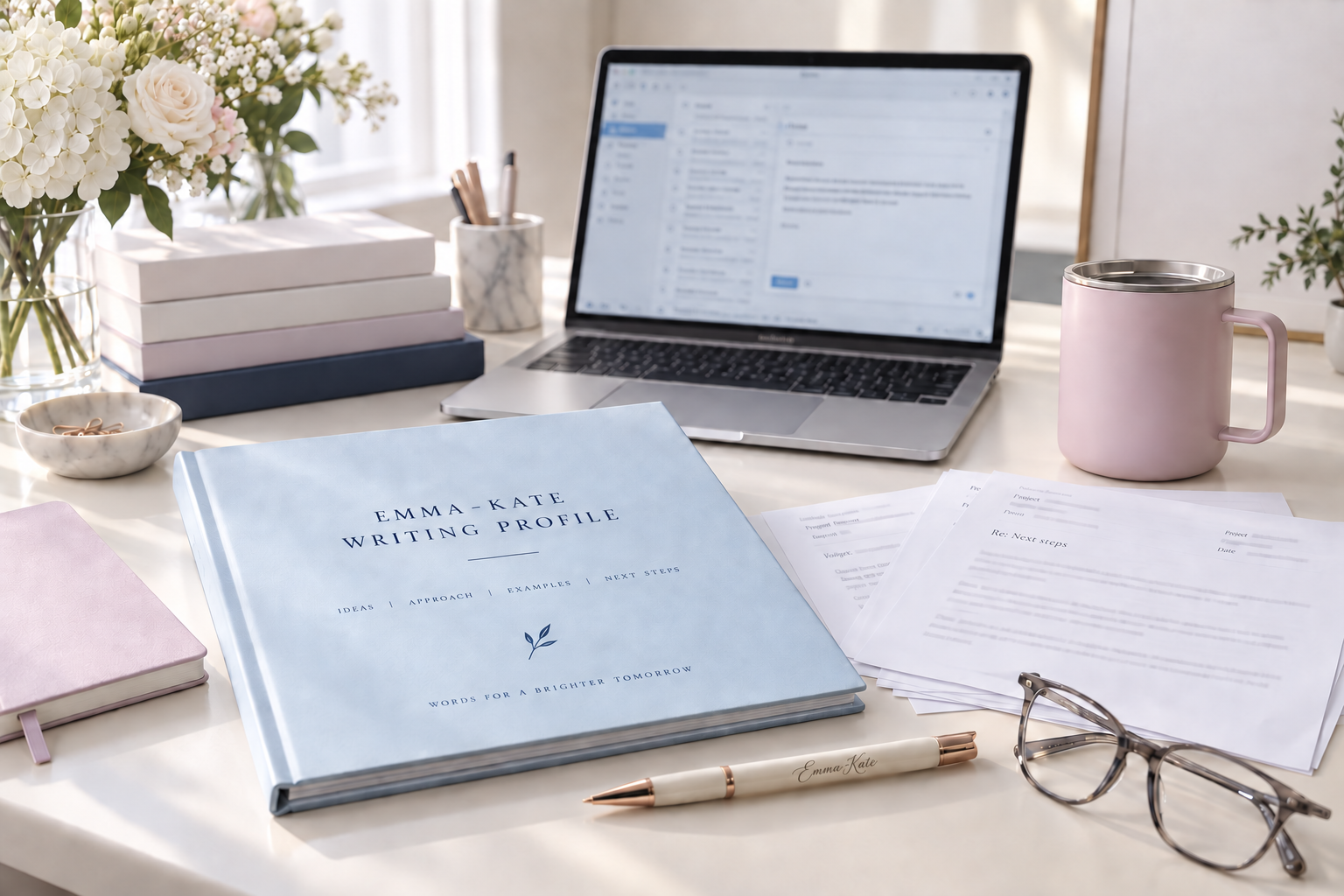
One of the most useful things I’ve learnt about AI is that a good instruction will only get you so far. You can tell it to be warm but professional, ask for British English, explain that you prefer concise emails and give it a list of phrases you dislike. The result will probably improve, but there is still a fairly fundamental problem: you’re relying on your ability to describe something you probably do instinctively.
That was the problem I kept running into. AI could draft a perfectly competent email, but there was often something slightly off about it. Nothing was necessarily wrong. It just wasn’t quite how I would have written it.
Then it occurred to me that I already had an enormous body of evidence showing exactly how I write. It was sitting in my Sent folder.
So instead of trying to write an increasingly elaborate prompt explaining my style, I gave AI a different job: study a substantial sample of emails I had actually written, work out the patterns and create a detailed profile that could teach another AI to write like me.
That worked astonishingly well.
I let the evidence do the talking
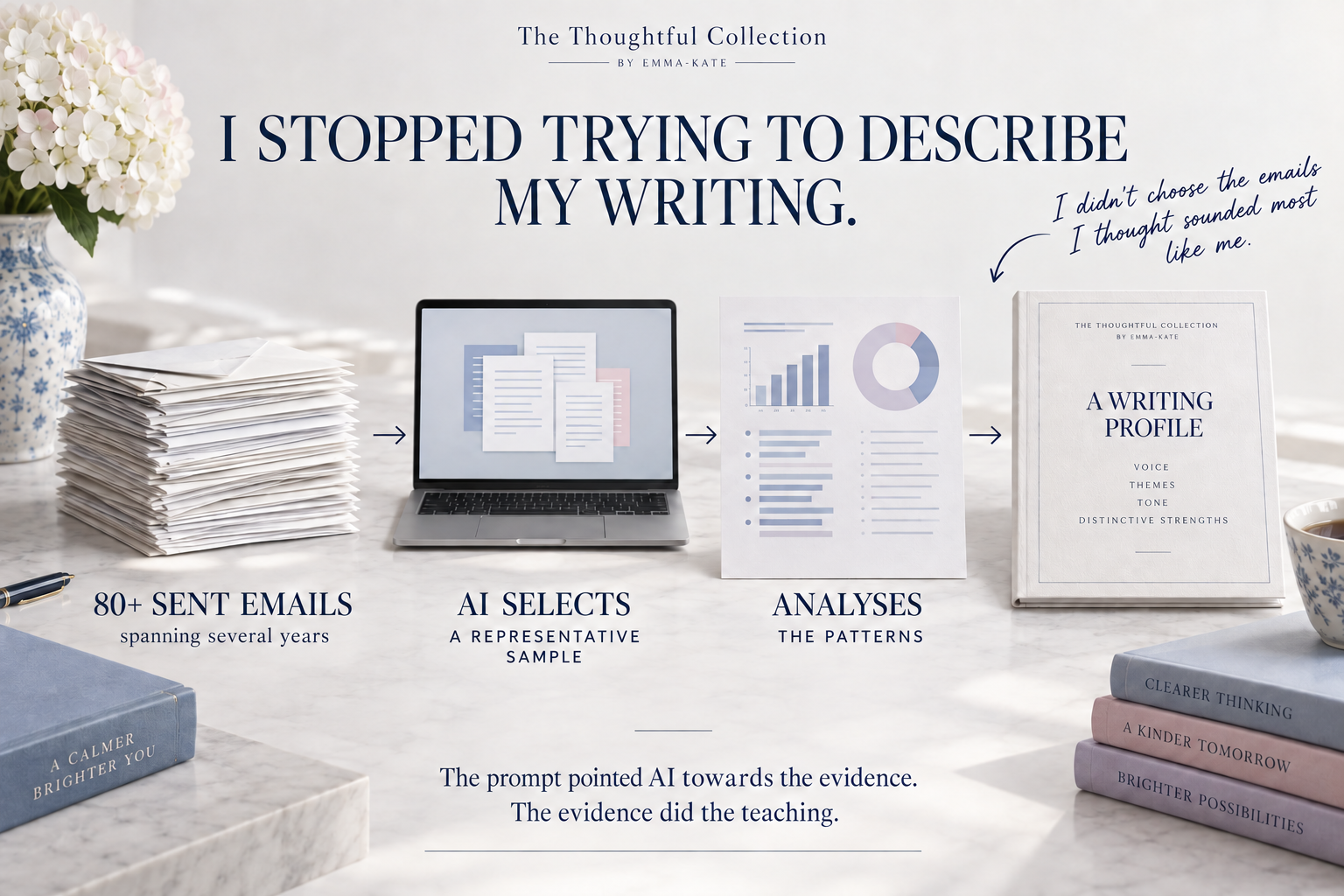
I first experimented with this using Copilot at work. I asked it to review at least 80 emails from my Sent folder, spanning several years. Importantly, I didn’t handpick 80 beautifully written emails that I thought represented Emma-Kate at her finest. I asked Copilot to make its own selection from the correspondence available to it.
That mattered because I wasn’t really interested in teaching AI how I thought I wrote. I wanted it to find out how I actually wrote.
If I had selected all the examples myself, I would inevitably have introduced my own assumptions. I might have chosen the emails I was particularly pleased with or unconsciously selected examples that supported things I already believed about my style. A much broader sample gave the AI an opportunity to spot patterns I wasn’t consciously aware of.
I then asked it to turn those findings into something more useful: a detailed writing profile designed specifically to teach other AI systems how to draft in my voice.
This wasn’t a case of prompts suddenly becoming irrelevant. I absolutely used a prompt. The difference was what I asked the prompt to do.
I wasn’t trying to squeeze my entire personality into an instruction box. I was using the instruction to point AI towards the context from which it could learn.
Apparently, I don’t have one writing style
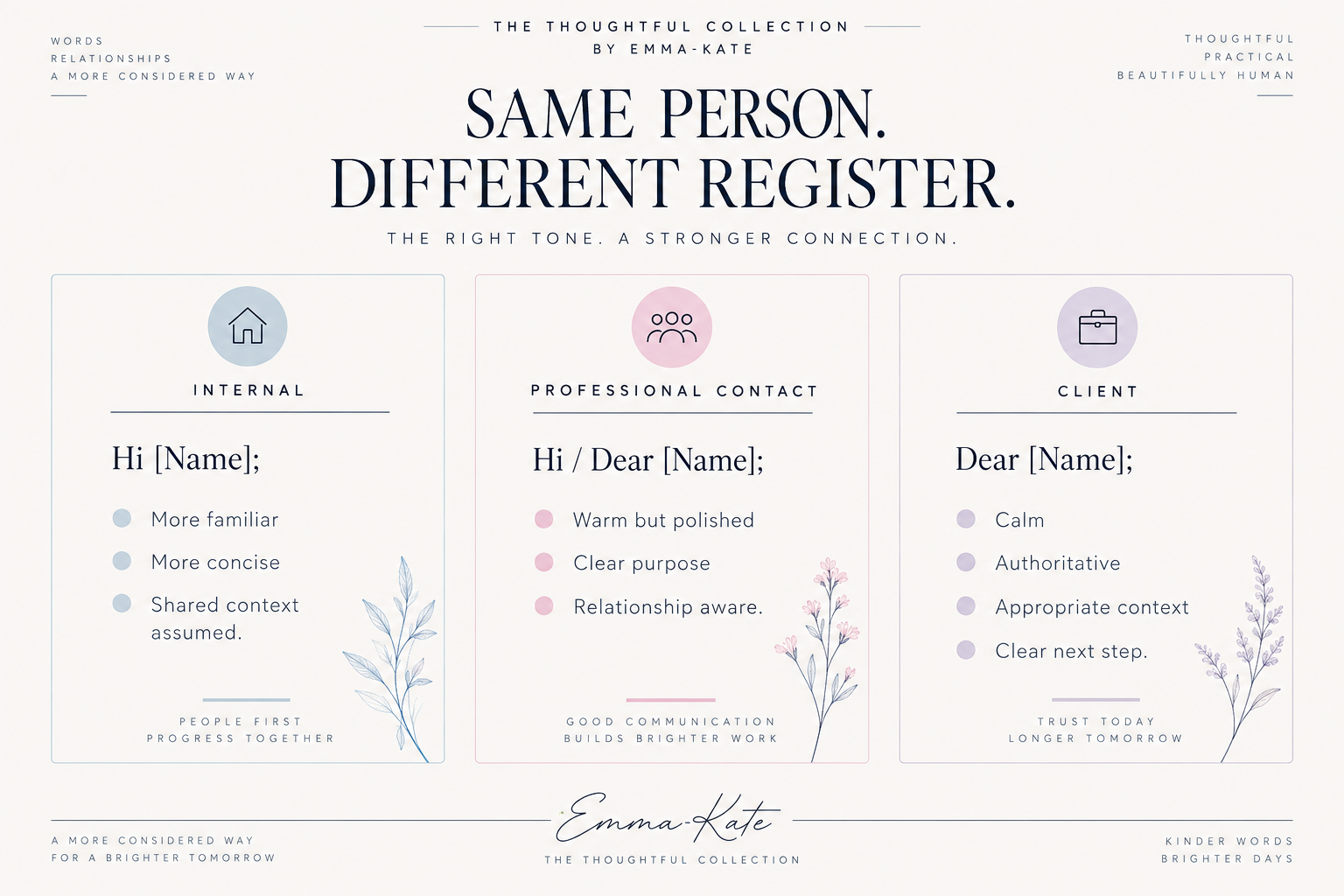
One of the most useful things the analysis discovered was something that sounds obvious once you say it aloud: I don’t write to everybody in exactly the same way.
Of course I don’t.
An email to somebody I work with every day shouldn’t sound exactly like an email to a client. The way I write to a professional contact isn’t identical to the way I write internally. They are all recognisably me, but the register changes according to the relationship.
Copilot was able to identify those differences from the correspondence itself. It picked up how I opened emails in different contexts, how I signed them off, how much explanation I tended to give and the sorts of phrases I used with different people.
That was far more useful than simply telling it to write in a warm, intelligent and professional way. Quite apart from anything else, that instruction assumes I have the faintest idea how to describe myself objectively.
My Sent folder had evidence.
It learnt details I would never have thought to specify
If I had sat down with a blank sheet of paper and tried to write a guide to my own email style, I could certainly have produced something. I know I prefer British English. I know I dislike unnecessarily formal language. I know there are certain expressions that immediately make me think, AI wrote that.
But I wouldn’t necessarily have thought to document every difference in how I communicate depending on the recipient. I probably wouldn’t have analysed my typical sentence length or thought carefully about when I use contractions. I certainly wouldn’t have remembered every phrase I naturally reach for or every phrase I apparently never use.
AI could find those patterns because it had enough evidence to compare.
That is where context becomes so much more powerful than another increasingly elaborate set of instructions. Instructions contain the things you have consciously thought to tell the AI. Context gives it an opportunity to notice the things you haven’t.
The profile it produced was substantial, around 11 or 12 pages rather than a paragraph I could paste above an email. It covered not just general tone but the practical details that make writing recognisably mine, including different registers, greetings, sign offs, phrasing and language to avoid.
It also taught me something I now think is particularly important: sometimes the most useful information you can give AI is what not to do.
AI has a writing style too
Anyone who uses generative AI regularly will probably have encountered some of its favourite phrases. Left unsupervised, it can become rather fond of language such as “I’m excited to share…”, “thoughtfully curated…” and “designed to empower…”.
There is nothing inherently wrong with those phrases. They just aren’t particularly me.
My current writing profile specifically records language and constructions that should be resisted, alongside the things I genuinely do. It knows, for example, that generic launch enthusiasm, formulaic audience language and over polished warmth tend not to sound like me.
Apparently, part of teaching AI my personality involves giving it an increasingly detailed list of things that irritate me.
This feels entirely on brand.
Negative guidance matters because otherwise you can spend an extraordinary amount of time correcting the same habits. If every draft contains a phrase you would never use, telling AI to remove it fixes that email. Teaching the underlying system that the phrase isn’t characteristic of you fixes something much more useful.
Your past writing is evidence, not law
There is one important catch to asking AI to analyse how you have historically written: it may correctly identify something you don’t actually want it to reproduce.
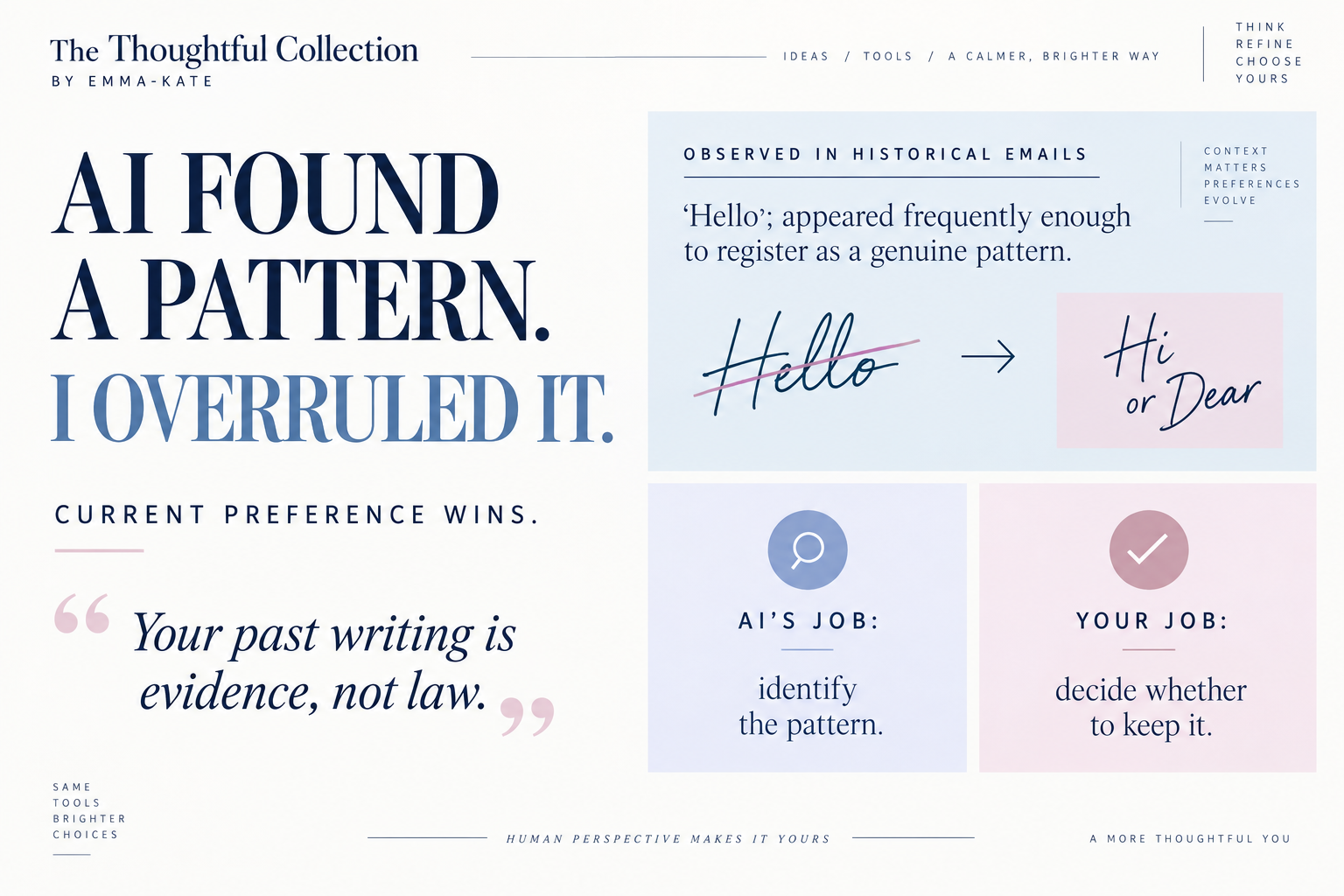
My current writing profile contains a perfect example. A later analysis of one of my personal mailboxes found that I had historically opened a meaningful proportion of emails with “Hello”. The observation was accurate. The conclusion that AI should therefore continue doing it was not.
My explicit preference is now very simple: always “Hi” or “Dear”. Never “Hello”. The current profile therefore preserves the historical finding as evidence but gives my deliberate preference priority.
I think that distinction is essential.
The point of analysing your writing isn’t to fossilise every habit you have ever had. It is to discover patterns that you can then review. Some findings will make you think, Yes, that’s exactly what I do. Others may reveal a habit you want to change. Some may simply reflect the particular sample analysed.
AI gets to observe.
You still get to decide.
The profile became portable
The really useful part came next.
The writing profile wasn’t valuable only inside the AI system that had created it. Once the patterns had been distilled into clear guidance, I could use that context elsewhere.
The approach had worked with Copilot, and I was then able to use the resulting guidance when training Harvey AI to write more like me too. Instead of starting from scratch with every new system and gradually correcting dozens of individual drafts, I had a body of context explaining how I communicate.
The improvement was astonishing. I now need to tweak very little in many AI drafted emails because the first version starts so much closer to something I would genuinely write.
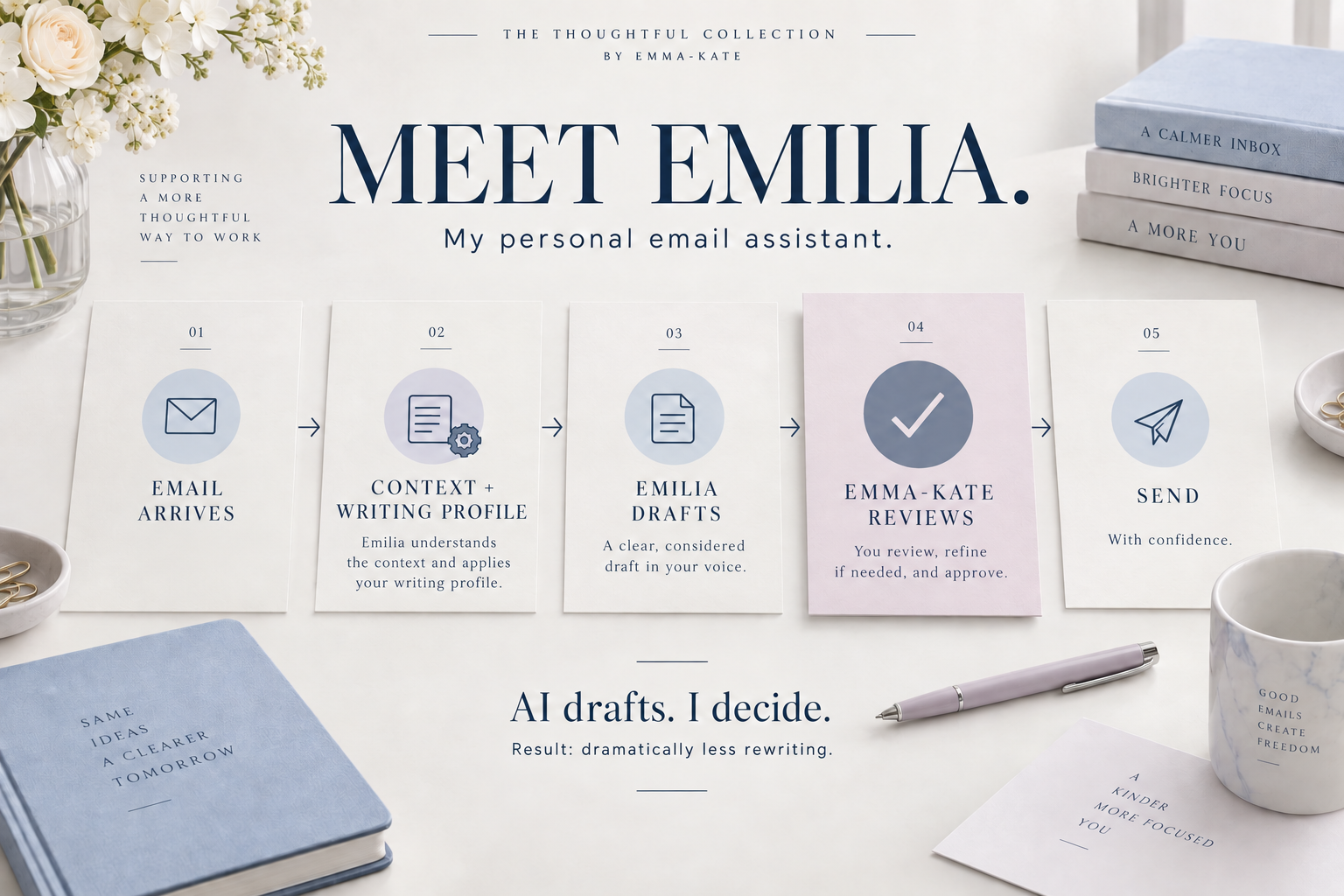
I still read it, obviously. The objective is not to have an AI firing off correspondence while I wander around blissfully unaware of what I have apparently said to people.
I want AI to remove the repetitive work of drafting. I don’t want it to inherit my judgement.
That remains mine.
Then there was Emilia
Eventually, I wanted the same principle applied to my personal email system, which led to Emilia.
Emilia is a play on the word “email”. Yes, I did sit there trying to think of a woman’s name that would make the pun work, and I remain disproportionately pleased with myself!
The name is the frivolous part. The context behind her is what makes her useful.
Emilia doesn’t have to approach every email as though she is meeting me for the first time. She can work from an evolving profile of how I actually communicate, including the distinctions between different types of writing and the explicit corrections I have made along the way.
My current profile describes the core voice as warm, intelligent, natural, direct and quietly confident, but it then goes much further. It distinguishes personal correspondence from creator writing and professional correspondence, with different guidance about warmth, context, directness and structure.
That is much closer to how humans actually communicate. We don’t become entirely different people depending on who receives the email, but neither do we write to everybody as though they occupy exactly the same relationship with us.
The aim isn’t to make AI impersonate you
There is a version of this idea that makes me uncomfortable: give AI enough examples and eventually it can convincingly pretend to be you without your involvement.
That isn’t what interests me.
I want it to understand enough about me to produce a better first draft.
Writing style isn’t simply punctuation, vocabulary and sentence length. It contains judgement. How warm should I be here? Does this person need context or do they already know it? How direct can I be? Is humour appropriate? Does this call for “Hi” or “Dear”? Does the recipient need three paragraphs or three sentences?
The more of that judgement an AI understands, the more useful its draft becomes. But I still decide whether it got the judgement right.
If it doesn’t, I’ve found it much more useful to correct the reason rather than only the sentence. Instead of simply changing the wording and moving on, the better question is: what did the AI misunderstand about how I communicate here?
That learning can then improve the context for next time.
You really don’t need my writing profile
Please don’t use mine.
You may end up sounding like a London lawyer with unusually strong feelings about em dashes.
What is useful is the method behind it.
If you have an AI system with appropriately authorised access to your correspondence, you can ask it to analyse a substantial and representative sample of writing across a meaningful period. In my original experiment, that meant at least 80 emails spanning several years, with the AI making its own selection rather than me cherry picking examples.
If your AI doesn’t have authorised access to your mailbox, the principle still works. You can provide a sufficiently broad collection of safe writing samples yourself, ideally covering different contexts and relationships.
Then ask the AI to analyse rather than imitate. What stays consistent? What changes depending on the recipient? Which greetings do you use? How do you make requests? How warm are you? What phrases recur? Which supposedly helpful AI phrases are conspicuously absent?
Once it produces the profile, review it. Correct it. Test it on something new and refine it when it gets something wrong.
The objective isn’t to build a perfect profile on day one. It is to create context that becomes more useful over time.
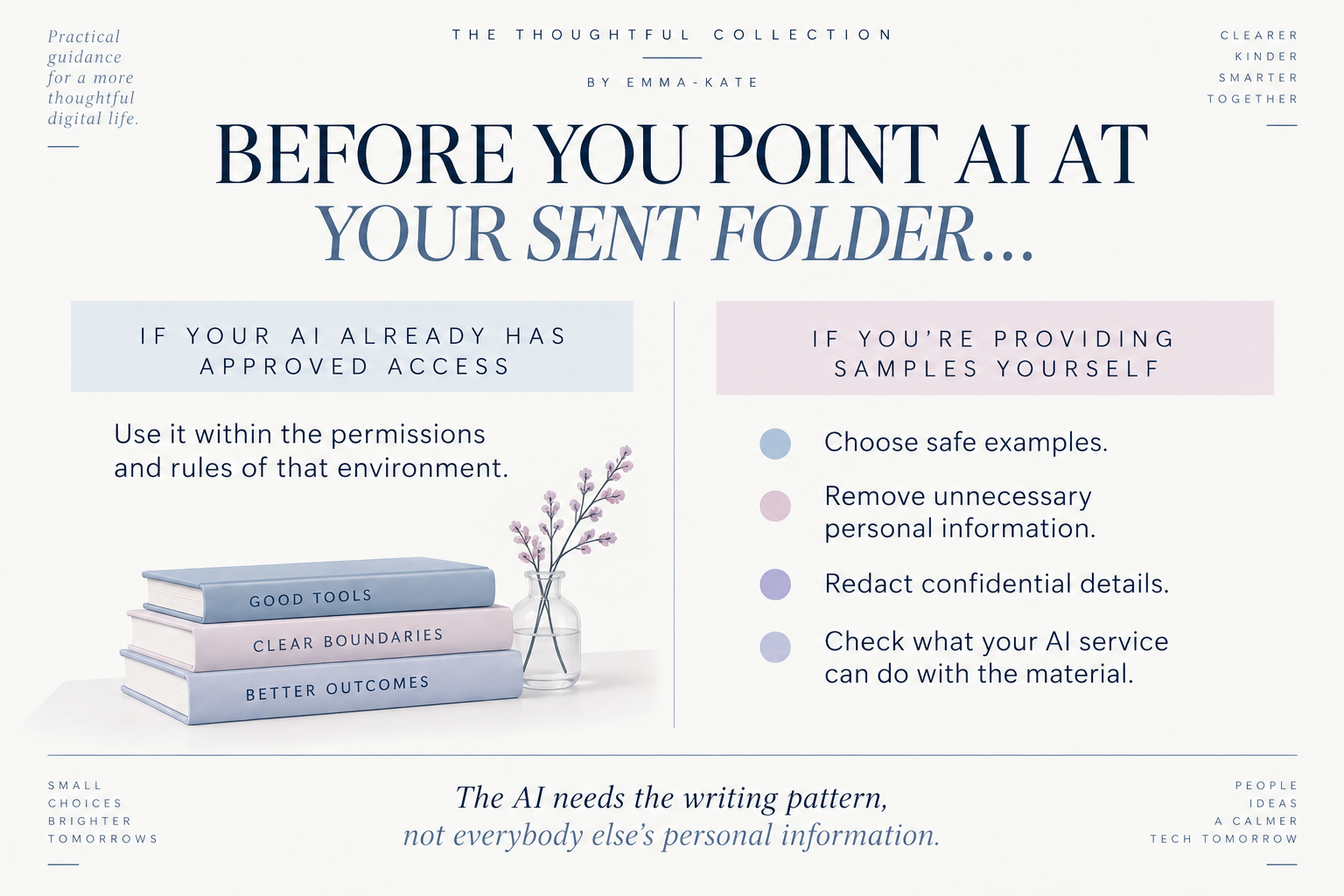
A word about privacy before you point AI at your Sent folder
There is an obvious caveat here.
My original professional experiment took place using an approved workplace AI tool within the environment where that correspondence already existed. That is very different from copying years of confidential correspondence into an arbitrary consumer AI service.
If you want to try the method yourself, think carefully about what your chosen AI is authorised to access and what you are entitled to provide. If you are manually supplying examples, choose correspondence that is safe to use and remove confidential, sensitive or unnecessary third party information where appropriate.
You do not need somebody else’s personal details to teach AI that you tend to write short paragraphs and sign off with “Kind regards”.
The objective is to extract the pattern, not preserve the correspondence.
The prompt wasn’t the clever bit
I still use prompts. This whole experiment started with one.
But the prompt was essentially an instruction to go and learn from better evidence.
That distinction has changed the way I use AI far beyond email. I’ve found exactly the same thing with my wardrobe. AI became considerably more useful once it knew what I genuinely owned, how I dressed and what I actually liked rather than simply knowing that I was a True Summer looking for outfit ideas.
Email turned out to be the same.
The clever bit wasn’t finding a more elaborate way to say write like me. It was giving AI enough genuine evidence to understand what like me actually meant.
And once it did, I stopped spending quite so much time editing the AI out of my AI drafted emails.
Which, frankly, was the whole point.
If you’d like to try this yourself, I’ve put the process into Teach AI Your Writing Style, a practical workbook with prompts, checklists and space to build your own profile. It’s free for The Thoughtful Edit subscribers, including anyone who has already joined.

THE THOUGHTFUL EDIT
Teach AI your writing style.
Join The Thoughtful Edit for a short weekly collection of useful ideas, and receive the complimentary 23-page workbook in your welcome email.
Prompts, checklists and exercises to help you build a writing profile from your own words.
Unsubscribe at any time. Read our privacy policy.
Already subscribed? Get the workbook.