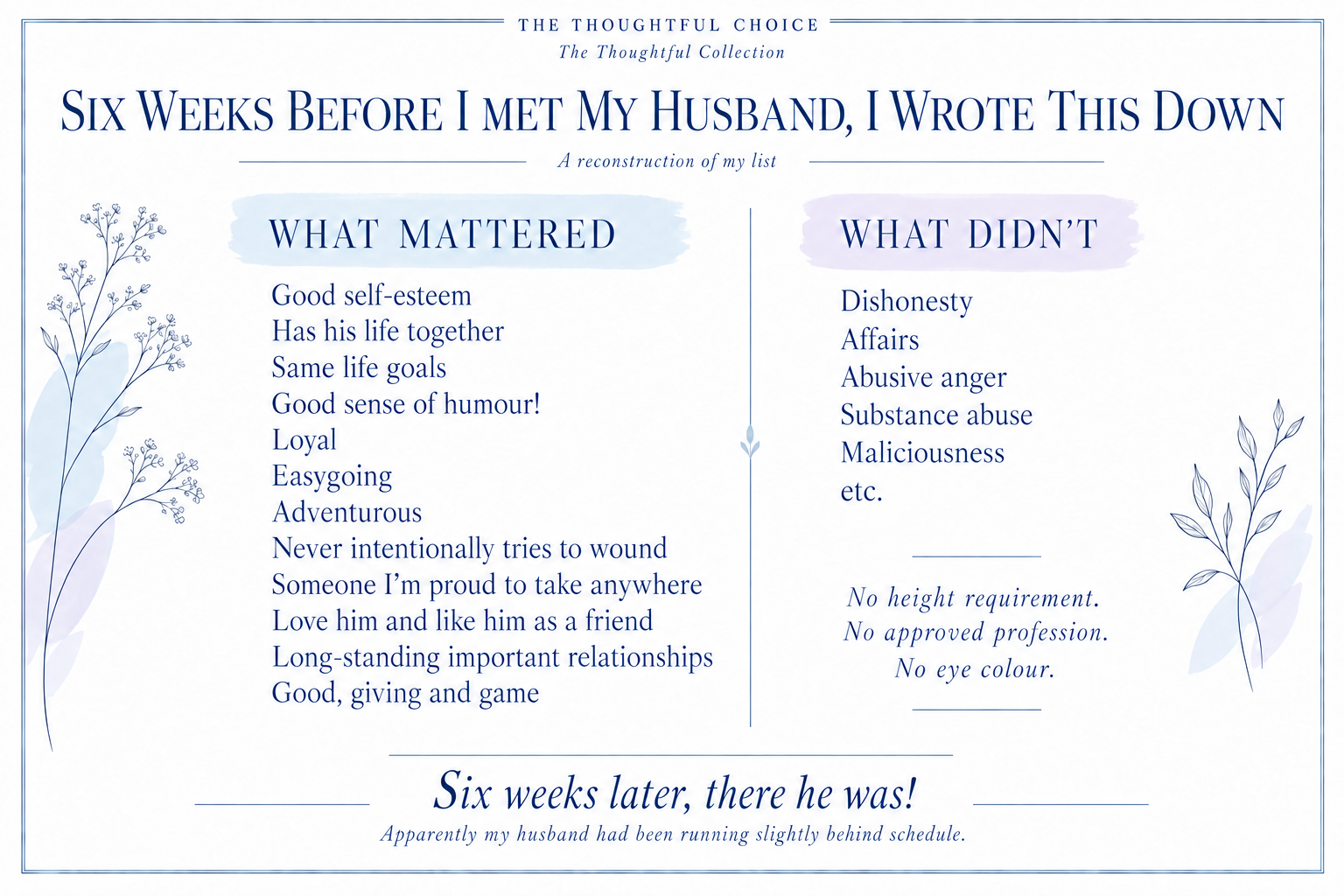
About six weeks before I met my husband, I wrote a list. It wasn't particularly romantic. There was no description of how tall he should be, what colour eyes he should have or which profession would look particularly attractive beside mine on a wedding invitation. Instead, I wrote down the things I had finally realised actually mattered to me.
Good self-esteem. Has his life together. The same life goals. Loyal. Easygoing. Adventurous. A good sense of humour, which was non-negotiable for obvious reasons! Someone I could love and genuinely like as a friend. Someone I would be proud to take anywhere. Someone with a history of maintaining important relationships and friendships. Someone who was good, giving and game.
There were deal-breakers too: dishonesty, affairs, abusive anger, substance abuse, maliciousness and the sorts of behaviours I knew by then I wasn't interested in explaining away. I had reached the Where the hell is my husband? stage of proceedings, but I was also clearer than I'd ever been about what I was actually looking for.
So I wrote it down. Call it manifestation, prayer, clarity or simply finally being specific with myself. I believe in a little bit of all of it.
Six weeks later, there he was!
Apparently my husband had been running slightly behind schedule.
The important change happened before I met him
I don't think the most important part of this story is that I wrote a list and then met my husband. The important part is who I had become by the time I wrote it.
There had been relationships and situations where I had overlooked behaviour because there was chemistry, given somebody more chances than they deserved or wondered whether perhaps I was being too picky. At one point, somebody actually told me that I was. I was later to discover that things weren't quite as harmonious in their own life as they had presented them to be, which taught me another useful lesson: other people's tolerance for a relationship is not necessarily a sensible benchmark for your own.
I wasn't too picky. I simply hadn't yet become completely comfortable trusting my own standards.
That took time and experience. It also took becoming genuinely comfortable with being single. Not pretending to enjoy being single while privately regarding every unattached Saturday night as evidence that something had gone terribly wrong, but actually being comfortable. I began to understand what I brought to a relationship and to think seriously about what I wanted one to add to my life. I became clearer about what mattered to me and, just as importantly, what I was no longer prepared to accept.
That's what I mean when I talk about doing the inner work. It isn't about reaching some flawless state of enlightenment before you're allowed to meet somebody. I certainly hadn't. It's about becoming secure enough in your own life that a relationship doesn't have to rescue you from it.
That changes the choices you make.
Chemistry can make us surprisingly generous
Chemistry is wonderful. It is also capable of mounting an extremely persuasive defence case for behaviour that, viewed objectively, isn't particularly impressive.
When we really like somebody, it becomes remarkably easy to explain things away. They're busy. They're scared. They're not very good at texting. They've been hurt before. They don't know what they want yet. They like you, they're just not ready. Perhaps. Or perhaps they're simply inconsistent.
I had certainly been guilty of giving chemistry too much evidential weight in the past. When the attraction was strong, I could be more patient with behaviour than I should have been or give another chance because I could see the potential. The problem with potential is that you cannot actually have a relationship with it.
Eventually, I became much more interested in behaviour. Not what somebody might become, what I could imagine the relationship looking like if several important things changed or what somebody told me they wanted while behaving in a completely contradictory way. I became interested in what was actually happening.
Once I started looking at things that way, some decisions became considerably easier.
I stopped confusing uncertainty with butterflies
I think people sometimes mistake inconsistency for chemistry. That slightly anxious feeling when you don't know where you stand can feel exciting. You're waiting for the message, wondering what something meant and trying to work out whether they're as interested as you are. Then, when they finally give you the reassurance you've been waiting for, you get a rush of relief.
We can call all of that butterflies. I'm no longer convinced it always is. Sometimes butterflies are attraction. Sometimes they are nerves. Sometimes they are your nervous system pointing out that you have absolutely no idea what is going on.
As I became more secure in myself, the attraction of that uncertainty changed dramatically. Wishy-washy behaviour didn't make somebody more intriguing. It made them less attractive to me. The interesting thing is that this wasn't a dating technique I had to force myself to follow. I wasn't sitting on my hands trying desperately not to text somebody because a book had told me to appear unavailable. I genuinely became uninterested.
Somewhere along the way, inconsistency stopped feeling exciting and started feeling irritating. That is a much easier boundary to maintain.
“Treat them mean, keep them keen” has a fairly obvious flaw
There is an old theory that withholding interest makes somebody want you more. Perhaps it sometimes does, but treat them mean, keep them keen has one fairly significant design flaw: it assumes the person on the receiving end will respond to being treated badly by trying harder.
Once I valued myself and my time properly, my response was generally to lose interest. If somebody couldn't decide whether they wanted to see me, that was useful information. If they were inconsistent, vague or deliberately trying to make me insecure, I didn't interpret that as evidence of their mysterious depth.
There is a confidence in being straightforward about wanting somebody that I think is often underestimated. Playing games can sometimes look like power, but frequently it is the opposite. If you need to keep somebody uncertain to maintain their interest, how secure are you really?
A genuinely confident person can risk being clear. That became incredibly attractive to me.
Being chosen isn't the same as choosing
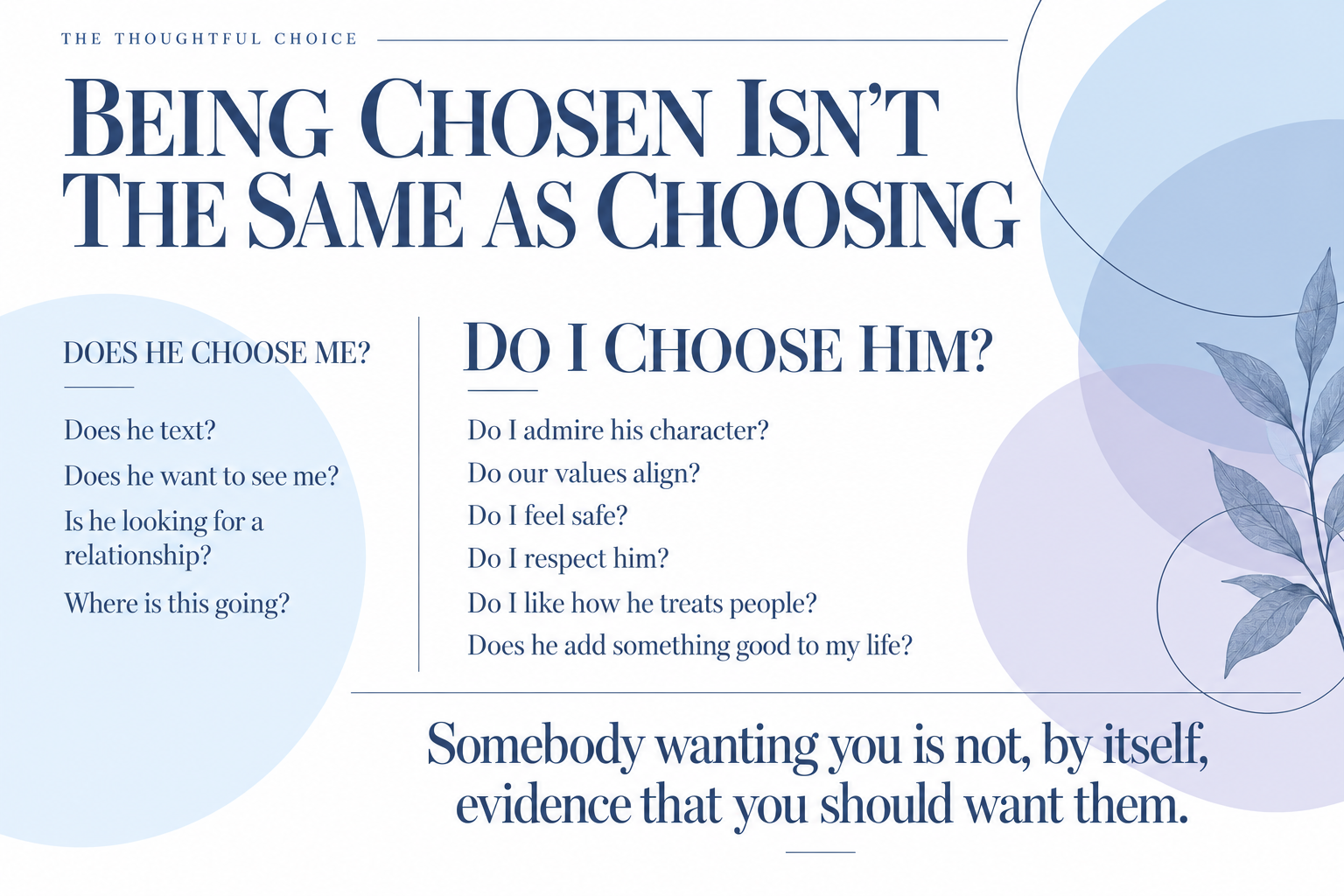
So much attention in dating can go into the question: Does he like me? Did he text? Does he want to see me again? Is he looking for a relationship? Is this going somewhere?
Those things matter. Mutual interest is fairly fundamental. But there is another question that can get strangely neglected while we're busy analysing whether somebody has chosen us: Do I choose him?
Not Could I make this work? Not Does he have potential? Not even Does he really like me? I mean: do I actually like the man he is? Do I admire his character? Does his life reflect values I respect? Do we want the same things? Do I feel safe with him? Do I like how he treats other people? Does he add something genuinely good to the life I already have?
Somebody wanting you is not, by itself, evidence that you should want them. Once I understood that, dating felt very different.
Then I met somebody who was very clear
My husband was not wishy-washy. There was no prolonged period of wondering whether he was interested or trying to interpret what his behaviour meant. He pursued me and he pursued me hard. He made plans, made the effort, laid his cards on the table and was very upfront about what he was looking for.
I found that incredibly attractive.
Part of what attracted me to him was also the life he had built. He was ambitious, successful, responsible and independent. He had his life together. He was confident enough to take the initiative without apparently worrying that showing too much interest would somehow reduce his value. It didn't. Quite the opposite.
I sometimes describe the dynamic between us as masculine and feminine energy, but what I really mean by that is quite practical. My professional life requires me to be decisive, manage people, take responsibility and frequently be the person driving things forward. I'm perfectly capable of doing all of that, but I don't particularly want to manage my relationship as well.
I like that my husband is decisive and proactive. I like that he makes plans and takes responsibility. I like being with somebody strong enough that my own strength isn't threatening to him. That doesn't make me passive. Anyone who knows me would find that suggestion fairly entertaining! I challenge him, have strong opinions and don't put up with rubbish. He would probably be bored senseless with somebody who simply agreed with everything he said.
The dynamic works precisely because neither of us needs the other one to become smaller.
His certainty gave me space to assess him
My husband's clear interest didn't automatically make him the right man for me. It simply removed one unnecessary question. I didn't have to spend my emotional energy working out whether he wanted me, which meant I could use that energy to work out whether I wanted him.
Was he kind? Was he loyal? Did we laugh together? Did I respect him? Did our life goals align? Was he somebody I was proud to be with? Did I like him as a person as well as love him romantically? Did his behaviour match the things I had written on that list?
His clarity gave me the security to look at the actual relationship rather than constantly looking for reassurance about whether one existed. That is very different from chasing somebody whose ambiguity becomes the central feature of the connection.
Standards aren't the same as an impossible checklist
I think this is where the accusation of being “too picky” can become quite unhelpful. There is obviously such a thing as constructing an impossible human specification. If your future partner must be exactly 6'2", have a particular hair colour, work in one of four approved professions, enjoy precisely the same hobbies and possess a passport photograph that meets your preferred aesthetic standards, you may indeed be narrowing the field unnecessarily. (Admittedly, I eventually married a 6'6", dark-haired, dark-eyed man, so apparently the universe took “tall, dark and handsome” rather more literally than I intended.)
That wasn't what my list was about. Most of the things I wrote down concerned character and compatibility: good self-esteem, loyalty, shared life goals, humour, kindness, emotional health, someone who had sustained important friendships and relationships and someone I loved romantically but also genuinely liked as a friend.
The deal-breakers were equally revealing. I wasn't ruling people out because they ordered the wrong wine. I was saying no to things such as dishonesty, maliciousness, abusive anger, affairs and substance abuse.
There is a difference between demanding perfection and knowing what you cannot build a healthy life around. Being discerning isn't the same as being impossible to please.
Scarcity makes bad options look safer
This is where I think so many choices become distorted. You know something isn't quite right, but then another thought arrives: What if this is my last chance? What if I don't meet somebody else? What if I'm being too demanding? What if I leave and regret it? What if everyone else pairs off and I'm still single?
Scarcity makes something feel safer than nothing, even when the something in question is making you unhappy.
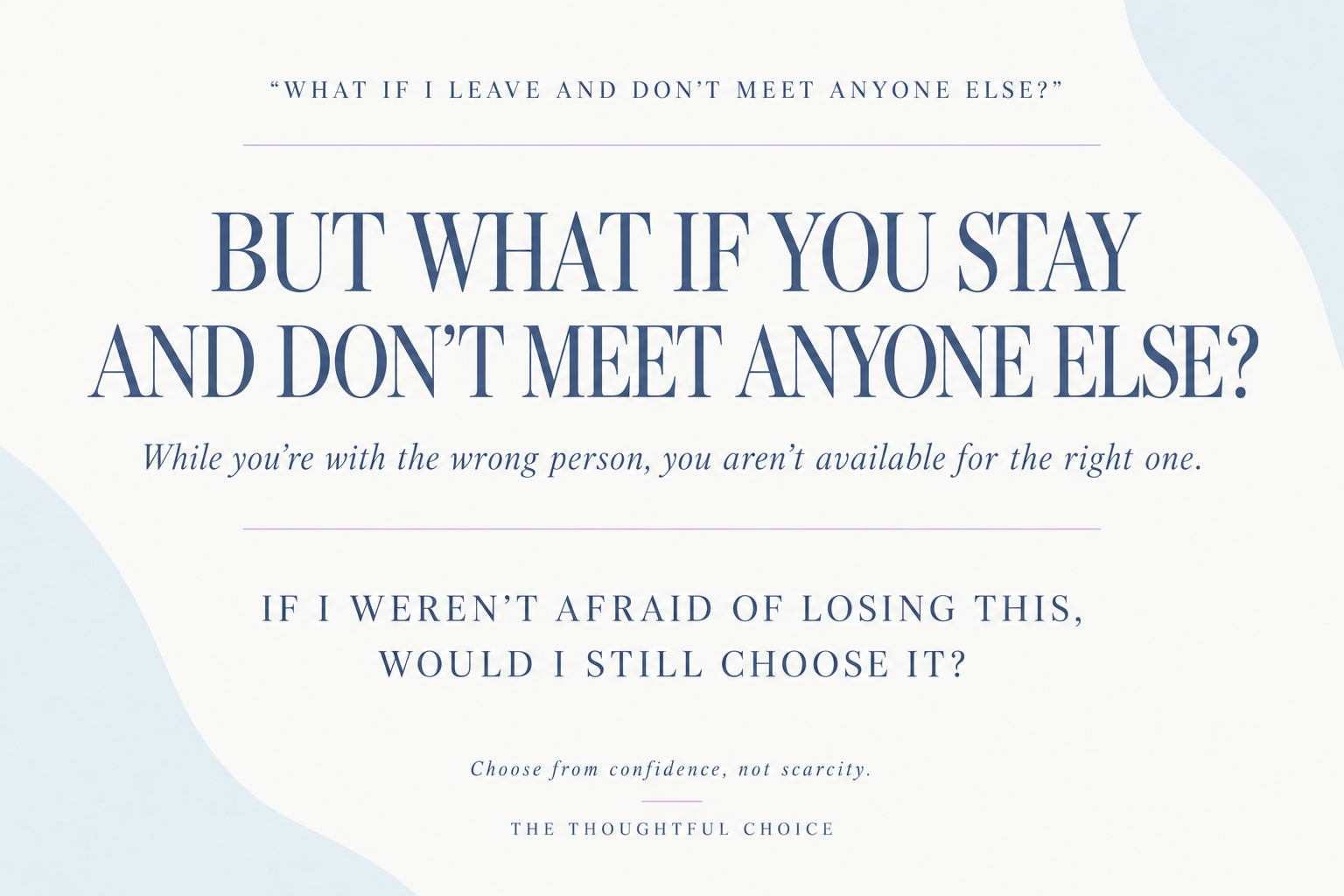
If a woman said to me now, “What if I leave him and don't meet anyone else?”, my answer would be:
But what if you stay and don't meet anyone else? Because while you're with the wrong person, you aren't available for the right one.
That doesn't mean leaving a relationship guarantees that your ideal partner will appear six weeks later carrying your manifestation list and a completed application form. Life does not generally operate with that level of administrative efficiency.
It means that fear of an unknown future is not, by itself, a good reason to choose a present you already know is wrong.
Not every relationship that ends was a mistake
Looking back, I can see that some people entered my life at exactly the right time even though they weren't meant to stay in it. Perhaps they taught me something, showed me a pattern I needed to stop repeating or clarified what I did and didn't want. Perhaps they simply occupied a chapter between one version of me and the next.
I don't think every relationship that ends was therefore a mistake. Sometimes you need the experience to become the person capable of making a different choice later. That's certainly how I feel about my own journey.
By the time I met my husband, I wasn't the same woman I had been several years earlier. I had learnt from previous relationships, become comfortable alone, understood what I brought to the table and become much clearer about the life and relationship I wanted. Perhaps that was why the timing worked. Had I still been trying to persuade one of those earlier, inconsistent situations to become something it wasn't, I might not have been available when my husband came along.
That's the part of manifestation I find most interesting. Maybe writing the list sent a message to the universe. Maybe God had excellent timing. Maybe the act of writing it simply proved that I had finally become clear enough to recognise what I wanted when it appeared.
I'm perfectly happy to leave room for all three possibilities.
Confidence is not certainty
Choosing from confidence doesn't mean knowing that if you leave the wrong relationship, the right person will definitely appear. It doesn't mean believing you're so irresistible that another opportunity is guaranteed. It means being secure enough to say: Even if I don't know what comes next, I know this isn't right for me.
That's a much quieter kind of confidence. It's knowing what you bring to a relationship without needing somebody else to validate it, trusting yourself enough to recognise behaviour you don't want and being willing to tolerate the uncertainty of an open future rather than choosing the certainty of something that doesn't fit.
The alternative is allowing fear to make the decision for you. Fear is very persuasive. It is not always particularly discerning.
This goes much further than relationships
Relationships are where I learnt this most clearly, but I don't think scarcity confines itself to dating. We do it with jobs: What if another opportunity doesn't come along? We do it with purchases: It's the last one in my size. We do it with friendships, houses, career decisions and opportunities.
Sometimes scarcity is real and practical realities matter. But sometimes the urgency exists largely in our own minds and causes us to evaluate the option in front of us differently.
The question I increasingly try to ask is:
If I weren't afraid of losing this, would I still choose it?
That can produce an uncomfortable answer. It can also produce a very useful one.
The real change is in the chooser
I used to think having higher standards meant becoming better at rejecting the wrong people. I don't think that's quite it anymore.
The deeper change is that many of the things you once had to consciously talk yourself out of stop appealing to you in the first place. Inconsistency doesn't feel mysterious. Ambiguity doesn't feel exciting. Being made insecure doesn't feel like chemistry and somebody withholding affection doesn't make you work harder to earn it. You simply look at the behaviour and think, No, thank you.
That is an enormously peaceful place to reach, not because you know exactly who is coming next but because you're no longer frightened enough of an empty space to fill it with somebody who shouldn't be there.
About six weeks before I met my husband, I wrote down what I wanted and then got on with my life. When he arrived, the most important thing wasn't that he chose me.
It was that, by then, I knew how to choose him too.